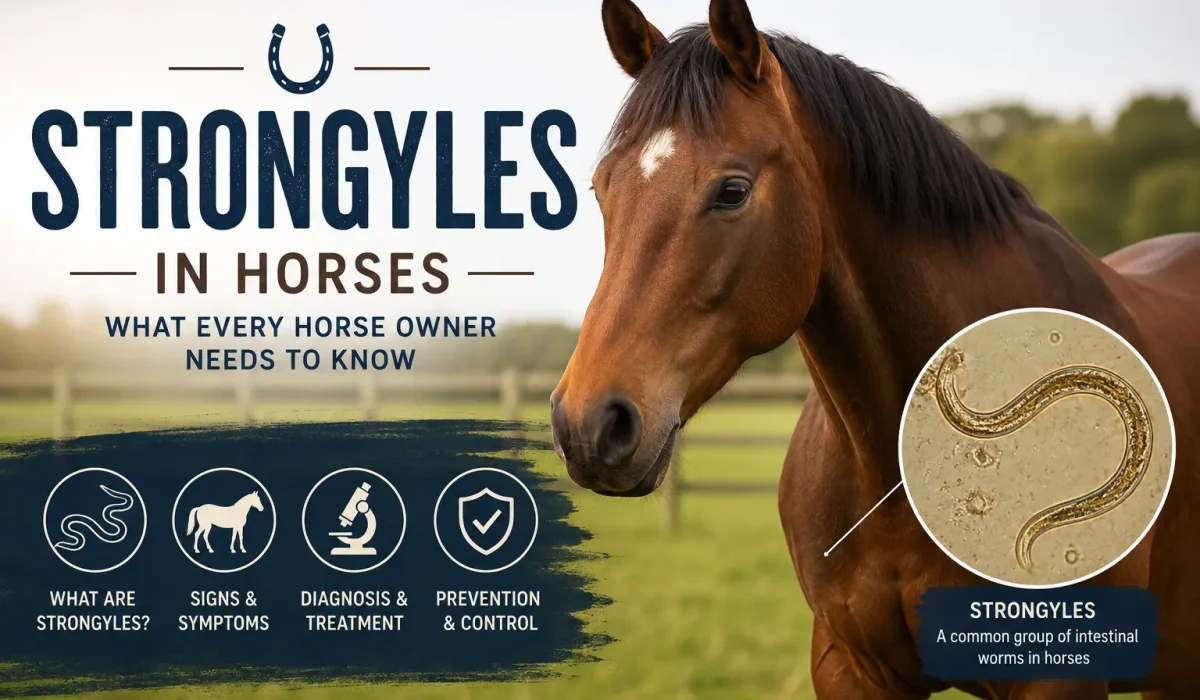
Strongyles in horses are the most common and most damaging internal parasites your horse will ever face. These intestinal worms live in the large intestine, feed on your horse from the inside, and can trigger weight loss, poor coat condition, diarrhea, and life threatening colic. The good news is that you can control them. This guide explains what strongyles are, how they make your horse sick, and the exact steps you take to protect your herd.
You will learn to recognize the warning signs early, understand how veterinarians diagnose these parasites, and build a smart deworming plan that actually works. Equine parasite control has changed a great deal in recent years, and the old habit of deworming every horse every eight weeks now does more harm than good. Read on to feed your knowledge and safeguard your horse.
| KEY TAKEAWAYS |
- Strongyles split into two groups: small strongyles, which are now the top parasite threat, and large strongyles, which are rarer but more deadly.
- Many infected horses show no obvious symptoms until the parasite burden is already severe, so testing matters more than guessing.
- A fecal egg count tells you which horses shed the most eggs, allowing you to target treatment instead of dosing the whole barn blindly.
- Anthelmintic resistance is rising fast, and overuse of dewormers is the single biggest reason your products may stop working.
- Smart pasture management, manure removal, and strategic deworming protect your horse far better than the calendar based routines of the past.
What Are Strongyles in Horses?
Strongyles in horses are parasitic roundworms, also called nematodes, that live in the large intestine and pass their eggs out in manure. They are the most prevalent internal parasite group in grazing horses worldwide. Almost every horse that lives on pasture carries some strongyles, which makes understanding them essential for every owner.
These equine parasites divide into two families that differ sharply in behavior and danger. Knowing the difference shapes how you respond to a strongyle infection in horses.
Why These Parasites Matter So Much
Strongyles cause more parasite related disease in horses than any other worm group. Cornell University College of Veterinary Medicine notes that nearly every grazing horse carries them, and the damage accumulates quietly over months. A horse parasite infection rarely announces itself early. Instead it erodes body condition, dulls the coat, and weakens the gut wall long before you notice a problem.
That slow, hidden burn is exactly why strongyles cost owners so much. Lost condition, reduced performance, and emergency colic bills add up far beyond the price of a fecal test. When you treat these parasites with a smart plan, you protect both your horse and your budget. The rest of this guide shows you how.
Small Strongyles (Cyathostomins)
Small strongyles, known to veterinarians as cyathostomins, are now the primary parasitic threat to adult horses. More than 50 species exist, and a single horse can host several at once. Their larvae burrow into the gut wall, where they can hide for months before emerging.
The danger lies in that hiding behavior. When large numbers of encysted larvae emerge from the gut lining at the same time, they cause a severe disease called larval cyathostominosis, which can be fatal.
Large Strongyles (Strongylus species)
Large strongyles are bigger, less common today, but far more destructive per worm. The most notorious species is Strongylus vulgaris, sometimes called the bloodworm. Its larvae migrate through the blood vessels that supply the intestines, causing damage that can kill a horse.
Two other species matter as well. Strongylus edentatus and Strongylus equinus also migrate through body tissues, though their paths and timelines differ. Modern deworming has made large strongyles rare on well managed farms, but they still appear where parasite control is weak.
Here is the key thing to remember. Cyathostomins are common and chronic, while Strongylus vulgaris is rare and acute. Both deserve your attention, and both respond to a thoughtful equine parasite control program.
Small Strongyles VS Large Strongyles
The single most useful skill for any owner is telling these two groups apart. Small strongyles cause slow, grinding damage to the gut lining. Large strongyles cause dramatic, sometimes sudden injury to blood vessels and organs. The table below lays out the core differences at a glance.
| Feature | Small Strongyles (Cyathostomins) | Large Strongyles (Strongylus vulgaris) |
| Prevalence today | Very common, the top threat | Rare on managed farms |
| Adult size | Up to about 1 centimeter | Up to about 5 centimeters |
| Larval behavior | Encyst in the gut wall | Migrate through blood vessels |
| Main danger | Mass larval emergence | Damage to intestinal arteries |
| Time to maturity | Six weeks to many months | Six to eleven months |
| Classic outcome | Diarrhea, weight loss, colic | Severe colic, tissue death |
| Drug resistance | Widespread and growing | Still largely treatable |
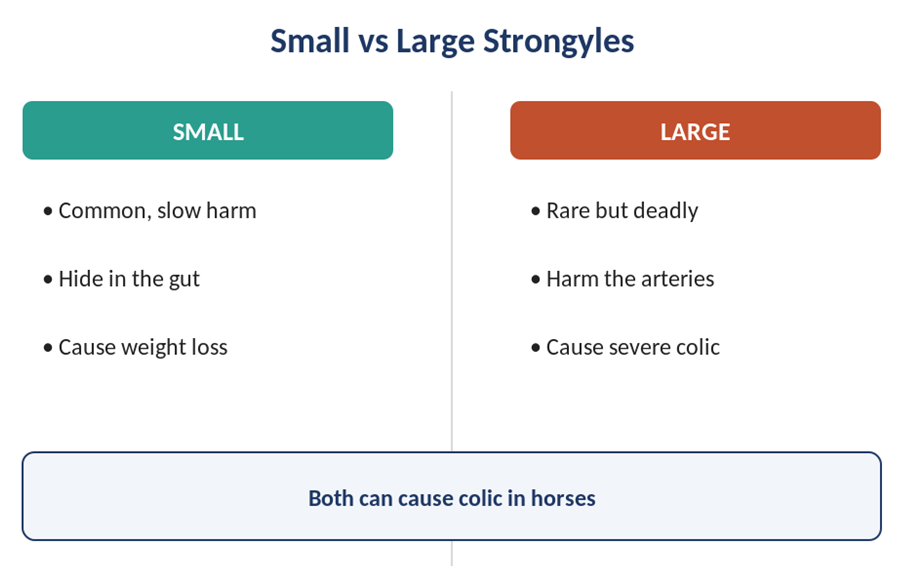
Think of it this way. Small strongyles are the quiet thief that drains your horse slowly over a season. Large strongyles are the violent intruder that strikes hard and fast. Your prevention plan must account for both, because the testing and timing that catch one will help control the other.
The Three Large Strongyle Species
Three species of large strongyles infect horses, and each behaves differently inside the body. Strongylus vulgaris is the most dangerous, because its larvae travel up the cranial mesenteric artery, the main vessel feeding the intestines. The Western College of Veterinary Medicine describes how this migration can cause clots, reduced blood flow, and deadly colic.
Strongylus edentatus takes a slower route through the liver and the tissues lining the abdomen. Strongylus equinus, the least common, migrates through the liver and pancreas before returning to the gut. All three take roughly six to eleven months to mature, which gives a well timed deworming program ample chance to interrupt them. Today these large strongyles stay uncommon on farms that test and treat wisely, yet they remain a real threat where parasite control has lapsed.
Why Resistance Changes Everything
Anthelmintic resistance means a dewormer that once killed a parasite no longer does. Cyathostomins have developed resistance to several major drug classes, and this is the central challenge in modern equine parasite control. You cannot solve a resistant infection by simply deworming more often. In fact, that approach speeds resistance up.
The University of Kentucky Gluck Equine Research Center, led by parasitologist Dr. Martin Nielsen, has documented this resistance across the United States. Their work shapes the current guidance you will read about below.
How a Strongyle Infection in Horses Begins
A strongyle infection in horses always starts on the pasture. Adult worms inside the gut lay eggs, those eggs pass out in manure, and within days they hatch and develop into infective larvae on the grass. Your horse then swallows the larvae while grazing, completing the parasite life cycle. Understanding this loop is the foundation of every control strategy.
Grazing contamination is the engine that drives the whole process. The more manure that sits on a pasture, the more larvae your horse picks up with each bite of grass.
The Strongyle Parasite Life Cycle Step by Step
The life cycle follows a predictable path, and breaking any link in the chain reduces infection. Here is how the cycle unfolds from start to finish:
- Adult worms in the large intestine lay thousands of eggs each day.
- Eggs leave the horse in manure and land on the pasture.
- Eggs hatch and the larvae molt twice to reach the infective third stage.
- Infective larvae climb wet grass blades, especially in mild, damp weather.
- The grazing horse swallows the larvae along with the forage.
- Larvae develop inside the gut, either maturing or encysting in the wall.
- New adult worms begin laying eggs, and the cycle repeats.
Larvae are remarkably tough. They survive cold winters and can remain infective on pasture for months, which is why grazing contamination builds up over a season if manure is left in place.
Why Encysted Larvae Make Treatment Tricky
Encysted larvae are small strongyle larvae that have burrowed into the gut wall and entered a dormant state. They matter because most ordinary dewormers cannot reach them while they hide. A horse can test negative on a fecal sample yet still carry a large hidden burden of these encysted stages. This is one of the trickiest aspects of managing intestinal worms in horses, and it shapes how veterinarians choose treatment.
How Quickly Reinfection Happens
Reinfection begins the moment a treated horse returns to a contaminated pasture. Even an effective dewormer clears only the worms present that day, not the larvae waiting on the grass. Within weeks your horse can pick up a fresh burden if the pasture stays dirty.
This is why drugs alone never solve a strongyle problem. The Equine Disease Quarterly from the University of Kentucky and university extension programs both stress that pasture hygiene and treatment must work together. Remove the larvae from the environment, and each dose of dewormer lasts far longer in practice.
How Weather Shapes the Risk
Weather decides how fast grazing contamination builds on your pasture. Strongyle larvae thrive in mild, moist conditions, so spring and autumn often bring the highest pasture infectivity in temperate climates. Warm and wet weather lets eggs hatch quickly and larvae spread across the grass.
Extreme conditions work in your favor. Hard frost, baking heat, and prolonged drought all kill larvae on the pasture and lower the risk to your grazing horse. Knowing your local pattern helps you time fecal testing and any treatment for the windows when your horse faces the greatest exposure.
Strongyles in Horses Symptoms
Strongyles in horses symptoms range from completely invisible to severe and life threatening. Many horses with a light burden look perfectly healthy, which is exactly why parasites are so easy to underestimate. Symptoms appear as the burden grows or when encysted larvae emerge in large numbers.
The most common warning signs of a horse parasite infection include the following. Watch for several appearing together rather than relying on any single clue.
- Gradual weight loss despite a normal or increased appetite
- A dull, rough coat that fails to shine
- Recurring or persistent diarrhea
- A pot bellied appearance, especially in young horses
- Lethargy and reduced performance under saddle
- Mild, repeated bouts of colic in horses
- Swelling under the belly or along the lower legs in advanced cases
But here is where most horse owners go wrong. They wait for visible symptoms before acting. By the time weight loss and a poor coat appear, the parasite burden is usually well established, and damage to the gut may already be done.
Symptoms in Foals and Young Horses
Young horses often show the clearest signs of a strongyle infection in horses. A pot bellied look, slow growth, a rough coat, and bouts of diarrhea all point toward a heavy burden. Because foals and weanlings have not built up immunity, their symptoms tend to appear sooner and hit harder than in adults.
Keep a closer eye on every horse under three years of age. Sudden weight loss or persistent loose manure in a youngster warrants a prompt call to your veterinarian, since young horses can decline quickly once a burden becomes severe.
Larval Cyathostominosis: The Dangerous One
Larval cyathostominosis is the most serious disease that small strongyles cause. It happens when huge numbers of encysted larvae emerge from the gut wall at once, usually in late winter or early spring. This sudden mass emergence inflames the entire large intestine and produces severe, often bloody diarrhea, rapid weight loss, and swelling from protein loss.
This condition is a genuine emergency. Even with intensive veterinary care, the death rate can reach close to half of affected horses, so prevention is far better than treatment here.
When Strongyles Cause Colic
Colic in horses is one of the most feared outcomes of a heavy strongyle burden, particularly with Strongylus vulgaris. As bloodworm larvae migrate through and damage the arteries feeding the intestine, they can disrupt blood flow and cause a section of bowel to lose its supply. The result is intense abdominal pain that may require surgery.
Here is the bottom line. Any horse with unexplained weight loss, chronic diarrhea, or repeated colic should be evaluated for parasites as part of the workup, even if recent fecal tests looked clean.
Risk Factors for a Horse Parasite Infection
Some horses face a far higher risk of heavy strongyle burdens than others. Knowing your horse’s risk level helps you decide how closely to monitor and how aggressively to treat. Age, environment, and management all play a part in equine strongyles exposure.
The following factors raise the odds of a serious strongyle infection in horses, and most of them are within your control.
Young Horses
Foals, weanlings, and yearlings are the most vulnerable group because their immune systems have not yet learned to limit parasite numbers. Young horses tend to shed far more eggs than mature horses, contaminating pasture heavily. They also suffer worse clinical disease, so they need closer monitoring and a tailored deworming schedule.
Contaminated and Overstocked Pasture
Pasture that carries a heavy load of manure and larvae is the leading environmental risk. The more horses you keep on a given acreage, the faster grazing contamination accumulates. Overstocking concentrates manure, shortens the grass, and forces horses to graze closer to droppings where larvae gather.
Weak Management Habits
Poor management quietly fuels parasite problems. The biggest culprits are skipping manure removal, never rotating pastures, and following an outdated deworming routine that ignores fecal testing. Climate matters too, since warm and humid conditions let larvae thrive, while extreme heat or drought reduces survival on the grass.
Immune Status and Individual Variation
Every horse controls parasites differently, and that individual immune response explains why some horses stay low shedders for life while others shed heavily no matter what. Genetics, age, stress, and overall health all influence how well a horse limits its worm burden.
This variation is the reason testing beats blanket treatment. You cannot tell a high shedder from a low shedder by looking, so a fecal egg count gives you the only reliable answer. Older horses and those under stress from illness, travel, or hard work may show weaker resistance and need extra monitoring.
Diagnosis and Strongyles in Horses Treatment
Effective strongyles in horses treatment starts with accurate diagnosis, not guesswork. Veterinarians rely on fecal testing to measure how many eggs a horse is shedding and to check whether your dewormers still work. This testing turns parasite control from a blind routine into a targeted, evidence based plan.
The two cornerstone tests are the fecal egg count and the fecal egg count reduction test. Both are simple, affordable, and central to the guidelines from the American Association of Equine Practitioners.
The Fecal Egg Count
A fecal egg count, or FEC, is a laboratory test that measures the number of strongyle eggs per gram of manure because that number reveals how much a horse contributes to pasture contamination. The result sorts each horse into a shedding category and guides how often that horse truly needs treatment.
The American Association of Equine Practitioners groups horses into three shedding levels. These categories let you focus your effort where it counts:
- Low shedders carry fewer than 200 eggs per gram and rarely need frequent deworming.
- Moderate shedders fall between 200 and 500 eggs per gram.
- High shedders exceed 500 eggs per gram and drive most pasture contamination.
Research consistently shows that a small share of horses, often around 20 percent, produce roughly 80 percent of all the eggs in a herd. Identifying these high shedders is the most powerful step in any equine parasite control program.
The Fecal Egg Count Reduction Test
A fecal egg count reduction test, or FECRT, checks whether your dewormer actually worked. You count eggs before treatment, deworm the horse, then count again about 10 to 14 days later. A large drop means the drug is effective, while a small drop signals anthelmintic resistance on your farm.
The AAEP recommends running this test regularly, because resistance varies from barn to barn. Without it, you may keep paying for a product that no longer protects your horse.
Deworming Medications and Horse Deworming Strategy
Horse deworming relies on three main drug classes, each with strengths and weaknesses. No single product is best for every situation, so your veterinarian matches the drug to the parasite, the season, and your resistance profile.
| Drug Class | Common Examples | Notes on Use |
| Macrocyclic lactones | Ivermectin, moxidectin | Broad activity, moxidectin reaches some encysted larvae |
| Benzimidazoles | Fenbendazole, oxibendazole | Resistance common in small strongyles |
| Tetrahydropyrimidines | Pyrantel pamoate | Useful but resistance is increasing |
Moxidectin and a specific extended fenbendazole protocol are the main tools that reach encysted larvae, which makes them valuable for horses at risk of larval cyathostominosis. Always follow veterinary guidance on dosing, because underdosing speeds resistance and overdosing wastes a limited resource.
Here is the key thing. The goal of modern treatment is not to kill every worm in every horse. It is to keep parasite numbers low enough to prevent disease while preserving the dewormers you still have.
Matching Treatment to the Parasite
The right product depends on which strongyle you are targeting. For routine small strongyle control, ivermectin and pyrantel remain useful where resistance has not taken hold. To tackle encysted larvae, your veterinarian may reach for moxidectin or a five day fenbendazole course, the two protocols proven to reach those hidden stages.
Large strongyles respond well to most modern dewormers, which is why they have become rare. The Merck Veterinary Manual stresses that timing and accurate dosing matter as much as the drug you pick. Weigh your horse with a weight tape or scale, because guessing the weight is the most common reason a treatment underperforms.
The Problem With Calendar Deworming
For decades, owners dewormed every horse every two months regardless of need. That habit, once standard advice, is now the leading cause of anthelmintic resistance worldwide. Each unnecessary dose kills the susceptible worms and leaves the resistant ones to breed.
The American Association of Equine Practitioners now advises against this blanket approach for adult horses. Instead, you deworm based on fecal results and treat only when the evidence supports it. Letting go of the calendar feels strange at first, yet it is the single most important shift in modern horse deworming.
What to Expect After Treatment
Most horses with a typical strongyle burden recover fully once they receive effective treatment and good management. The outlook is excellent when you catch the infection before it damages the gut. You should see steady weight gain, a brighter coat, and firmer manure within a few weeks.
The outlook is far more guarded for horses that develop larval cyathostominosis or severe colic from migrating large strongyles. These cases need intensive veterinary care, and some do not survive. This sharp contrast is the strongest argument for prevention, because a routine that keeps burdens low spares your horse from ever reaching the dangerous end of the spectrum.
Strongyles in Horses Prevention and Equine Parasite Control
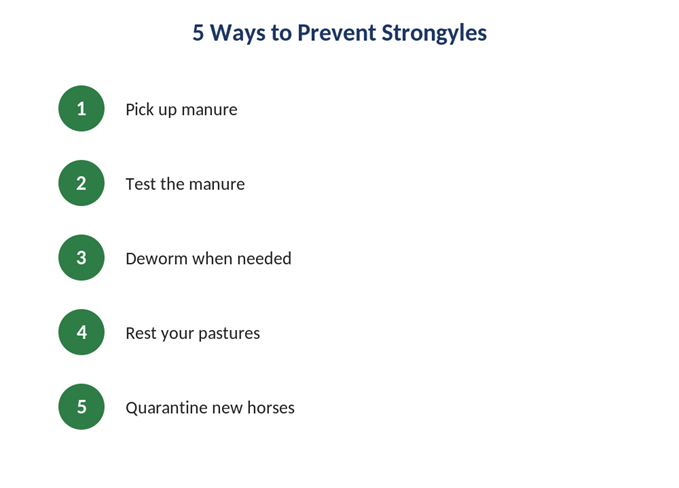
Strongyles in horses prevention rests on a simple truth: reducing the larvae on your pasture protects your horse better than any drug. The most successful programs combine targeted deworming with diligent pasture management. Together these break the parasite life cycle at multiple points.
Modern equine parasite control has moved away from deworming every horse on a fixed calendar. That old approach drove the resistance crisis we face today. The smarter path uses testing to treat the right horses at the right time.
Pasture Management That Works
Pasture management is your most powerful and most overlooked tool against grazing contamination. Removing manure from paddocks at least twice a week dramatically lowers the larvae your horse encounters. Composting that manure before spreading it kills larvae through heat, while spreading fresh manure on grazed fields only spreads the problem.
Rotating and resting pastures also helps, since larvae die off over time without a host. Cross grazing with cattle or sheep can clean a pasture further, because horse strongyles do not survive in those other species.
Building a Smart Deworming Schedule
A modern deworming schedule treats every adult horse once or twice a year as a baseline, then adds extra treatments only for high shedders identified through testing. Foals and young horses follow a more structured plan, since they are so vulnerable. Your veterinarian builds the exact timing around your climate and your fecal results.
The concept of refugia underpins this strategy. Refugia refers to the parasite population not exposed to a dewormer at any given time, and keeping some refugia slows resistance because it preserves worms that remain susceptible to the drugs.
Quarantine and New Arrivals
Every new horse should be treated as a potential source of resistant parasites. Quarantine new arrivals, run a fecal egg count, deworm with an effective product, and confirm the treatment worked before turning that horse out with your herd. This single habit prevents you from importing resistant strongyles onto a clean farm.
Reducing Pasture Risk for High Shedders
High shedders deserve special handling, because they seed most of the larvae on your land. Beyond extra deworming, you can lower their impact by keeping them on smaller, more easily cleaned paddocks and by removing manure from their areas most often. Some owners graze high shedders separately from foals and other vulnerable horses.
Think of your high shedders as the source of the river. Control the source, and the whole pasture stays cleaner. This targeted approach delivers far more benefit than treating every horse identically, and it slows resistance by leaving your low shedders largely untreated.
Monitoring and Keeping Records
Good records turn parasite control from guesswork into strategy. Track each horse’s fecal egg counts, the products you use, and the dates you treat. Over a season this history reveals your reliable low shedders, your repeat high shedders, and whether your dewormers still perform on your farm.
Share these records with your veterinarian at least once a year. Together you can refine the plan, retire any product that resistance has weakened, and concentrate treatment on the horses that genuinely drive contamination. Consistent monitoring is the quiet habit that keeps a whole herd healthy.
Timing Treatments Through the Year
Timing turns a good deworming plan into a great one. In most temperate regions, the highest pasture risk falls in spring and autumn, when mild, moist weather lets larvae flourish on the grass. A well timed treatment in late autumn can clear encysted larvae before they emerge and cause larval cyathostominosis in late winter.
Your exact calendar depends on where you live. Southern, warmer climates often see year round transmission with a summer lull, while northern climates see a winter pause. The American Association of Equine Practitioners advises matching treatment windows to your local transmission season rather than a fixed national schedule.
Work with your veterinarian to map the right months for your farm. Combine that timing with regular fecal egg counts, and you treat exactly when it counts most. This blend of smart timing and testing is the heart of sustainable equine parasite control, and it protects both your horse and the dewormers you depend on.
Think of it this way. Your pasture is a bank account, and every dropping left in place is a deposit of future infection. Manure removal is the simplest withdrawal you can make.
Horse Strongyles FAQs
What are the first signs of strongyles in horses?
The earliest signs are often subtle and easy to miss. Watch for gradual weight loss, a dull coat, lower energy, and occasional soft manure. Many horses show no clear symptoms at all in the early stages, which is why routine fecal egg count testing matters more than waiting for visible illness to appear.
How do I know if my horse needs deworming for strongyles?
You know by testing, not by the calendar. A fecal egg count tells you whether your horse is a low, moderate, or high shedder and whether treatment is truly needed. Your veterinarian uses that result, along with your horse’s age and history, to decide on the right deworming schedule for your situation.
Can strongyles in horses be completely eliminated?
No, and trying to eliminate every strongyle is neither realistic nor wise. The aim of equine parasite control is to keep parasite numbers low enough to prevent disease while preserving effective dewormers. Some susceptible worms in refugia actually help by slowing the spread of anthelmintic resistance across your herd.
What is the difference between large and small strongyles in horses?
Small strongyles, or cyathostomins, are common today and cause slow damage by encysting in the gut wall. Large strongyles, especially Strongylus vulgaris, are rarer but more dangerous because their larvae migrate through the arteries that feed the intestines, which can trigger severe colic and tissue death.
Are foals more at risk of strongyle infection than adult horses?
Yes, foals and young horses are far more vulnerable. Their immune systems have not yet learned to control parasite numbers, so they shed more eggs and develop worse disease. Young horses need a more structured deworming plan and closer monitoring than mature horses on the same farm.
How often should I run a fecal egg count on my horse?
For most adult horses, testing once or twice a year is enough to classify shedding status and guide treatment. High shedders and young horses may need more frequent checks. Your veterinarian also recommends a fecal egg count reduction test periodically to confirm your dewormers still work on your farm.
Why is my dewormer not working against strongyles anymore?
The most likely answer is anthelmintic resistance. Decades of deworming every horse on a fixed schedule have allowed small strongyles to survive several drug classes. A fecal egg count reduction test reveals whether resistance is present in your herd, and your veterinarian can then choose a product that remains effective.
Can strongyles in horses cause colic?
Yes, strongyles are a well recognized cause of colic in horses. Large strongyle larvae damage intestinal blood vessels, while a heavy small strongyle burden inflames the gut. Both can produce mild recurring colic or, in severe cases, a surgical emergency, so any colicky horse deserves a parasite evaluation.
Strongyles in horses will always be part of life on pasture, but severe disease does not have to be. By testing before you treat, removing manure faithfully, managing your pastures, and deworming strategically rather than blindly, you protect your horse and preserve the medicines that keep working. The shift from calendar based dosing to evidence based control is the most important change you can make for your herd’s long term health. Because every farm and every horse is different, work closely with your veterinarian or a qualified equine parasitologist to build a deworming and prevention plan tailored to your horse’s individual needs.