Can horses recognize their owners? Yes, and modern science proves it beyond reasonable doubt. Studies from the University of Sussex and the French research institute INRAE show that horses identify familiar people by face, voice, scent, and movement, and they hold onto those memories for months and even years. This guide explains exactly how equine recognition works, what your horse actually notices about you, and how you can use that knowledge to build a deeper connection.
You will also learn the clearest signs a horse recognizes you, what research says about horse memory, and six practical ways to strengthen trust. Everything below comes from published, peer reviewed studies, not barn folklore.
Key Takeaways
- Horses recognize their owners using a combination of face, voice, scent, and body language rather than a single cue.
- Research published in Proceedings of the Royal Society B shows horses match a familiar person’s face with the correct voice.
- Horses in an INRAE study picked out photographs of their keepers even after six months of separation.
- Positive interactions create lasting positive memories, while rough handling teaches horses to avoid specific people.
- You can strengthen your bond through calm routines, clear cues, reward based training, and respect for your horse’s space.
Can Horses Recognize Their Owners?
The short answer is that horses recognize their owners as specific individuals, not just as generic humans who bring food. Your horse knows your face, your voice, your smell, and even the way you walk. Researchers have tested this ability under carefully controlled conditions, and the results are remarkably consistent across studies, countries, and breeds.
Equine recognition is the ability of horses to identify specific people by linking facial features, vocal cues, scent, and movement patterns into a single memory, because the equine brain evolved to track individual herd members and now applies that same social skill to the familiar humans in its daily life.
Here is the key thing. Recognition in horses is not a vague feeling or a lucky guess. It is a measurable cognitive skill that scientists can test, time, and quantify, and the rest of this article walks you through exactly what they have found.
What Individual Recognition Actually Means
Individual recognition means an animal can tell one specific individual apart from all others, rather than simply sorting the world into broad categories like human or horse. In a landmark 2012 study published in Proceedings of the Royal Society B, researchers Leanne Proops and Karen McComb of the University of Sussex demonstrated that horses form cross modal memories of familiar humans. Cross modal recognition means the horse connects information from two different senses, such as matching a voice it hears with a face it sees.
That distinction matters more than it first appears. A horse that merely learned that humans bring food would treat every person at the gate the same way. A horse with true individual recognition treats you differently from your neighbor, your farrier, and the stranger leaning on the fence, because it holds a separate mental record for each of you.
Why Horses Evolved This Social Skill
Horses are herd animals whose survival depended on knowing exactly who was nearby. Wild and feral horses live in stable social groups where each member must recognize dozens of individuals, remember past interactions with them, and predict their behavior. Ethologists, the scientists who study animal behavior in natural settings, argue that domestic horses simply extended this ancient social machinery to the humans who now share their lives. Recognizing a herd mate and recognizing a familiar handler appear to use the same underlying cognitive tools.
Think of it this way. Your horse carries a complete mental file about you, built from every grooming session, feeding, ride, and quiet moment you have shared. Each interaction updates that file. The sections below show how the file gets built, how long it lasts, and how you can make sure yours is a good one.
How Do Horses Recognize Their Owners?
Horses recognize their owners by combining visual cues, vocal cues, scent, and learned associations from previous interactions. No single sense does all the work. Instead, the equine brain merges input from eyes, ears, and nostrils into one clear picture of a familiar person, then checks that picture against memory every time you appear.
So how do horses recognize people in practice? Research shows they weigh several channels at once, which is exactly how they identify individual herd members in the field. Understanding how horses identify humans starts with understanding equine senses, so let us walk through them one at a time.
Sight: Faces, Posture, and Movement
Your horse reads your face far better than most owners expect. A 2020 study led by Léa Lansade at INRAE, published in Scientific Reports, trained horses to choose between photographs on a screen. The horses selected their current keeper’s face at rates well above chance, which confirmed human facial recognition in horses using images alone. So can horses recognize faces without any scent or sound to help them? The evidence says yes, and they can even do it from a flat picture.
But here is where most horse owners go wrong. They assume horses only notice large shapes and silhouettes. In reality, horses in the INRAE work identified keepers from photographs they had never seen before, which means they were reading the actual features of the face rather than memorizing one specific image. Horses also track whole body posture, stride length, and rhythm of movement, so your walk across the paddock is part of your visual signature.
One honest caveat belongs here. Horses see the world differently from you, with eyes set on the sides of the head, a wide field of view, and weaker color discrimination. Recognition works despite these differences, but a sudden change in your appearance, such as a bulky winter coat or a new hat, can briefly puzzle a horse until voice and scent confirm your identity.
Hearing: Your Voice as an Identity Tag
Horses treat your voice like a name tag. In the University of Sussex cross modal study, a familiar person stood before each horse while a loudspeaker played either that person’s voice or a different familiar voice. When the voice did not match the person, horses looked faster and longer, a classic sign of surprise that researchers call an expectancy violation.
That response only makes sense if the horse holds a mental link between one specific face and one specific voice. Voice recognition, in other words, is tied to identity and not just to sound. Your horse hears you and expects you, not just any human.
Smell, Touch, and Learned Associations
Human scent gives your horse a third layer of confirmation. A horse’s olfactory system is far more sensitive than yours, and researchers believe smell helps confirm identity at close range, although this channel remains less studied than sight and sound. Honest scientists acknowledge that gap, and you should treat claims about horses smelling emotions with some caution.
Daily routines complete the picture. Your horse learns that your arrival predicts feeding, turnout, grooming, or work, and it learns the particular way your hands feel during grooming and tacking up. These learned associations wrap around the sensory memory and give it emotional meaning. Recognition tells the horse who you are. Association tells the horse what you mean, and the two together decide how your horse feels when you appear at the gate.
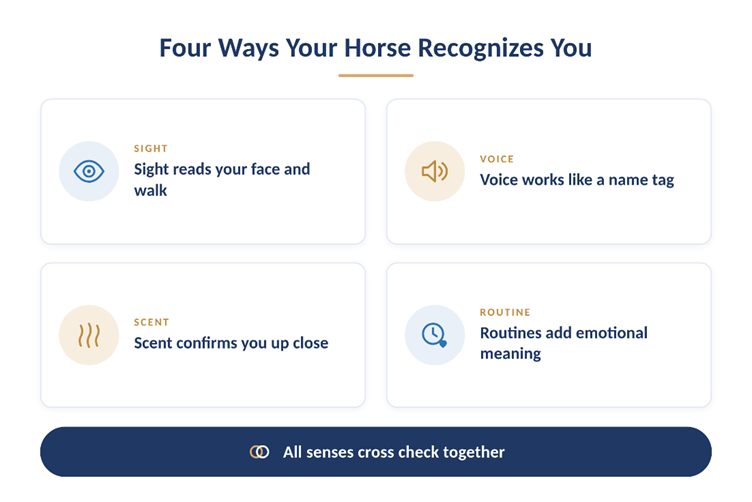
The table below summarizes how each sense contributes to multisensory recognition.
| Sense | What Your Horse Detects | Role in Recognition |
| Vision | Facial features, posture, gait, clothing patterns | Primary identification, works even from photographs |
| Hearing | Voice pitch, tone, rhythm of speech | Confirms identity and reveals emotional state |
| Smell | Individual human scent signature | Close range confirmation of identity |
| Association | Routines, handling style, rewards | Adds emotional meaning to sensory memory |
The bottom line is this. Your horse cross checks you constantly, using at least three senses plus a history of shared experiences. That is a far richer form of recognition than a simple food response, and it is the reason your horse can pick you out of a crowd at the rail.
Can Horses Recognize Their Owners’ Voices?
Yes, horses recognize their owners’ voices and can tell them apart from the voices of strangers and other familiar people. The Proops and McComb experiments showed that horses do not merely react to human speech in general. They match a specific voice to a specific person, and they notice when the two do not line up.
Here is why that matters for you. If your horse can recognize your voice as belonging to you alone, then how you use that voice shapes your relationship every single day. So can horses recognize your voice when they cannot see you at all? The evidence says yes, and they also read the emotion carried inside it.
Horses Hear the Emotion in Your Tone
Horses do more than identify who is speaking. A 2018 study in Scientific Reports on cross modal perception of human emotion found that horses match angry voices with angry faces and gentle voices with relaxed faces. Related work by Amy Smith and colleagues at the University of Sussex, published in Biology Letters in 2016, showed that horses viewing photographs of angry human faces developed elevated heart rates and turned to view the images with their left eye, a pattern linked to processing threatening stimuli.
There is more. A follow up experiment from the same Sussex group found that horses remembered the emotional expressions they had seen in photographs hours earlier and behaved more warily toward the person who had appeared angry. Your horse is not only listening to your words. It is filing away your moods and attaching them to your identity.
Now for the practical part. Speak in calm, consistent tones around your horse, especially during stressful moments like clipping, loading, or veterinary visits. Your voice is both an identity tag and an emotional broadcast, and your horse listens to both channels at once.
How to Use Your Voice More Effectively
Your voice becomes a stronger bonding tool when you use it with intention. Because horses connect vocal cues to identity and mood, a few simple habits can turn everyday speech into steady reassurance.
- Greet your horse with the same word or phrase each time you arrive, so the sound itself predicts something pleasant.
- Keep your pitch low and your pace unhurried when the horse is anxious, since sharp or rapid speech signals alarm.
- Pair a specific calm word with relaxation during grooming, then use that word during stressful procedures.
- Avoid shouting around the barn, because your horse links harsh sounds to the people who make them.
Do Horses Answer Back?
Many owners notice a nicker when they arrive at the barn. That soft, low vocalization is a genuine social greeting that horses typically direct toward familiar individuals they associate with positive experiences. A whinny across a field can serve a similar contact function, essentially asking where are you and announcing here I am. Researchers studying equine vocal behavior note that these greetings are selective, which makes them useful evidence of recognition rather than random noise.
Here is the key thing. If your horse greets you vocally but stays quiet when strangers pass, you are watching individual recognition in action. Your horse is announcing that it knows exactly who just walked in, and that your arrival is worth commenting on.
Do Horses Remember Positive and Negative Treatment?
Horses remember both kind and harsh treatment, and those memories directly change how they behave toward specific people. Horse memory is the capacity of horses to store and recall experiences, individuals, and learned skills over months and years, because their survival as prey animals depended on remembering exactly which situations, places, and individuals were safe and which ones carried danger.
But here is where most horse owners go wrong. They assume a horse lives only in the moment and forgets a rough session by the next morning. The research says otherwise, and the details should change how you approach every interaction you have with your horse.
The Evidence for Long Term Memory
A 2010 study by Carol Sankey and colleagues at the University of Rennes, published in the journal Animal Behaviour, found that young horses trained with positive reinforcement remembered their trainer after eight months apart. Positive reinforcement means adding something the horse values, such as food or scratches, immediately after a desired behavior. The horses approached that trainer more readily, stayed closer to her, and even generalized their friendly behavior toward unfamiliar people.
The INRAE photograph study pushed the timeline further. Horses correctly identified images of a previous keeper they had not seen in six months, with no rewards or reminders in between. Taken together, these results answer the question of how long do horses remember people. Well beyond half a year, and many equine scientists believe important social memories persist for life, although lifetime tracking studies remain rare and honest researchers say so plainly.
Negative Memories Stick Too
Memory cuts both ways. In the Sankey work, horses handled roughly or trained with punishment became more reluctant, showed more defensive behavior, and carried that wariness into later sessions with the same person. Horses that watched a person behave harshly toward another horse also grew more cautious around that person, according to observational learning research summarized by the International Society for Equitation Science.
Think of it this way. Every interaction is a deposit or a withdrawal in a trust account your horse keeps under your name. The account never closes, the horse never loses the ledger, and it checks the balance every single time you approach.
How Horse Memory Works Day to Day
Equine memory relies heavily on association rather than on replaying events the way you might. Your horse links people, places, sounds, and feelings, so the sight of a person who once caused pain can trigger tension even when nothing bad is happening now. The same wiring works in your favor, because the sight of a person linked to scratches and calm handling triggers relaxation instead.
This associative style also explains why horses seem to remember places and trailers so vividly. A horse that had one frightening loading experience may resist the ramp for months, while a horse with a long history of easy trips walks on without hesitation. The memory is not a story. It is a feeling attached to a cue, and you are one of the strongest cues in your horse’s world.
Rebuilding Trust After a Bad Start
A horse with a difficult history is not a lost cause, because memory in horses is layered rather than fixed. New positive experiences do not erase old negative ones, but they can outweigh them, especially when the new experiences are frequent, predictable, and free of pressure.
Start with short sessions in which nothing is asked of the horse at all. Add food rewards for calm behavior, keep your movements slow and consistent, and let the horse control the distance between you. Behaviorists report that most horses begin offering voluntary approach within weeks when handlers commit to this pattern, though badly frightened individuals may need months of patient work.
What This Means for Everyday Handling
Do horses remember their owners after a sale, a move, or a long winter apart? The memory research strongly suggests they do, and that the emotional tone of your past handling travels with the memory. A reunion after years often begins with sniffing and staring as the horse cross references its stored file before relaxing into familiar behavior.
Here is why that matters. Consistency is not just a training nicety. It is the raw material of your reputation with your horse, and that reputation outlasts the season, the sale, and sometimes the decade.
Signs a Horse Recognizes You
The clearest signs a horse recognizes you include a greeting nicker, ears turned toward you, relaxed body language, and voluntary approach. Recognition shows up in dozens of small behaviors that are easy to miss if you do not know what to look for, so it helps to have a checklist in mind when you walk into the barn.
So, can horses recognize humans they see only occasionally, like a farrier or a weekend visitor? Often yes, if the encounters were memorable, but the signals below appear most reliably with the people a horse knows best and trusts most.
Watch for these seven signals the next time you arrive.
- A soft nicker or whinny when you come into view or call out, before you offer any food or treats.
- Ears swiveling toward you and tracking your movement across the yard, even while the horse continues eating.
- Walking or trotting toward you in the pasture without being called, especially when other people are present.
- A lowered head, soft eye, and loose lower lip while you are nearby, which together signal relaxation.
- Resting or grazing close to where you stand, a herd behavior horses reserve for trusted companions.
- Gentle sniffing or breathing near your face and hands, which refreshes the scent portion of the memory.
- Calmer behavior during stressful procedures when you are the one holding the lead rope.
How to Read the Pattern, Not the Moment
One sign alone proves little, because a hungry horse will approach almost anyone at feeding time. Recognition shows in the pattern, especially in relaxed behavior that continues after the treats are gone and in responses your horse gives you but withholds from strangers.
Emotional expressions like the soft eye and low head tell you the horse feels safe with you specifically, which is the foundation of every strong horse and owner bond. If you want a simple test, arrive at an unusual hour, stand quietly at the fence, and watch what your horse does before you produce anything edible. A horse that leaves its hay to stand beside you is answering the recognition question in the clearest language it has.
Keep a mental note of these behaviors over several visits. Tracking the pattern across weeks tells you far more about your relationship than any single greeting, and it shows you whether the trust between you is growing, holding steady, or quietly slipping.
How to Strengthen Your Bond With Your Horse
You strengthen your bond by becoming predictable, rewarding, and safe in your horse’s memory file. The horse and owner bond is not built in dramatic moments of connection. It grows through hundreds of small, calm, consistent interactions that stack up into trust, the same way a savings account grows through steady deposits.
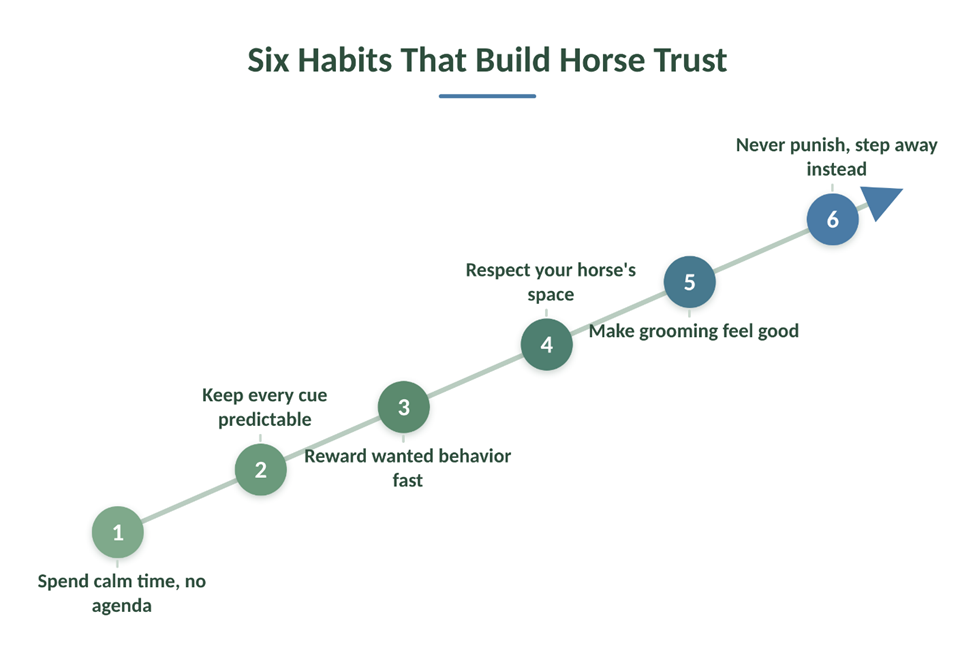
Equitation science, the discipline that applies learning theory and measurement to horse training, gives you a practical roadmap. The six habits below come straight from the recognition and memory research covered above, and every one of them is within reach of an ordinary owner on an ordinary schedule.
Spend Calm, Consistent Time Together
Presence without pressure teaches your horse that you are safe company. Spend time grooming, hand grazing, or simply standing quietly in the paddock with no agenda at all. Because horses build recognition through repeated exposure, these low stress visits enrich the sensory file your horse keeps on you while attaching a feeling of ease to it.
Frequency beats duration here. Four short, pleasant visits spread across the week teach your horse more about you than one long weekend marathon, because each arrival and departure is another rehearsal of the recognition sequence. Horses learn who you are by meeting you often, and they learn what you mean by what happens when you stay.
Use Clear and Predictable Handling Cues
Horses trust handlers they can predict. Use the same words, the same touch, and the same sequence for everyday tasks like haltering, leading, and picking up feet. Clear cues reduce confusion, and reduced confusion lowers stress.
A familiar handler who behaves consistently becomes a source of certainty in an environment full of surprises. If several people handle your horse, agree on shared cues so the horse meets the same language from everyone.
Reward the Behavior You Want
Positive reinforcement is the single best documented bond builder in equine science. The Sankey study showed that food rewards during training produced horses that sought out human contact months later, while the same tasks taught without reward left horses indifferent or wary.
Reward promptly, within a second or two of the behavior you want, and keep sessions short. Let scratches at the withers stand in for treats when you want to avoid food based pushiness, since scratching mimics natural grooming between bonded horses. Timing matters more than generosity, because a late reward teaches nothing at all.
Respect Your Horse’s Personal Space
Trust grows when your horse can say no and be heard. Let your horse approach you rather than always closing the distance yourself, and pause when you see tension such as a raised head, a tight muzzle, or a shifting of weight away from you.
Respecting these signals teaches your horse that its body language works on you, which paradoxically makes the horse seek you out more. Animals that feel control over their social encounters engage in them more willingly.
Make Grooming and Training Comfortable
Grooming mimics the mutual scratching that bonded horses perform in the herd, and research on equine social behavior shows that grooming at the withers can measurably lower a horse’s heart rate. Find the spots your horse enjoys and linger there, watching for the extended neck and wiggling lip that signal pleasure.
Keep training sessions positive and end on success, even a small one. Comfort during shared activities writes pleasant entries into your horse’s long term memory, and those entries are attached to your face, your voice, and your hands.
Avoid Punishment and Forced Interaction
Punishment damages the very recognition systems you are trying to build. Because horses remember harsh treatment and connect it to a specific person, one bad blowup can undo months of careful deposits in the trust account.
If you feel frustration rising, step away, breathe, and return calm. Your horse will remember the restraint just as surely as it would have remembered the outburst, and the relationship will be stronger for it. Forced interaction teaches tolerance at best, while voluntary interaction is what builds real attachment.
The bottom line is this. Every habit above works because of how horse behavior links memory with identity. You are not just training responses. You are editing the permanent file your horse keeps about who you are and what your presence predicts.
Frequently Asked Questions
Can Horses Recognize Their Owners After Years Apart?
Very likely yes. Documented studies confirm accurate recognition after six to eight months of separation, and many credible reports describe horses greeting former owners enthusiastically after several years apart. Long term social memory served wild horses living in stable herds, so lasting recognition of bonded humans fits the biology of the species. Expect some initial sniffing and staring as your horse confirms the match against its stored memory before fully relaxing.
Do Horses Recognize Their Owners’ Faces?
Yes. The INRAE research team showed that horses can pick their keeper’s photograph from a screen, even when the image was one they had never seen before and no scent or voice was available to help. This confirms that horses process human faces as meaningful identity information, not just as vague shapes, and that they can manage the harder task of recognizing a three dimensional person from a two dimensional image.
Can Horses Recognize a Familiar Voice?
Yes. Cross modal research from the University of Sussex demonstrated that horses link a familiar human voice with the correct familiar person. When a recorded voice was played beside the wrong person, the horses reacted with visible surprise and searched for the expected speaker. Your voice functions as an identity tag, so speaking naturally as you approach the stable helps your horse confirm who you are before you even come into clear view.
Do Horses Know Their Names?
Horses can learn to respond to their names through repetition and reward, though researchers debate whether they understand a name as an identity label the way humans do. Your horse most likely treats its name as a reliable sound cue that predicts your attention and often something pleasant after it. Consistent use, paired with rewards and calm handling, keeps the response quick and reliable for the rest of the horse’s life.
How Can You Tell Whether a Horse Remembers You?
Look for the recognition pattern rather than any single behavior. A greeting nicker, ears tracking you, voluntary approach, relaxed posture, and gentle sniffing together indicate that the horse has matched you to a stored memory. With a horse you have not seen in years, give it a quiet minute of sniffing and observation before you judge. Recognition after long separation often unfolds slowly, then all at once, so patience during that first quiet minute usually pays off.
Do Horses Remember People Who Treated Them Badly?
Yes, and the memory can be remarkably durable. Studies on handling show that horses become wary of specific people after rough treatment and may generalize that caution to similar looking situations, equipment, or places. Patience, predictability, and reward based handling can rebuild trust over time, but expect the process to take considerably longer than building trust from a neutral starting point would have taken.
Can a Horse Have More Than One Favorite Person?
Yes. Horses form multiple social attachments within a herd, and they extend the same capacity to the people in their lives. A horse can hold strong bonds with an owner, a trainer, and a regular groom at the same time, without one bond weakening another. Each person occupies a separate file built from their own history of interactions, and the warmth of each bond reflects the quality of that shared history.
So, can horses recognize their owners? The research answer is a confident yes. Your horse knows your face, your voice, and your scent, remembers how you have treated it across months and years, and adjusts its behavior toward you accordingly. That knowledge carries a quiet responsibility, because every interaction you share is being recorded by a mind built to remember.
Use that to your advantage. Show up consistently, handle calmly, reward generously, and respect the signals your horse gives you. Recognition will deepen into trust, and trust will deepen into the kind of partnership every horse owner hopes for. For guidance tailored to your horse’s individual needs, consult your veterinarian or a certified equine professional, such as a behaviorist or nutritionist, who can evaluate your horse in person.