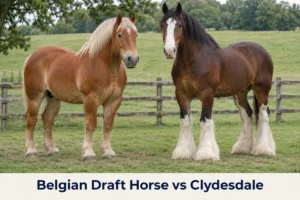
The Belgian Draft Horse vs Clydesdale question comes down to build, looks and purpose. The Belgian is usually shorter, wider and heavier for its height, while the Clydesdale is usually taller, leaner and flashier in motion. Both breeds are calm, willing heavy horse breeds that suit careful owners.
For a fuller breed profile, read our Belgian Draft Horse overview.
This guide gives you a clear side by side comparison of size, temperament, strength, care and cost. By the end, you will know exactly which breed fits your work, your property and your experience level.
Key Takeaways
- Belgians are typically heavier and more compact, while Clydesdales are typically taller with longer legs.
- Both breeds share a calm temperament, but Clydesdales tend to show more animation and higher action.
- Heavy leg feathering makes Clydesdales more demanding to groom and more prone to lower leg skin trouble.
- Belgians carry a higher reported rate of PSSM1, a muscle disorder managed through diet and steady exercise.
- Either breed costs more to keep than a light horse because of feed, farrier work, trailers and equipment.
Belgian Draft Horse vs Clydesdale: Side by Side Comparison
The fastest way to see the Belgian Draft Horse and Clydesdale differences is to compare them trait by trait. Both are true draft breeds, but each was shaped by a different landscape and a different job.
A draft horse breed comparison is a structured look at how heavy horse breeds differ in size, conformation, movement, temperament and care needs, because each breed was selected for a specific type of work. Comparing these traits helps you match a horse to your goals instead of choosing on looks alone.
Averages describe breeds, not individuals. A tall Belgian can outsize a small Clydesdale, so always judge the horse in front of you.
| Trait | American Belgian Draft Horse | Clydesdale Horse |
|---|---|---|
| Origin | Brabant region of Belgium | Clyde Valley, Lanarkshire, Scotland |
| Average height | About 16.2 to 17 hands high | About 16 to 18 hands high, some taller |
| Typical adult weight | About 1,800 to 2,200 pounds, some far heavier | About 1,600 to 2,200 pounds |
| Body build | Compact, deep, wide and very muscular | Taller, longer legged, more upright |
| Leg feathering | Light | Heavy and silky |
| Common colors | Chestnut and sorrel with flaxen mane and tail | Bay, brown, black and roan with white markings |
| Movement | Steady, powerful, ground covering | High stepping with noticeable action |
| US registry | Belgian Draft Horse Corporation of America | Clydesdale Breeders of the USA |
Origins and History of Each Breed
The Belgian descends from the Flemish horse, the heavy war and farm horse of medieval Flanders. According to the Belgian Draft Horse Corporation of America, American enthusiasts organized in 1887 and took the current registry name in 1937. The American Belgian Draft Horse later developed into a distinct type, with a lighter, taller frame than the European Brabant.
The Clydesdale comes from the Clyde Valley in Scotland, where breeders crossed local mares with heavier Flemish stallions in the 1700s. The Clydesdale Horse Society formed in Scotland in 1877, and the American association that became the Clydesdale Breeders of the USA followed in 1879. Breeders prized sound feet and active movement for city haulage.
The Belgian was built to pull hard in deep fields, while the Clydesdale was built to move briskly along roads with a heavy load. That history still shows in how each breed looks and moves today.
Coat Colors and Markings
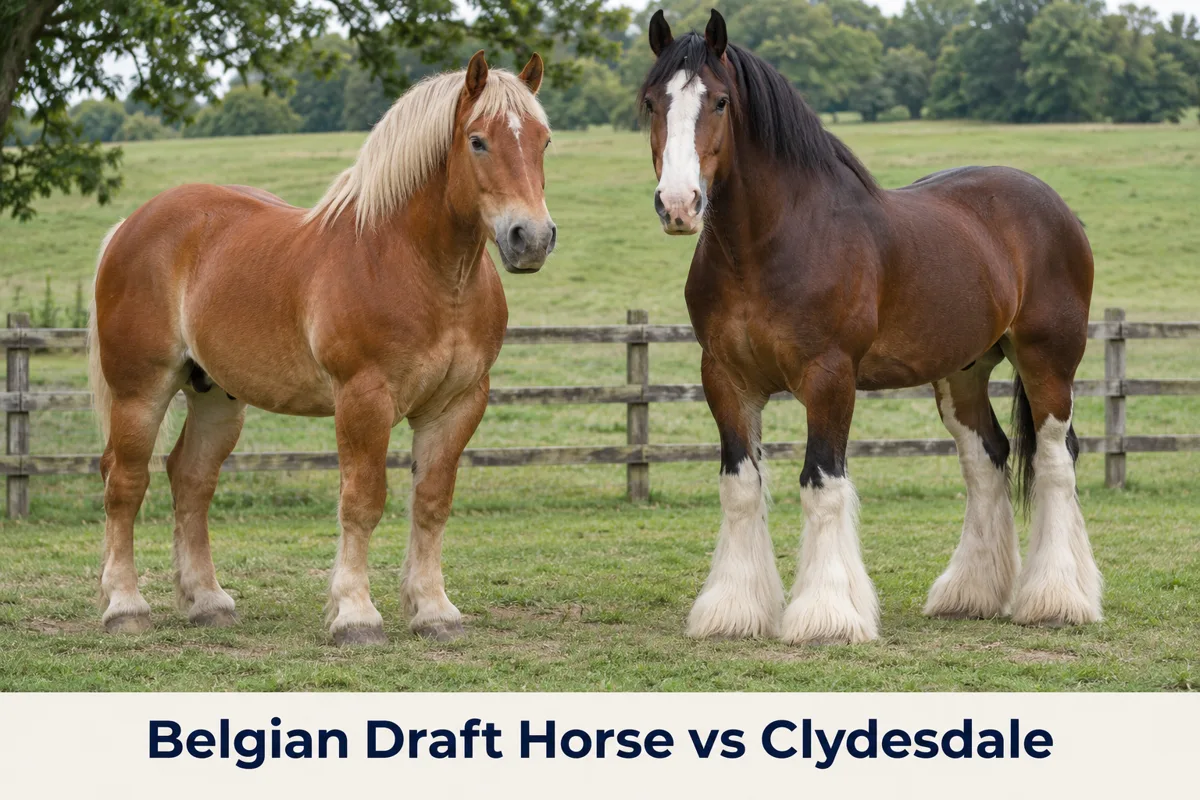
Coat colors and markings are the quickest visual clue. Most American Belgians are chestnut or sorrel, a light reddish coat, paired with a flaxen mane and tail, which means pale blonde hair. Many also wear a white blaze and white socks.
Clydesdales are usually bay, a brown body with black mane, tail and lower legs. Most show bold white facial markings and white legs, and some carry white patches on the belly. The Budweiser hitch made this bay look famous worldwide. Some Clydesdales are also black or roan, which is a mix of white and colored hairs across the body.
Color has practical effects too. White legs and pink skin burn more easily and show more irritation, so a flashy Clydesdale may need extra sun and skin protection compared with a darker legged horse.
Population, Lifespan and Availability
Population size shapes how easily you can buy, breed and find support for each breed. Mad Barn and other breed profiles report that Belgians outnumber all other draft breeds combined in North America. Clydesdales are far fewer, and The Livestock Conservancy has tracked the breed on its conservation priority list for years.
Lifespan is similar for both. Heavy horses often live shorter lives than light breeds, and many drafts show age related joint wear in their late teens. Good weight control, sound hooves and steady exercise give either breed the best chance at a long working life.
So what does that mean for you? If you live far from draft country, a Belgian is usually easier to source locally, while a quality Clydesdale may require a longer search or transport from a specialist breeder.
Which Is Bigger: a Belgian Draft Horse or a Clydesdale?
The Clydesdale is usually taller, and the Belgian is usually heavier for its height. So the answer to Belgian vs Clydesdale size depends on whether you mean height or mass.
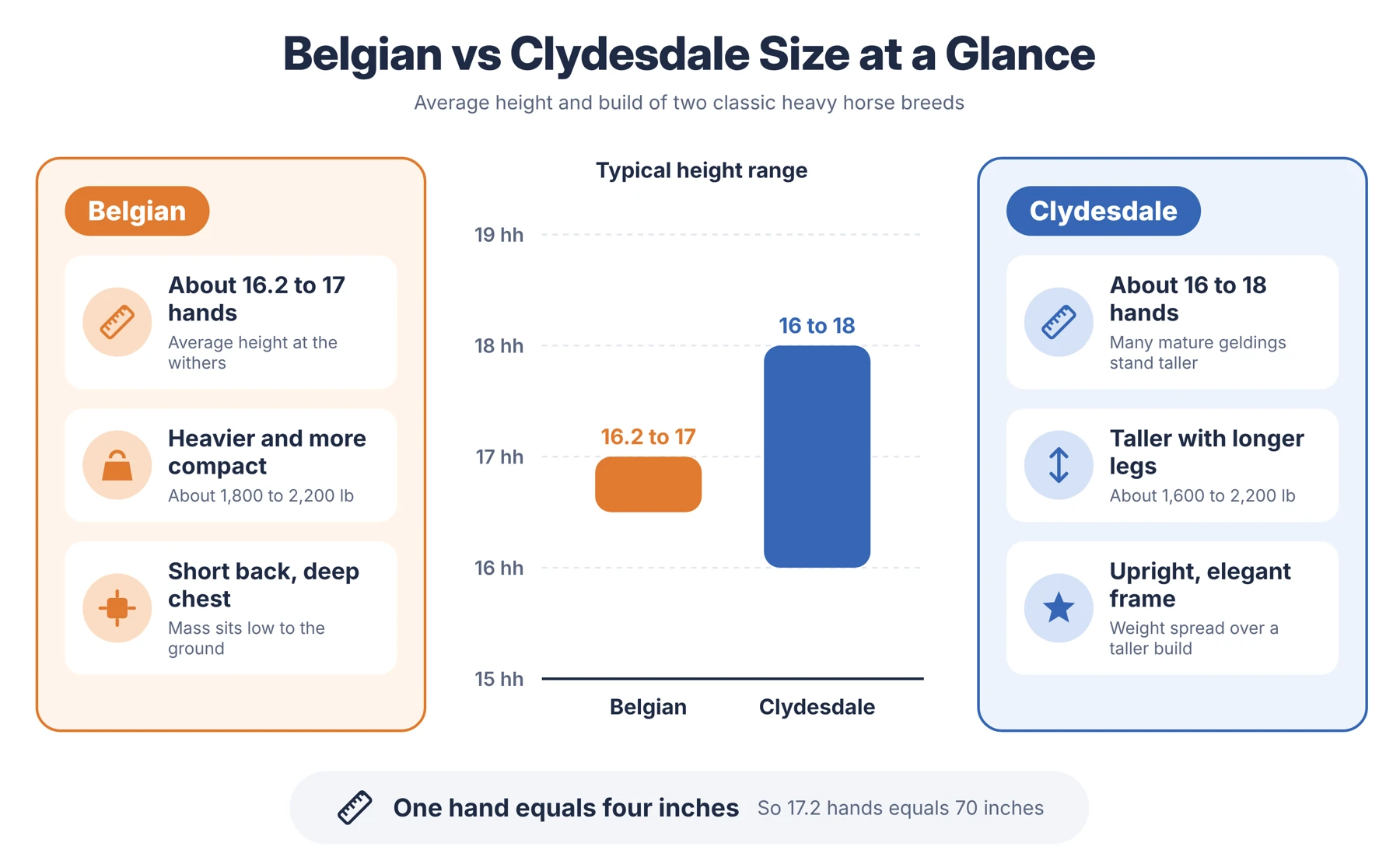
Horse owners measure height at the withers, the bony ridge where the neck meets the back. Height is stated in hands high, and one hand equals four inches. A horse listed at 17.2 hands stands 17 hands plus 2 inches, or 70 inches, at the withers.
But here is where most buyers go wrong: they compare photos instead of measurements. A long legged Clydesdale often looks bigger in a picture, even when a Belgian of similar height carries more weight on the scale.
Height: Which Breed Is Taller?
Published height ranges vary with sex, breeding line and population. The approximate ranges shown here are useful for an initial comparison, not breed limits. The Clydesdale Horse Society describes 17 to 18 hands as common, with smaller mares and larger stallions or geldings also occurring.
Selection pressure explains part of this gap. Anheuser Busch requires its Budweiser hitch geldings to stand about 18 hands, or 72 inches, at maturity. Strong demand for tall show and hitch horses has pushed many Clydesdale lines upward.
Keep in mind that tall Belgians exist too. One famous Belgian stallion, Brooklyn Supreme, was reported in the early 1900s at about 19.2 hands, so individual variation is wide.
Weight and Build: Which Breed Is Heavier?
On Belgian vs Clydesdale weight, the Belgian usually wins pound for pound. Typical adult horse weight for Belgians runs from about 1,800 to 2,200 pounds, and The Livestock Conservancy notes some individuals reach 3,000 pounds. Clydesdales usually range from about 1,600 to 2,200 pounds.
The difference lies in body build and conformation, which means the overall shape and proportion of the horse. Belgians have a short back, a deep chest, a wide croup and a heavily muscular build. Clydesdales carry more leg length and a slightly more refined frame, with weight spread over a taller skeleton.
Hooves, Bone and Overall Scale
Both breeds carry enormous hooves, often close to dinner plate size on a mature horse. Clydesdale breeders have long prized wide, open feet and flat bone, which means strong, clean cannon bones below the knee.
Belgian feet are also large but can be more upright on some lines. Either way, hoof size affects your shoe sizes, your farrier tools and how often the feet need balancing.
If you want maximum mass close to the ground, choose a Belgian. If you want height and presence, the Clydesdale usually delivers more of it.
Belgian vs Clydesdale Temperament
On Belgian vs Clydesdale temperament, both breeds earn their gentle giant reputation. Each has a calm temperament, a willing attitude and a high tolerance for people, noise and handling.
The subtle difference shows up in energy. Belgians are often described as steady, patient and almost unflappable, which suits field work and beginners in harness. Clydesdales tend to be equally kind but slightly more animated, with a brighter, more forward way of going.
Here is why that matters for you. An energetic Clydesdale may enjoy parades, shows and trail riding, while a quieter Belgian may suit a calm farm routine. Neither breed is hot, but daily handling and training shape temperament far more than breed alone.
How Training Shapes Draft Horse Behavior
Size magnifies every habit, good or bad. A pushy 2,000 pound horse is dangerous even when it means no harm, so consistent groundwork matters more with draft horses than with light breeds.
Start with clear boundaries for leading, standing tied and picking up feet. Reward calm behavior and stop sessions on a good note. If you are new to heavy horses, work with a trainer who handles draft breeds regularly.
Handling Differences Around the Barn
Clydesdale vs Belgian Draft Horse handling feels similar day to day, with a few small differences. Clydesdales often react a little more to new sights because they carry more natural energy. Belgians may test boundaries more slowly but can lean on handlers when they feel unsure.
Here is a practical tip. Teach both breeds to hold each foot up for the farrier without leaning, because a draft that rests its weight on a person can cause real injury. Short, frequent practice sessions build this habit faster than one long lesson.
Watch body language closely as well. A swishing tail, pinned ears or a raised head in a 2,000 pound horse deserves the same respect you would give a much smaller, hotter horse.
Which Breed Is Better for Riding and Driving?
Both breeds can suit riding, driving and farm work. Choose an individual horse with suitable conformation, soundness, training and conditioning for your intended job; breed alone does not establish which horse is better.
Clydesdales move with more lift and reach, which many riders find comfortable at the walk and trot. Their height and calm nature also make them popular as mounted patrol horses in police units. Belgians, by contrast, excel in logging, plowing, wagon work and competitive pulling.
But here is the catch: riding a tall draft horse needs the right gear. You will need a draft fit saddle, a wide tree, a larger bridle and a sturdy mounting block. Poor saddle fit causes more problems in drafts than in light horses.
Choosing by Discipline
Use this quick numbered guide to match each breed to common uses:
- Trail riding: Clydesdale for longer stride, Belgian for steadier footing.
- Pleasure driving and carriage work: both breeds suit this well.
- Farm work and plowing: Belgian for sheer pulling mass.
- Logging and forestry: Belgian, thanks to its compact power.
- Parades and show hitches: Clydesdale for height and high action.
- Competitive pulling: Belgian, the breed most often seen in these contests.
Keep in mind that many horses cross over successfully. Plenty of Belgians ride beautifully on trails, and many Clydesdales work happily on small farms when they are trained and conditioned for the job.
Tack and Saddle Fit for Draft Horses
Draft horses have broad, flat backs and wide shoulders, so standard saddles rarely fit. A poorly fitted tree pinches the withers or bridges across the back, which causes soreness and resistance over time.
Look for saddles made on a draft or extra wide tree, and ask a qualified saddle fitter to check the fit while the horse stands square. Recheck fit when your horse gains or loses condition, because draft backs change shape noticeably with fitness.
Harness needs the same care. A correctly sized collar spreads the load across the shoulders and protects the windpipe. Ill fitting collars cause sores fast, especially when a strong Belgian leans hard into a heavy pull.
Is a Belgian Draft Horse Stronger Than a Clydesdale?
Belgians are prominent in North American pulling competitions, but there is no universal breed-based pulling limit. Body mass, training, conditioning, footing and harness fit determine what an individual horse can safely pull.
Pulling power depends heavily on weight, leverage and low center of gravity. A shorter, heavier horse can lean into the collar and drive forward with less wasted motion. That is why Belgians dominate many North American horse pulling competitions.
The Belgian is a tractor, and the Clydesdale is a heavy duty truck. Both move huge loads, but the tractor wins the dead pull while the truck covers ground with more speed and style.
Fitness Matters More Than Breed
Fitness can matter more than breed. Conditioning, harness fit, footing and hoof balance all affect pulling performance and safety.
Build strength gradually with regular work, and never ask a horse to pull a load it has not trained for. Sudden heavy effort raises the risk of muscle damage, especially in horses with muscle disorders.
Warm up with ten to fifteen minutes of walking before any heavy work, and cool down the same way afterward. This simple habit protects muscles, tendons and joints in both breeds, and it costs you nothing but a little time.
What Pulling Competitions Reveal
Horse pulling contests measure how much weight a team can move a set distance on a sled or dynamometer. In North America, Belgian teams appear far more often than Clydesdale teams, partly because of breed numbers and partly because of their compact power.
That does not make Clydesdales weak. Breeders simply aimed them at a different target, favoring longer stride, clean legs and lively action for road and street work.
Here is the honest takeaway. Contest results reflect training, team matching and conditioning as much as breed. Use them as a guide to breed tendencies, not as proof that every Belgian will outpull every Clydesdale.
Which Breed Requires More Care?
The Clydesdale usually requires more grooming and leg care, while the Belgian usually requires more attention to diet and muscle health. Overall workload is similar, but the focus differs.
Both breeds need everything a light horse needs, only bigger. That includes vaccinations, deworming, dental work, quality forage and routine hoof care. Everything costs more and takes more time when the horse weighs a ton.
Draft horse problems often start quietly. Swelling under feathers or mild stiffness after work can signal larger issues, so daily hands on checks matter.
Feathering, Skin Checks and Grooming
Leg feathering refers to the long hair that grows from the knee or hock down over the hoof. Clydesdales carry heavy, silky feathering, while American Belgians usually have light feathering. That single trait drives much of the grooming gap.
Chronic progressive lymphedema is a slowly worsening disorder of the lower legs in which lymph fluid builds up, causing swelling, thickened skin, skin folds and nodules, because the lymphatic vessels stop draining properly. Researchers at UC Davis have documented it in Shires, Clydesdales and Belgians, and the condition currently has no cure.
Feathers can trap mud, moisture and mites, which encourages pastern dermatitis, also called scratches. The UC Davis Center for Equine Health notes that white legs add sun sensitivity to that risk. Follow these steps:
- Check under the feathers daily for crusts, heat, swelling or odor.
- Keep bedding clean and dry, and avoid long hours in deep mud.
- Dry legs thoroughly after washing instead of leaving feathers soaked.
- Ask your vet about mite control if your horse stamps or rubs its legs.
Feeding, Body Condition and Exercise
Most draft horses are easy keepers, which means they hold weight on less feed than you might expect for their size. Base the diet on forage, typically about 1.5 to 2 percent of body weight daily, and adjust using a body condition score.
Belgians are among the breeds affected by polysaccharide storage myopathy type 1 (PSSM1), an inherited glycogen-storage muscle disease. A DNA test can identify the known PSSM1 variant, but a negative result does not exclude every cause of muscle pain or tying up.
The good news is that management helps many horses. Researchers generally recommend a low starch diet, added fat for calories when needed and daily turnout or exercise. The UC Davis Veterinary Genetics Laboratory offers a PSSM1 test, so ask for results before you buy.
Water, Turnout and Daily Routine
Clean water matters just as much as feed. A large draft drinks a lot, often well over 10 gallons a day in warm weather or hard work, so check troughs and buckets at least twice daily.
Daily turnout keeps draft muscles, joints and digestion working well. Long hours standing in a stall raise the risk of stiffness, leg swelling and, in PSSM1 horses, painful muscle episodes after rest days.
Here is a simple rule that works for both breeds. Keep the routine consistent, with the same feeding times, regular movement and gradual changes to diet or workload. Draft horses handle steady routines far better than sudden shifts.
Health Screening and Genetic Testing
Genetic screening is one of the smartest steps you can take before buying a draft horse. Several inherited conditions appear in these breeds, and simple hair sample tests can reveal risk.
Belgian breeders also screen for junctional epidermolysis bullosa (JEB), a severe inherited skin disorder in foals. Ask for documented parental test results before breeding, and discuss the results with your veterinarian.
Shivers, a progressive nerve and muscle disorder that causes trembling and trouble backing up, also appears in draft breeds. No genetic test exists yet, so watch the horse back up and lift each hind leg during a prepurchase exam. Ask your veterinarian to include these checks:
- PSSM1 genetic test results, especially for Belgians.
- JEB status for any Belgian you plan to breed.
- Close inspection of the lower legs under the feathers for early lymphedema signs.
- Hoof quality, joint flexion and soundness at the walk and trot.
Hoof Care, Housing and Transport
Draft hooves are large, heavy and often prone to flaring or cracks. Book a farrier every six to eight weeks, and choose one who handles drafts regularly and has the right shoes, tools and stocks.
Your barn needs to scale up too. Plan for wider stalls, taller doorways, stronger fencing and heavier water buckets or automatic waterers. Standard trailers are often too short and narrow, so look for a stock trailer or a dedicated draft trailer with generous headroom.
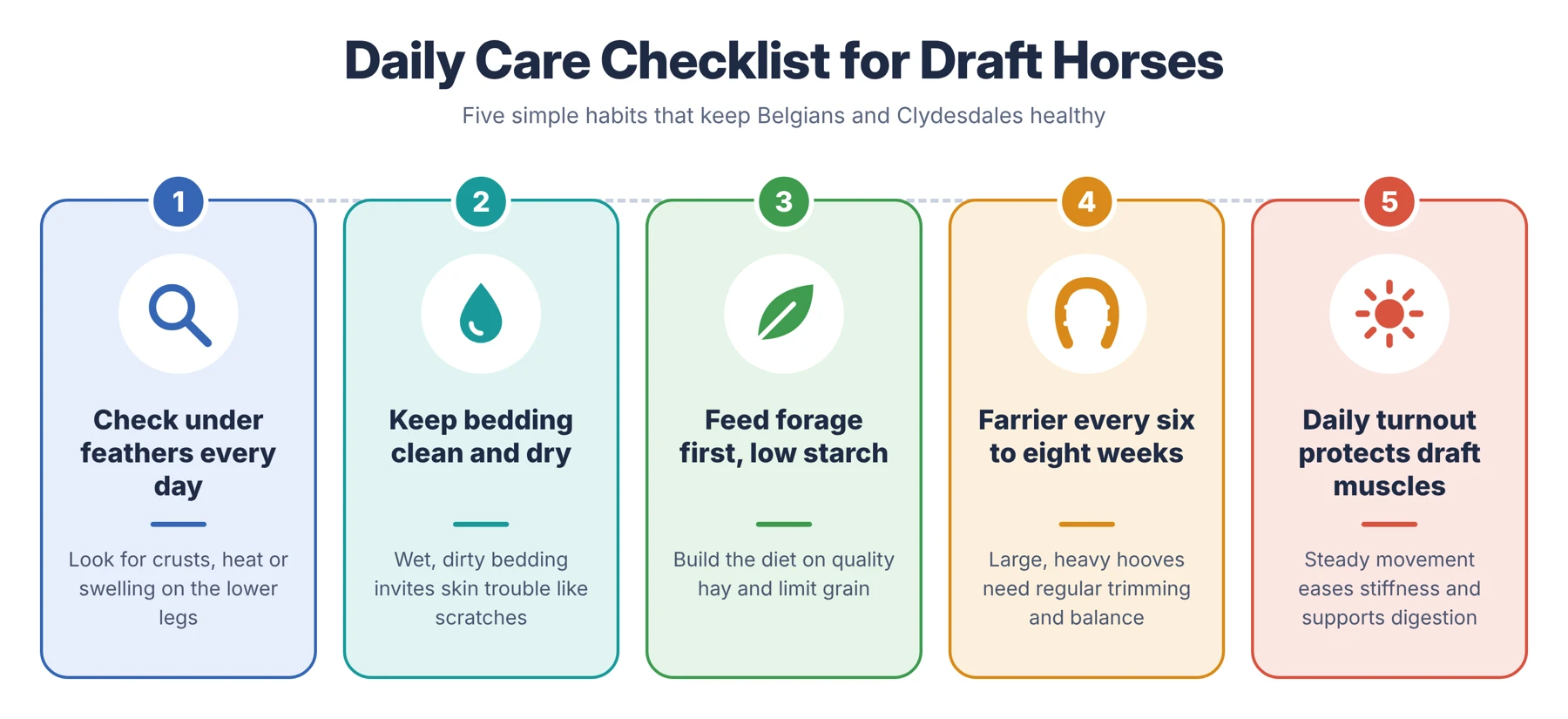
Build a care routine before you bring a draft horse home. Owners who plan stalls, trailers and farrier support in advance avoid most of the stress that follows a rushed purchase.
Belgian vs Clydesdale Cost: Buying and Keeping Each Breed
Purchase prices for both breeds vary widely, and Clydesdales with show quality markings often cost more than Belgians of similar training. Working grade Belgians are among the most affordable draft horses in North America because the breed is so numerous.
That supply matters. Belgians outnumber other draft breeds in North America, so buyers can find trained teams, solo driving horses and riding prospects more easily. Clydesdales are fewer in number, and buyers often pay a premium for bay horses with four white legs and a blaze.
Here is where most first time draft owners go wrong: they budget for the purchase and forget the upkeep. Monthly costs often matter far more than the sale price over the life of the horse.
Use our Belgian Draft Horse purchase and ownership budget to plan the costs beyond the sale price.
Ongoing Costs to Plan For
Expect higher bills than a light horse in every category. Plan for:
- Hay and bedding in larger volumes, often close to double a light horse.
- Draft size shoes, longer farrier visits and specialist handling.
- Custom or draft size saddles, harness, blankets and halters.
- Larger trailers and a truck rated to tow them safely.
- Veterinary costs that scale with body weight, including sedation and medication.
Insurance is worth pricing too. Mortality and major medical policies for large horses often cost more because treatment, surgery and transport cost more.
Clydesdale owners should also budget extra time and supplies for leg care. Belgian owners should budget for genetic testing and a carefully balanced, low starch feeding program.
Comparing Lifetime Value
Lifetime value matters more than sticker price. A trained, sound horse that works safely for ten years often costs less per year than a cheap horse that needs months of retraining or ongoing leg treatment.
Factor in resale value as well. Well trained Belgian teams and quiet Clydesdale riding horses usually hold their value, while untrained or unsound drafts are much harder to sell. Buying quality first protects both your budget and the horse's future.
Where to Find Each Breed
Draft horse auctions, breed association listings and Amish or Mennonite farming communities remain common sources for Belgians. Many of these horses come trained to drive, which can save you months of work.
Clydesdales more often come from specialist breeders, show barns and hitch operations. The Clydesdale Breeders of the USA lists members and sales that help buyers find registered stock with documented pedigrees.
But here is the warning every buyer needs. Never skip a prepurchase veterinary exam, even for a cheap auction horse. Hidden leg disease or muscle problems can cost far more than the horse itself over the following years.
Should You Choose a Belgian Draft Horse or a Clydesdale?
Choose a Belgian if you want maximum strength, easy grooming and a quiet partner for farm or harness work. Choose a Clydesdale if you want height, presence and an animated mover for riding, parades or showing.
The Belgian horse vs Clydesdale decision becomes easier when you rank your priorities honestly. Consider your main discipline, the time you can give to grooming, the size of your barn and your local access to draft savvy farriers and vets.
Here is the smartest next step. Visit breeders or owners of both breeds, handle each horse, watch them move and ask for health records. Ten minutes beside each breed will often tell you more than any spec sheet.
A Simple Decision Framework
Answer these questions before you shop:
- Will you mainly ride, drive, show or work the horse on a farm?
- Can you check and clean heavy feathers every day, all year?
- Do you have a farrier and vet experienced with horses over 1,800 pounds?
- Can your stalls, fences and trailer safely handle a draft horse?
If grooming time is short, lean toward the Belgian. If presentation and riding comfort rank highest, lean toward the Clydesdale.
Common Mistakes to Avoid
The biggest mistake is choosing on looks alone. A striking bay Clydesdale or a golden sorrel Belgian can hide poor feet, weak legs or a difficult temperament.
Other frequent errors include buying an untrained young horse as a first draft, overfeeding grain to a breed that needs little starch and using light horse tack that does not fit. Each of these mistakes is avoidable with honest planning and expert help.
You are not buying a big horse, you are adopting a big system. Feed, hooves, gear, housing and transport all have to work together for the horse to thrive.
Frequently Asked Questions
Are Belgian Draft Horses and Clydesdales the Same Breed?
No, they are separate breeds with separate registries and origins. The Belgian comes from Belgium, and the Clydesdale comes from Scotland. Early Clydesdale breeders did use Flemish stallions, so the two share some distant ancestry, but each developed its own type, colors and movement.
Today the Belgian Draft Horse Corporation of America and the Clydesdale Breeders of the USA keep completely separate studbooks, and crossbred foals cannot be registered as purebreds.
Which Is Better for a First Time Draft Horse Owner?
A mature, well-trained horse of either breed can suit a first-time draft owner with experienced support. A Belgian may require less feather grooming, but no breed reliably forgives handling mistakes. Prioritize temperament, training and soundness.
Look for a horse aged roughly 8 to 15 that already drives or rides quietly, and take lessons from a draft experienced trainer before you bring it home.
Can Belgian Draft Horses and Clydesdales Be Ridden by Larger Adults?
Some individuals can carry larger adult riders, but size alone does not establish a safe load. The often-quoted 20 percent rule is not a universal safety threshold. Ask a veterinarian and qualified saddle fitter to assess the horse, rider, tack, fitness, terrain and intended workload.
Build up riding time gradually, use a well fitted draft saddle and keep early rides short so the horse can strengthen its back muscles over several weeks.
Do Belgian Draft Horses Have Feathering Like Clydesdales?
American Belgians usually have light feathering, much less than a Clydesdale. European Belgians and Brabants can carry more. Light feathering makes daily leg checks easier, but Belgians can still develop chronic progressive lymphedema, so inspect their lower legs regularly.
Clipping or trimming feathers on any draft can make skin checks easier, though show owners usually leave Clydesdale feathers long for presentation.
Can You Keep a Belgian or Clydesdale With Smaller Horses?
Yes, you can keep a draft horse with smaller horses when you manage the herd carefully. Feed at separate stations so the big horse cannot push others off hay, introduce new herd members slowly and watch play closely, since a playful draft can injure a pony.
Check that fences, gates and shelters are strong enough for the largest horse in the group, and give everyone enough space to move away from conflict.
Is a Belgian Clydesdale Cross Suitable for Riding?
A Belgian Clydesdale cross may suit riding when its training, soundness, fitness and saddle fit match the rider and workload. A cross does not automatically combine the best traits of both parents; assess the individual horse.
Many crosses inherit moderate feathering and a medium build, which can mean easier grooming than a purebred Clydesdale and a smoother ride than a heavy Belgian.
The Belgian Draft Horse vs Clydesdale choice has no wrong answer, only a better fit for your goals. The Belgian gives you compact power, simpler grooming and quiet steadiness. The Clydesdale gives you height, flash and a lively stride, with more leg care in return. Both breeds reward patient, prepared owners with years of honest, willing work.
Whichever breed you choose, plan your care routine first and buy the horse second. Ask for genetic test results, inspect legs and hooves closely and line up experienced draft support before purchase day. Most importantly, consult your veterinarian or a certified equine nutritionist for advice tailored to your horse's individual needs.