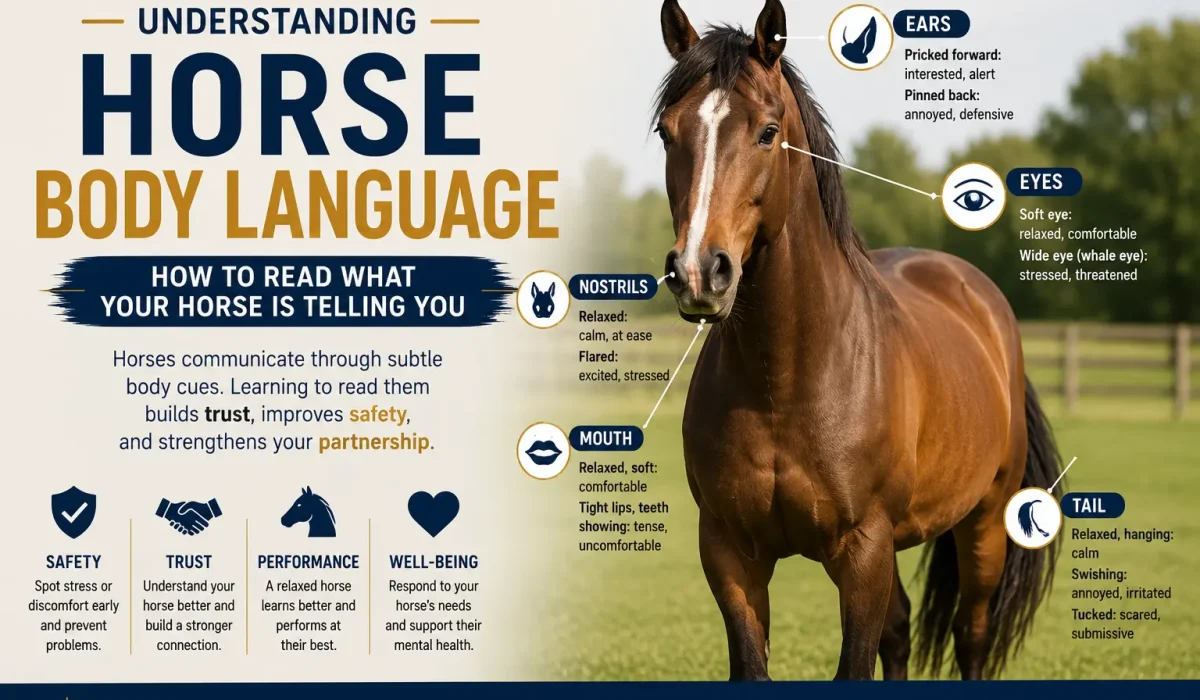
Understanding horse body language is the fastest way to build a safer, calmer, and more trusting relationship with your horse. Horses talk constantly through their ears, eyes, tail, legs, and posture, yet most of that conversation happens in silence. This guide shows you how to read those silent signals so you can respond before a small worry becomes a serious problem.
You will learn what each part of the body reveals, how to tell a relaxed horse from a stressed one, and how to use that knowledge to deepen your bond. Horses are prey animals by nature, so they rely on a rich physical language to warn the herd, signal comfort, and ask for space.
When you learn to read horse body language accurately, you stop guessing and start understanding. That shift protects you, protects your horse, and makes every ride and grooming session more rewarding. The skill grows with practice, and the payoff arrives quickly once you know where to look.
Key Takeaways
• Horses communicate mainly through posture, ears, eyes, tail, and legs rather than sound.
• Pinned ears, a tense muzzle, and a swishing tail are common warning signs to respect.
• Soft eyes, a relaxed lower lip, and a level neck usually signal a calm, content horse.
• Reading signals as a whole picture, not one part alone, prevents dangerous misreads.
• Consistent, calm responses to your horse’s signals build lasting trust and safety.
Why Understanding Horse Body Language Matters
Reading your horse correctly keeps you safe, keeps your horse calm, and builds the trust every partnership depends on. A horse cannot tell you in words that a saddle pinches or that a corner frightens it, so it tells you with its body instead. Owners who learn this language catch fear, pain, and confusion early.
Think of body language as your horse’s main voice. Every owner who handles, rides, or simply cares for a horse is having a constant conversation with it, whether they realize it or not. The owners who tune in to that conversation enjoy calmer horses, fewer accidents, and a partnership built on mutual understanding. Those who ignore it tend to face more spooks, more resistance, and more confusion on both sides.
Safety Comes First
Accurate reading prevents most handling injuries. A horse weighs around half a ton, and a single missed warning can lead to a kick, a bite, or a bolt. When you notice the early signs of fear or irritation, you can defuse the moment before anyone gets hurt.
Most serious incidents do not happen without warning. The horse usually signals discomfort through pinned ears, a raised head, or a shifting hindquarter well before it acts. Reading those early horse body language signs gives you the seconds you need to step back and stay safe.
A Foundation for Trust
Trust grows when your responses are predictable and fair. Horses are highly social and constantly read the herd for cues about safety, so they read you the same way. When you respond consistently to their signals, you become a trusted member of their social world.
Here is the key thing. A horse that learns its signals work feels far less need to escalate. Honoring a small request, such as a step back for space, proves to your horse that quiet communication is enough, which lowers anxiety over time.
Better Welfare and Performance
Reading body language protects your horse’s health and improves how it works with you. Subtle changes in expression often reveal pain long before lameness or illness becomes obvious. Equine veterinarians now use facial signs in formal pain scoring for exactly this reason.
Performance improves too. A horse that feels understood and safe moves more freely, learns faster, and resists less. The bottom line is this: every minute you spend learning equine body language pays you back in safety, connection, and a happier horse.
How Horses Communicate Through Equine Body Language
Horses communicate through a layered system of posture, facial expression, movement, and sound. Equine body language is the silent system of posture, ears, eyes, and movement that horses use to share emotion and intent, because as prey animals they evolved to signal danger and comfort to the herd without making the loud sounds that would draw a predator straight to them. Most of what your horse says is visual, not vocal.
A Whole Body Conversation
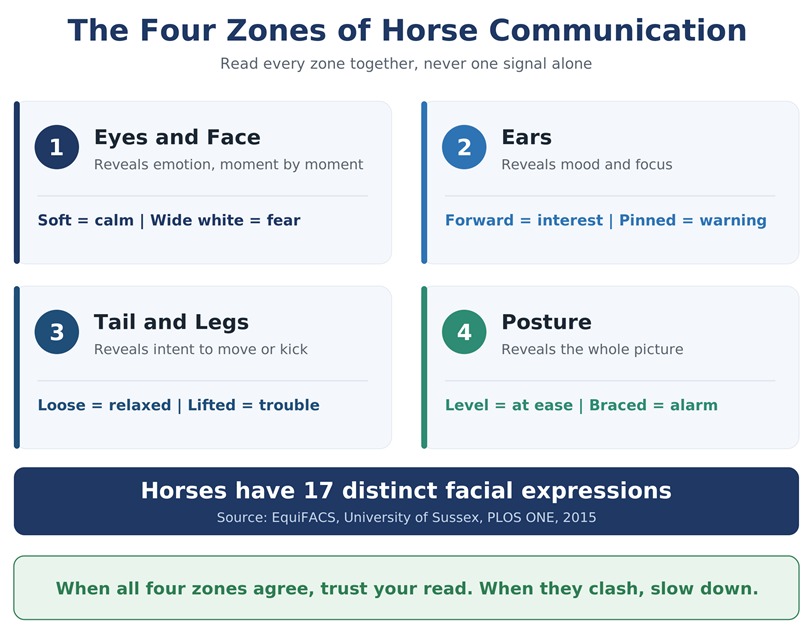
You read a horse best by watching the whole animal at once. A horse broadcasts its mood with the entire body together, much like a person whose face, hands, and posture all move during a conversation. No single ear flick or tail swish tells the full story on its own.
Think of it this way. If you focus only on the tail, you might miss the pinned ears and tense muzzle that change the meaning completely. Skilled handlers scan the head, body, and legs as one picture, then weigh the signals against the situation around the horse.
What Science Reveals About the Equine Face
Research confirms just how detailed this silent language is. A 2015 study from the University of Sussex created the Equine Facial Action Coding System, known as EquiFACS, and identified seventeen distinct facial movements in horses. Published by Wathan, Burrows, Waller, and McComb in the journal PLOS ONE, it showed the equine face is nearly as expressive as our own.
That work reshaped how scientists and owners think about how horses communicate. Behavioral researchers such as Professor Paul McGreevy, author of the textbook Equine Behavior, have long argued that horses use a precise and readable signaling system. Modern science now backs that view with measurable detail.
Signals Within the Herd
Horses learn this language from birth by living in a herd. A foal watches its mother and the other horses, then copies the postures and responses that keep it safe. By the time it grows up, it reads subtle shifts in another horse from across a field.
That herd instinct never switches off, even for a horse that lives mostly among people. Your horse still scans for the calm or alarm of those around it, including you. Once you accept that your behavior feeds directly into your horse’s sense of safety, every interaction gains new meaning and purpose.
Reading Horse Body Language: The Head and Face
The head and face hold the clearest horse body language signs you will ever read. Your horse’s eyes, ears, muzzle, and head position update moment by moment, giving you a live feed of its emotional state. Learn this region first, because it tells you the most in the least time.
Eyes: A Window Into Emotion
Soft, relaxed eyes signal a calm horse, while wide eyes with visible white often signal fear or alarm. When your horse feels safe, the eyelids soften and the gaze appears gentle and steady. When the eye opens wide and you see a rim of white sclera, the horse is usually startled or bracing to flee.
Watch the muscles around the eye as well. Tightness or wrinkles above the eye can point to pain or worry, a detail equine veterinarians use in pain scoring tools. Horse eye expressions change fast, so a quick glance at the eye gives you an instant read on mood.
Soft eyes paired with slow blinking are among the most reliable horse relaxation signs you can learn. A hard, fixed stare in one direction, by contrast, usually means the horse has locked onto something it finds threatening, and a reaction may follow.
Ears: A Key Indicator of Mood
Ear position is the single most reliable indicator of your horse’s mood. Horses rotate their ears toward whatever holds their attention, so ear direction tells you where the focus lies and how the horse feels about it. Understanding horse ear positions and their meaning will sharpen your reading faster than almost any other skill.
Forward ears usually show interest or curiosity, while ears that flick softly back and forth often mean the horse is listening to you and the surroundings at once. Loosely sideways ears, sometimes called airplane ears, often signal a relaxed or dozing horse rather than a worried one.
Ears clamped flat against the neck are a clear warning. This is the answer to why horses pin their ears back: it signals irritation, threat, or pain. When you see pinned ears, give the horse space and look for a cause, such as an ill fitting saddle or a pushy neighbor in the next stall.
The Muzzle and Lips
The muzzle reveals tension that the rest of the face may hide. A relaxed lower lip, sometimes drooping slightly, signals a content or dozing horse. A tight, pinched muzzle with wrinkles above the nostrils often points to stress, pain, or sharp focus on a perceived threat.
Watch for chewing and licking after a tense moment. This release frequently shows that the horse has processed something worrying and is starting to relax, a cue many trainers rely on during groundwork. It often appears right after a horse works out that you mean it no harm.
A raised upper lip with the head lifted, called the flehmen response, looks dramatic but is harmless. The horse is simply drawing a scent toward a sensory organ in the roof of its mouth to investigate an interesting smell.
Head Movements and Positioning
Head height is a quick gauge of arousal. A lowered, level head usually reflects calm and trust, while a high, rigid head signals alertness or fear. A horse that drops its head while you work near it is often telling you it feels safe in your company.
Sudden head tossing can mean irritation, discomfort from tack, or simply flies. A snaking head, swung low and side to side, is an assertive and sometimes aggressive gesture used to move others away. Reading horse head movements in context keeps you from confusing playful behavior with pushy behavior.
But here is where many owners go wrong. They read every high head as fear, when an excited horse at play also lifts its head high. Always pair head height with the eyes and ears to judge whether you are seeing joy, alarm, or assertiveness.
Vocals: Horse Sounds and Their Meanings
Horse vocalizations support body language but rarely replace it. A nicker is a soft, friendly greeting often aimed at people or foals, while a whinny or neigh is a louder call used to locate companions across distance.
A squeal usually signals protest or a tense social meeting, and you often hear it when two unfamiliar horses first meet. A snort can clear the nostrils or express alarm, depending on the posture that comes with it.
Listen to these sounds, but always read them alongside the ears, eyes, and posture for the full message. Sound alone is the smallest part of equine communication cues, so it confirms the body language rather than leading it.
Nostrils and Breathing
The nostrils and breathing rate reveal arousal that the eyes and ears may not show yet. Wide, flared nostrils often mean excitement, exertion, or alarm, while soft, round nostrils suggest a calm and settled horse. A quick read of the nostrils adds useful detail to your overall picture.
Breathing tells a similar story. Slow, even breaths signal relaxation, and fast, shallow breaths point to stress or physical effort. A sudden snort with a high head usually means the horse has spotted something worrying, so follow its gaze and check what caught its attention before you move on.
Putting the Facial Signals Together
No single facial signal tells the whole story, so you always read the face as a set. Soft eyes with pinned ears, for example, send a mixed message that calls for a second look rather than a quick judgment. The reliable readings come when several signs agree.
Build a simple habit. Glance at the eyes, then the ears, then the muzzle, and ask whether they point to the same emotion. When they line up, you can trust your read, and when they clash, you slow down and gather more information before you act.
Reading Horse Body Language: The Body, Tail, and Legs
The body, tail, and legs confirm what the face suggests and often warn you of action to come. While the head reveals emotion, the lower body reveals intent, including the intent to move, kick, or stand its ground. Reading these signals well is what keeps handlers safe around the back end of a horse.
Tail Movements: More Than a Fly Swatter
A loose, gently swinging tail signals relaxation, while a fast, hard swish signals irritation. Tails move for simple reasons too, such as brushing away flies, so you weigh the swish against the rest of the body. Understanding horse tail movements and their meaning helps you separate annoyance from genuine threat.
A clamped tail pressed tight to the hindquarters often shows fear, cold, or tension. A high, flagged tail signals excitement or high energy and appears often in spirited play, in alarm, and in certain breeds that naturally carry the tail higher.
When the tail wrings in fast circles under saddle, many horses are expressing discomfort or resistance. Pair that signal with the ears and the mouth, since a wringing tail combined with pinned ears usually means the horse is genuinely unhappy with something.
Front Legs: Signalling Intent
The front legs reveal restlessness, anticipation, and occasionally a warning. A horse that paws the ground is often impatient, frustrated, or anticipating food, though pawing can also signal anxiety in a tense setting. Watching when the pawing happens tells you which cause is most likely.
A lifted, striking front leg is a serious threat you should never ignore. Stallions and assertive horses may strike toward a rival or a handler who has pushed too far, so a raised front leg means create distance at once.
A relaxed horse rests a front leg only briefly, since horses doze mainly by resting a hind leg instead. A front leg held off the ground for a long period, rather than resting on the toe, can also point to pain and is worth a closer look.
Hind Legs: Defence and Relaxation
The hind legs show both deep relaxation and the clearest danger signals. A horse that cocks one hind leg and rests the hoof on its toe is usually relaxed and dozing, a posture you will see often in a calm barn. This is one of the most common horse relaxation signs.
A raised hind leg or a hind hoof lifted toward you is a direct warning of a possible kick. Learning why horses stomp their feet helps here too, since stomping usually signals flies, mild irritation, or impatience rather than a true threat to you.
Position yourself thoughtfully around the hindquarters. A horse that swings its hind end toward you while pinning its ears is sending a defensive message, so read the whole back end together and give a worried horse room to settle.
Overall Body Posture
Whole body posture sums up everything the parts are saying. A horse standing square and loose, with a level neck and soft eyes, is relaxed and at ease. A horse standing tense and tall, weight shifted back and muscles braced, is alarmed and may be ready to flee.
Horse posture and behavior also reveal social standing within the herd. A confident horse moves freely into space, while a worried horse shrinks, lowers its profile, or turns its hindquarters as a buffer. These patterns reflect deep rooted equine psychology shaped by life in a herd.
Reading the overall silhouette gives you the headline before you study the details. When the big picture and the small signals agree, you can trust your read, and when they disagree, you slow down and look again.
Staying Safe Around the Hindquarters
Most kicks are avoidable when you respect the warning signs the hind end gives you. A horse that clamps its tail, shifts weight to the forehand, and lifts a hind hoof is asking for distance in the clearest way it can. Read that cluster and step out of range.
Move predictably near the back legs and keep a hand on the horse so it always knows where you are. Sudden movement behind a tense horse invites a defensive reaction. Calm, steady handling tells your horse there is nothing to defend against, which keeps you both safe.
Horse Emotions: Signs of a Happy Versus Stressed Horse
You can sort most horse emotions into calm, alert, and distressed, and each shows a clear physical pattern. Knowing the contrast between a content horse and an anxious one lets you act early, long before stress builds into a bolt or a bite. This is where most horse owners go wrong, because they wait for an obvious explosion instead of reading the quiet buildup.
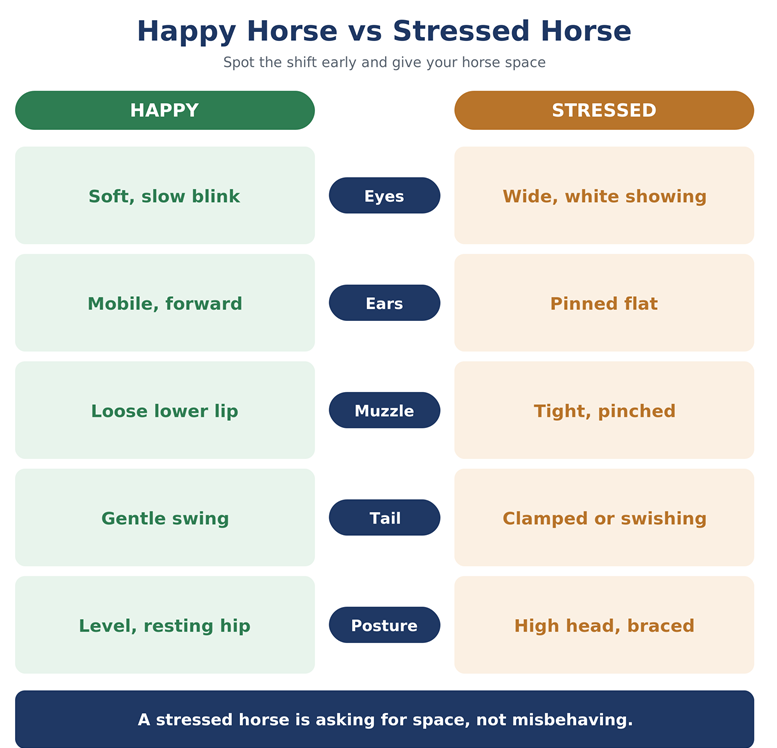
Signs of a happy horse include soft eyes, ears that move freely, a relaxed muzzle, and an even, unhurried posture. Signs of an anxious horse include a high head, wide eyes, a tight muzzle, a clamped or swishing tail, and quick, jerky movements. The table below maps the most useful contrasts at a glance.
| Body Part | Relaxed and Content | Stressed or Anxious |
| Eyes | Soft, gentle, slow blink | Wide, white showing, staring |
| Ears | Mobile, softly forward or sideways | Pinned flat or rigidly fixed |
| Muzzle | Loose lower lip, soft chin | Tight, wrinkled, pinched |
| Tail | Loose, gently swinging | Clamped down or hard swishing |
| Posture | Level neck, weight even, one hip resting | High head, braced, weight shifted back |
| Movement | Slow, fluid, willing | Quick, jumpy, reluctant |
Horse stress signals deserve special attention because they protect you from injury. Recognizing horse aggression signs early, such as pinned ears, a snaking head, bared teeth, or a lifted leg, gives you time to create distance and reassess. The key thing to remember is that a stressed horse is communicating a need, not misbehaving.
Catching Stress Before It Builds
A stress signal is an early physical warning your horse gives you before fear fully takes over, because its prey animal instincts push it to flag rising danger and seek safety long before the moment it would bolt, kick, or spin away. Catching that quiet stage protects you both. The signs are subtle at first, then grow louder if no one responds.
Watch for a rising head, a tighter mouth, faster breathing, and quick, shallow movements. These small changes tell you the horse is moving from calm toward alarm. When you ease the pressure at this point, with space, a pause, or a softer voice, you often stop a real reaction before it starts.
Putting It Into Practice: Building Trust With Your Horse
You build trust by reading your horse’s signals and responding to them with calm consistency. Horses learn that you are safe when your reactions are predictable and fair, which sits at the heart of building trust with your horse. Every correct response you give strengthens the partnership.
Equine psychology rewards patience over pressure. When you honor a horse’s request for space or a pause, you prove that its signals work, and a horse whose signals work feels far less need to escalate. Use the simple routine below every time you handle your horse.
- Pause and scan the whole horse before you approach, reading ears, eyes, and posture together.
- Name the likely emotion you see, whether calm, curious, unsure, or worried.
- Adjust your energy to match, slowing down and softening if the horse looks tense.
- Offer a clear, low pressure request and give the horse time to respond.
- Reward the smallest try with a release of pressure, a rub, or a kind word.
- Watch for the chew or sigh that signals the horse has relaxed and understood.
- Repeat with the same calm pattern so your responses stay predictable.
Consistency matters more than perfection, because every horse meets an owner who sometimes misreads a signal. What your horse needs is someone who keeps watching, keeps listening, and keeps responding with fairness over the long term.
Common Mistakes to Avoid
Most reading errors come from rushing or from judging one signal in isolation. Owners often correct pinned ears or a swish without asking what caused them, which teaches the horse that signaling brings trouble. Over time, that horse may stop warning you and skip straight to a bigger reaction.
Avoid labeling normal behavior as bad behavior. A nudge, a paw, or a snort is information, not defiance. When you treat each signal as a question your horse is asking, you respond with curiosity instead of frustration, and the relationship grows stronger for it.
Reading Your Horse Every Day
Daily observation is the habit that turns knowledge into fluency. Spend a few quiet minutes simply watching your horse in the field or stall, with no agenda beyond noticing how it stands, where its ears point, and how it greets a neighbor. These low pressure moments teach you your horse’s normal baseline.
Once you know what relaxed looks like for your individual horse, changes jump out at you. A horse that suddenly stands apart, holds its head high, or stops grooming with a companion is telling you something has shifted. Catching that change early is often the difference between a quick fix and a real problem.
When to Seek Expert Help
Some changes in horse behavior call for a professional rather than a guess. A normally calm horse that turns anxious, aggressive, or withdrawn may be in pain, and body language is often the first clue that something is wrong. Trust those signals and act on them.
Call your veterinarian when behavior shifts suddenly or comes paired with signs of discomfort. For deeper or lasting behavior concerns, a certified equine behaviorist can assess your horse and build a plan. There is no shame in asking for help, since the best horse owners know the limits of their own reading and lean on expert support when it matters.
Horse Body Language FAQs
Why do foals clack their teeth?
Foals clack or snap their teeth as a submissive gesture toward older horses. The foal opens its mouth, draws back the lips, and clicks the teeth together to signal that it is young, harmless, and not a threat. This behavior, sometimes called champing or snapping, usually fades as the foal matures and gains confidence within the herd. It is a normal and healthy part of growing up, and it shows that the foal already understands the social rules of equine life.
What does it mean when a horse stomps his front foot?
A horse that stomps a front foot is usually expressing irritation or trying to dislodge flies around its legs. Stomping is a low level signal that says something is bothering the horse right now. If there are no insects present, repeated stomping can point to impatience, mild frustration, or discomfort, so it helps to check the surroundings, the footing, and the horse’s overall mood before deciding what the stomp means. Read it together with the ears and tail for a clearer answer.
Why do horses pin their ears back?
Horses pin their ears flat against the neck to signal irritation, a threat, or pain, and it is one of the clearest warnings in equine body language. The message is usually give me space. Pinned ears during feeding, grooming, or saddling can also flag discomfort, so treat the signal as useful information. Look for the underlying cause, such as a tender back or a pushy companion, rather than simply correcting the horse for warning you in the only way it can.
Why does my horse nudge me?
A horse nudges you to get your attention, ask for food, or seek contact and comfort. Gentle nudging is often friendly and social, a sign your horse feels relaxed in your company. Pushy, repeated shoving can become a safety issue, especially with a large or assertive horse, so set clear and kind boundaries. You can welcome the affection behind the gesture while still teaching your horse to respect your personal space and to wait politely for attention.
What does it mean when a horse shows its teeth?
A horse that shows its teeth may be threatening, investigating a scent, or curling its lip in response to a smell. Bared teeth paired with pinned ears and a snaking head is a clear aggression sign that demands space. A raised upper lip with the head lifted, called the flehmen response, is harmless and simply helps the horse process an interesting odor. As always, read the teeth alongside the ears and posture so you judge the true meaning rather than guessing.
How can I tell if my horse likes me?
A horse that likes you greets you with soft eyes, gently mobile ears, and a relaxed posture, and it often chooses to stay near you. Many horses nicker softly, lower the head in your presence, or seek gentle contact when they feel safe. Trust shows in calm, willing behavior built over many positive interactions rather than in any single dramatic moment. Consistent, fair handling and good timing are what earn that quiet affection over the weeks and months you spend together.
Can horses read human emotions and facial expressions?
Yes, horses read human emotions and body language with surprising skill. A 2016 University of Sussex study published in the journal Biology Letters found that horses respond differently to angry and happy human facial expressions, which shows they pick up on our moods. This is why calm, steady handling matters so much. Your horse is reading your face, posture, and energy just as closely as you are reading its ears and tail, so the emotional state you bring to a session truly counts.
How long does it take to learn horse body language?
You can learn the basics of reading horse body language within a few weeks of focused, daily observation. Fluency, however, develops over months and years as you watch many horses in many situations. The fastest path is consistent time spent simply observing horses at rest, at play, and at work. Guidance from an experienced mentor, trainer, or certified equine behaviorist will speed your progress and help you avoid the common reading mistakes that slow most owners down.
Understanding horse body language is a skill that grows every time you watch, listen, and respond with care. The more you practice reading the ears, eyes, tail, legs, and posture together, the more clearly your horse’s voice comes through, and the safer and stronger your partnership becomes. Start with one body region, build from there, and trust that small daily observations, repeated patiently day after day, add up to deep understanding over time. Reputable organizations such as the British Horse Society and the American Association of Equine Practitioners offer excellent resources to support your learning. If your horse shows sudden, unexplained, or worrying changes in behavior, consult your veterinarian or a certified equine behaviorist for advice tailored to your horse’s individual needs.

1 comment on "Understanding Horse Body Language: How to Read What Your Horse Is Telling You"