Horse pasture management on a small property means balancing grazing pressure with grass recovery. A well-planned small acreage can provide useful forage, but its carrying capacity depends on climate, soil, grass species and the number and size of your horses. Rotation protects that resource; it cannot create more forage than the land can grow.
This guide shows you how to plan, graze, maintain and repair a small horse pasture. You will learn how to measure your usable grazing area, set a realistic stocking rate, divide the land into paddocks, time rotations by grass height and keep the soil productive season after season.
Key Takeaways
- Match stocking rate to forage production, and give grazed paddocks enough uninterrupted recovery time.
- For many established cool-season grass pastures, start grazing around six to eight inches and remove horses at three to four inches; adjust these targets for the species and local guidance.
- A well-designed dry lot gives horses turnout space while pastures rest, with hay, water and shelter provided.
- Soil testing every two to three years tells you what your pasture actually needs instead of leaving you guessing at fertilizer.
- Two or more paddocks plus a dry lot make it easier to control grazing and rest than unrestricted access to one field.
What Is Horse Pasture Management?
Horse pasture management is the practice of controlling grazing pressure, soil condition and plant recovery so a field keeps producing safe forage year after year. It matters because horses graze selectively and close to the ground, and they will eat their favorite plants to the roots if nobody ever moves them.
Think of your pasture as a crop rather than a surface. The grass plant stores energy in its roots and crown, pushes that energy up into leaf, then rebuilds its reserves using the leaf it has grown. Remove the leaf repeatedly and the plant never gets to rebuild.
Rutgers Cooperative Extension describes rotational grazing as a way to balance forage use and plant recovery. Adequate acreage, soil care and stocking rate remain important alongside rest.
Why Small Properties Need More Discipline
Small properties concentrate damage. On twenty acres a horse spreads its grazing, its manure and its hoof traffic over a wide area, so mistakes dilute themselves. On two acres every mistake lands in the same place.
The number of horses per acre is only half the equation. The other half is how many days in a row those horses stand on the same grass, and that part is entirely within your control.
What Good Pasture Management Looks Like in Practice
A well managed small pasture is easy to recognize from the gate. The grass sits at an even height across the whole paddock, bare patches are rare, weeds are scattered rather than dominant and the gateway is firm underfoot even after rain.
A poorly managed pasture looks patchy. Short grazed lawns sit beside tall clumps the horses avoid, manure collects in the same corners, mud spreads outward from gates and water troughs, and thistles or docks hold whole sections of the field.
Rest periods can make a substantial difference, but drainage, fertility, grass species and stocking rate also influence these patterns.
The Four Levers You Actually Control
Four practical management factors help you diagnose many pasture problems:
- Time: how many days horses graze a paddock before you move them.
- Rest: how many days that paddock recovers before horses return.
- Stocking rate: the number of horses grazing a given area at one time.
- Soil: the fertility, pH and drainage that decide how fast grass regrows.
Use these factors together. Seed and fertilizer cannot compensate for grazing pressure that repeatedly removes new growth.
How to Plan a Horse Pasture on a Small Property
Learning how to manage a horse pasture starts with measurement, not with fencing. A plan built on real numbers for usable area, carrying capacity and existing grass cover will save you from the most expensive mistake in small horse pasture layout, which is fencing the land before you understand it.
Work through the six steps below in order. Each one feeds the next, and skipping ahead to gates and water usually means moving them later.
Measure Your Usable Pasture Area
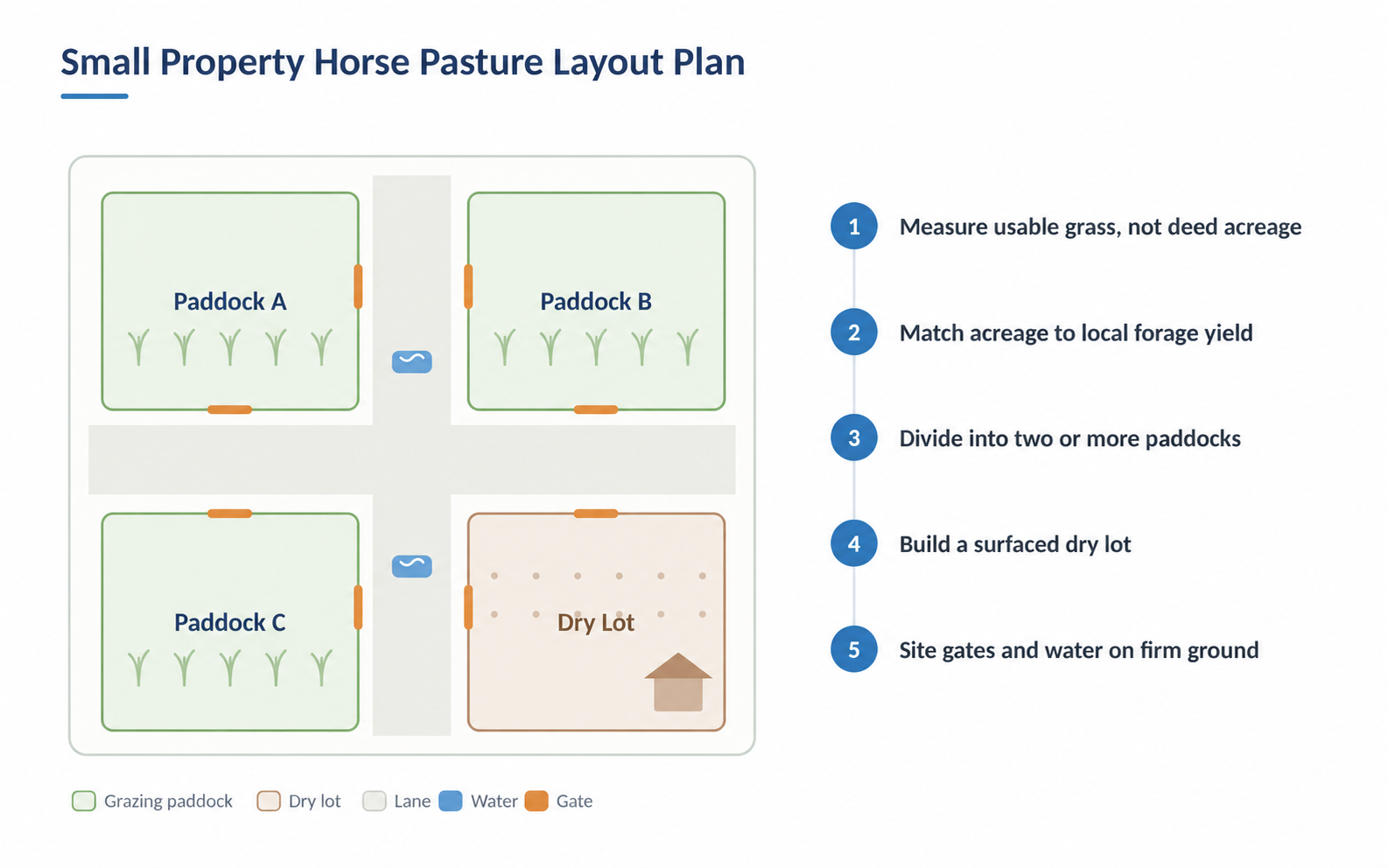
Start here. Measure only the ground that actually grows grass horses can eat. Your deed acreage includes the house, the barn, the driveway, the arena, the muck heap, treelines and any wet or rocky patches that will never carry forage.
Walk the boundary and sketch it, or trace only the grazing area with a satellite measuring tool. Subtract buildings, roads and other non-grazing areas before estimating carrying capacity.
Mark wet hollows, steep banks and shaded strips separately. Assess their suitability before planning lanes or a dry lot; avoid concentrating traffic and runoff in wet ground. Base the plan on usable pasture rather than deed acreage.
Assess How Many Horses the Land Can Support
Pasture carrying capacity is the number of horses the forage can support without damaging the stand. Around two acres of productive pasture per adult horse is a common starting estimate in some temperate regions, but published recommendations vary with grazing system and local conditions. It is not a universal minimum or a promise of year-round feed.
That figure assumes good grass, reasonable rainfall and active rotation. Thin soil, drought, heavy clay or a short growing season all push the requirement higher. Irrigated, well managed ground pushes it lower.
On limited acreage, budget for supplemental hay and dry-lot turnout. Local zoning, animal-welfare requirements, drainage and manure handling also affect whether a property can responsibly accommodate horses. Ask your extension service to help estimate local forage production. Read our guide to how to choose the right hay for your horse for related information.
Check Existing Grass Cover and Soil Conditions
Count what is already growing before you spend money. Walk the field in a straight line, stop every ten paces and note what sits under the toe of your boot: desirable grass, weed, bare soil or manure.
Count each ground-cover category and divide by the total observations for a rough percentage. Sample several representative routes. Extensive bare ground or weeds warrant a renovation assessment; a quick walk is a screening tool rather than a definitive threshold for reseeding.
Collect a representative soil sample and request a pasture soil test from a suitable laboratory. Follow its sampling-depth instructions and check which nutrients and organic-matter tests are included. Use the results to decide whether lime or fertilizer is needed.
Divide the Property Into Practical Grazing Areas
Where practical, divide the usable area into at least two grazing paddocks and a separate dry lot. This lets you rest grazed areas without losing all turnout space.
Three or four paddocks beat two where the layout allows. More divisions mean shorter grazing periods, longer rest and less selective grazing, since horses moving on regularly graze more evenly.
Keep shapes practical, provide safe access and avoid narrow dead ends where horses can be trapped. Paddock size and shape should suit the terrain, herd and available equipment.
Position Fencing, Gates, Water and Shelter
Place the fixed features where they cause the least damage, then build the paddocks around them. High traffic points are where small pastures fail first.
- Water: site troughs on firm, well drained ground, ideally where two paddocks meet so one trough serves both.
- Gates: open gates into a central lane or dry lot rather than directly into another paddock, and avoid placing them at the lowest point of the field.
- Shelter: put run in sheds on high ground with hardstanding at the entrance.
- Fencing: use visible, horse-safe fencing such as post and rail or equine no-climb mesh. Suitable electric tape can divide paddocks within a secure perimeter when horses are accustomed to it. Avoid barbed wire.
But here is where most owners go wrong. They fence the pretty line instead of the practical one, then spend every winter hauling bedding into a gateway that was always going to turn to mud.
Set Aside a Dry Lot for Pasture Recovery
A dry lot, also called a sacrifice paddock, is a fenced area with no grass cover where horses live while every pasture rests. It is not a compromise. On small acreage it is what makes grazing management possible at all.
University of Minnesota Extension recommends at least 400 square feet per average 1,100-pound horse, excluding shelter, feeders and water sources, for compatible horses. More space may be needed for larger horses, incompatible groups or extended confinement. This is a holding-area guideline, not an exercise requirement. Plan safe, well-drained footing and feeding surfaces with local professional advice; avoid feeding directly from loose sand.
Provide water, hay, shelter and safe access for every horse. Install suitable high-traffic pads around gates and feeding areas, divert clean runoff, and remove manure regularly. Read our guide to how to manage mud in your horse paddock for related information.
How to Manage Grazing and Prevent Overgrazing
Overgrazing occurs when grazing removes plant growth faster than it can recover. Too many horses, excessive time on a paddock and insufficient rest can all contribute.
The fix is a rotation triggered by grass height rather than by the calendar. Grass does not grow on a schedule, so your turnout should not follow one either.
Why Rotational Grazing Works on Small Acreage
Rotational grazing means using one paddock for a limited period, removing horses before the target residual height is breached, and resting it while other areas are used. On small properties, the dry lot bridges periods when no paddock is ready.
Unrestricted continuous grazing on limited acreage often leads horses back to favored regrowth while rejected patches become mature. Matching stocking rate to available forage remains necessary with any grazing system.
Start with a manageable layout and adjust movement to grass growth. Extra divisions are useful only when you actually protect the resting areas.
Assess How Much Forage Your Pasture Can Provide
Start with the numbers. A mature horse eats roughly one and a half to two and a half percent of its body weight in dry forage each day. For a one thousand pound horse that is around fifteen to twenty five pounds of dry matter daily, and a grazing horse can take in a surprising amount of that within a few hours.
Cool-season grasses such as orchardgrass, timothy, Kentucky bluegrass and tall fescue commonly grow strongly in spring and fall and slow in summer heat. Warm-season grasses such as bermudagrass have a different growth pattern. Choose horse-appropriate seed with local advice; endophyte-infected tall fescue poses particular reproductive risks for pregnant mares.
Here is the practical consequence. Your rotation speed in May should look nothing like your rotation speed in August, and a plan that ignores that will overgraze every summer.
Introduce Horses to Pasture Gradually
Introduce pasture gradually after a period on hay. For healthy horses, a common extension approach starts with about 15 minutes and increases grazing time gradually over several weeks. This is an example, not a universal turnout prescription. Sudden dietary changes can cause digestive upset, and pasture sugars can be hazardous to susceptible horses.
Feed hay before turnout during this period so horses arrive on the grass with a partly full gut. Horses carrying extra weight, or with any history of laminitis or metabolic disease, need a far more cautious approach and veterinary input before spring turnout. Read our guide to how diet affects equine gut health for related information.
Decide When to Move Horses Based on Grass Height
For many established cool-season grass pastures, six to eight inches is a useful starting target and three to four inches a useful removal target. Recommendations differ: Penn State also describes seven to ten inches for entry. Identify your grass species and follow local guidance; these heights are not proof that pasture is safe for a horse with metabolic disease.
| Pasture Stage | Grass Height | What To Do | Why It Matters |
|---|---|---|---|
| Ready to graze | Six to eight inches | Turn horses onto the paddock | Plants hold enough leaf to feed horses and still regrow |
| Grazing window | Four to six inches | Keep grazing, plan the next move | Monitor residual height and prepare to move before overgrazing |
| Time to move | Three to four inches | Remove horses and close the gate | Retaining leaf area helps plants recover |
| Overgrazed | Under two inches | Exclude horses; assess stand recovery and reseeding needs | Bare soil invites weeds, erosion and compaction |
Here is the simplest tool for the job. Carry a folding ruler or mark your boot at four inches. Measuring takes ten seconds and removes all the guesswork from the decision.
Allow Grass to Recover Before Grazing Again
Pasture rest and recovery usually takes two to four weeks in strong growing conditions and six weeks or longer in midsummer heat or drought. The paddock is ready when it reaches grazing height again, never when the rotation chart says so.
Regrowth depends on remaining leaf area, moisture, temperature, fertility and species. A fixed number of days cannot guarantee recovery, especially during drought or dormancy.
Rest length is a result you observe, not a number you choose in advance.
How to Prevent Overgrazing in Horse Pastures
Use the appropriate residual-height target for your grass species. Repeatedly grazing below it reduces leaf area and can weaken plants, slow regrowth and create space for weeds.
Four habits help prevent overgrazing on small acreage:
- Check grass height twice a week during the growing season instead of relying on how the field looks from the gate.
- Move horses off on the day the trigger height arrives, even when the rotation feels early to you.
- Use the dry lot whenever no paddock has reached grazing height, rather than borrowing days from a field that is not ready.
- Reduce turnout hours in midsummer and drought, when regrowth slows to a fraction of its spring rate.
Delaying a move after the residual target is reached can prolong recovery. There is no reliable one-day-to-one-week formula for the damage.
Manage Grazing When You Have Only One Field
A single field can sometimes be divided with visible, horse-safe temporary electric fencing inside a secure perimeter. Plan adequate space, safe access to water and escape routes within each section, and introduce horses carefully to new boundaries.
If subdivision is impossible, limited grazing plus dry-lot turnout can reduce pressure. However, returning daily to the same regrowth does not provide uninterrupted rest; close the field completely whenever growth cannot keep pace.
Strip grazing allocates a fresh area at intervals. To protect previously grazed regrowth, use a back fence as well as the advancing front fence, while maintaining safe access to water and shelter. A single moving front fence alone does not protect the area behind it.
Horse Pasture Maintenance Through the Growing Season
Horse pasture maintenance is the routine work that keeps grass competitive: soil correction, weed control, manure management and traffic repair. Rotation protects the grass you have, while maintenance decides how much grass you get in the first place.
Soil Testing, Fertility and pH
Test soil every two to three years, or at the interval your local laboratory recommends. Many pasture grasses perform well near pH six to seven, although species requirements vary. Soil acidity affects nutrient availability; use the test recommendation rather than applying fertilizer by habit.
Apply lime only when a soil test calls for it. It takes time to change soil pH, so plan ahead of establishment where practical. Application timing, rate and nutrient needs should follow local recommendations.
Weed Control and Toxic Pasture Plants
Here is the key thing about weeds. They are a symptom of bare ground, so thick grass is your cheapest herbicide. Mowing before weeds set seed, spot treating problem patches and overseeding thin areas all reduce weed pressure without blanket spraying.
Identify toxic plants and trees in and around your paddocks. Regional hazards include wilted or dried red maple leaves, hoary alyssum, bracken fern, nightshades and ragwort. Black walnut is particularly associated with contaminated bedding and sawdust. Your extension office can help identify local hazards and safe removal methods.
Do not rely on horses avoiding poisonous plants, even when forage is plentiful. Some remain toxic when dried, and cut or sprayed plants may still be dangerous. Remove hazardous material and follow all herbicide grazing, haying and reseeding restrictions. Contact your veterinarian promptly after suspected ingestion.
Manure Management on Limited Acreage
Manure accumulates quickly on limited acreage. Unmanaged deposits can smother grass, contribute to nutrient runoff and parasite exposure, and create rejected grazing patches.
Regular collection into a properly managed storage or composting area is often practical on small properties. Keep it away from waterways and manage runoff under local requirements. Do not assume dragging or visible decomposition makes pasture parasite-free; coordinate spreading and pasture rest with your veterinarian and extension adviser. Read our guide to strongyles in horses for related information.
Mowing and Topping Through the Season
Mow rejected stems or weeds when needed, using a height suited to your forage species; around four inches is common for many cool-season pastures. Avoid scalping short or drought-stressed grass. Remove poisonous cut plants and do not offer piles of lawn clippings to horses.
Mow while the paddock is resting and keep horses away from operating machinery. Use equipment suitable for the ground, slopes and vegetation; mowing time depends on conditions and machine capacity.
Drainage, Compaction and Ground Cover
Compaction and poor drainage can seriously damage small pastures. Hoof traffic on saturated ground compresses soil and damages plants, leaving muddy or bare patches.
Keep horses off saturated fields and use an adequately drained dry lot. Investigate soil and drainage conditions before aerating or undertaking earthworks; poorly timed cultivation can worsen damage. Protect continuous cover and direct runoff safely.
How to Improve an Overgrazed Horse Pasture
Recovering a damaged pasture requires coordinated grazing exclusion, soil correction and plant establishment. Use the following sequence as a planning framework, adjusting timing to soil tests, local seeding windows and any herbicide restrictions.
- Remove the horses completely and move them onto the dry lot so the field carries no grazing pressure at all.
- Test soil and apply lime or nutrients only where recommended. Plan the timing before establishing new grass.
- Clear weeds and any toxic plants while the field is empty and you can treat it safely.
- Address compaction and hoof damage when soil conditions are suitable, and seek advice on drainage and erosion control.
- Overseed bare patches with a grass mix suited to your region, using a seed drill or harrowing seed into disturbed soil.
- Fertilize according to the soil test results, and split applications across the season rather than applying everything at once.
- Keep horses off until seedlings are well rooted and established, not merely tall enough. University of Minnesota guidance recommends waiting until the new stand has been mowed two to three times. The closure may extend for a growing season depending on establishment and local conditions.
Returning horses too early can pull out seedlings and undo the renovation. Check rooting and stand density as well as height before allowing light grazing.
Recovery may take months or more than one season. Weather, species, soil condition and the extent of damage determine the timeline; there is no fixed one- or two-season guarantee.
Seasonal Horse Pasture Care Checklist
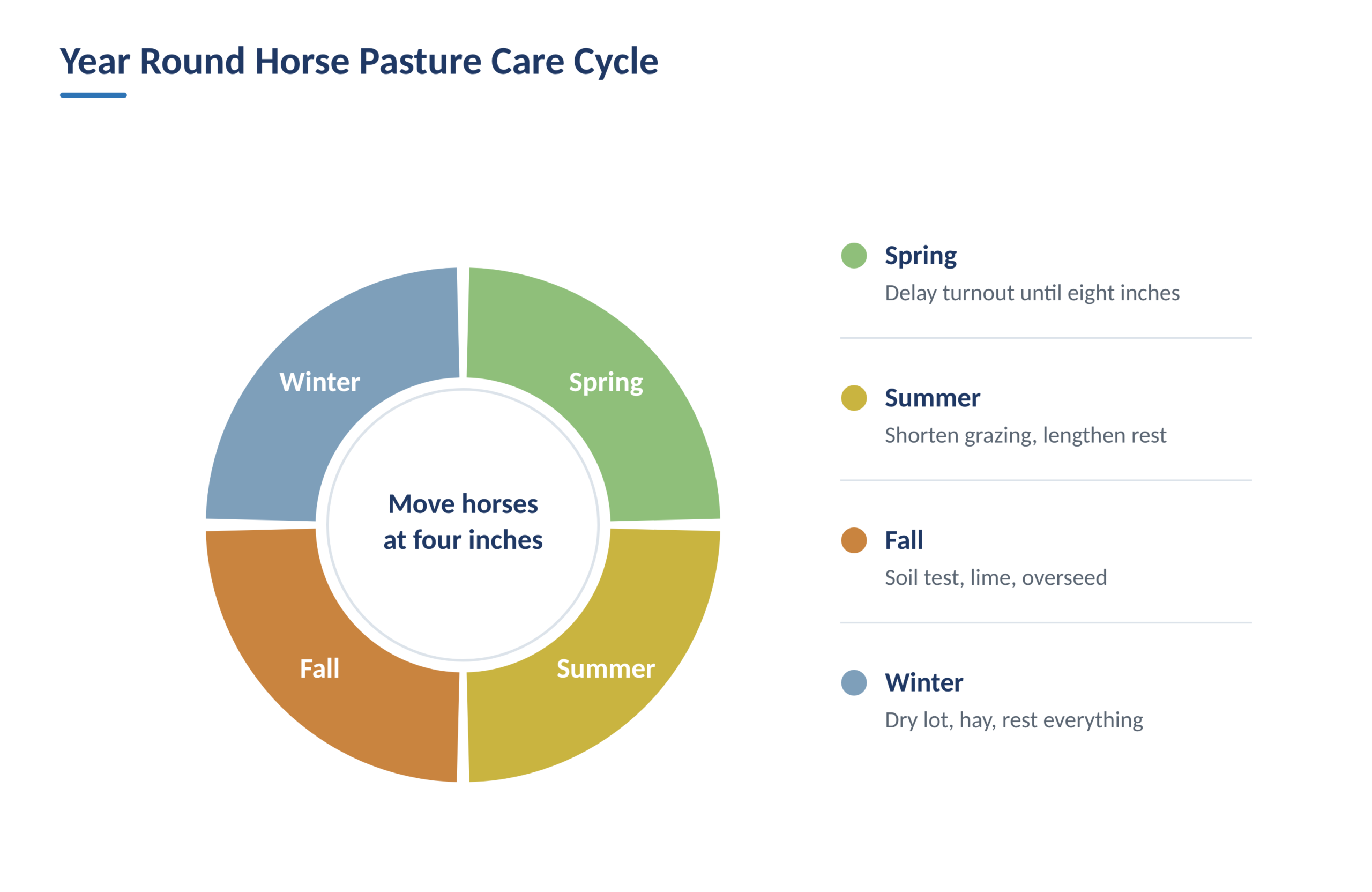
This checklist and the infographic describe a typical cool-season pasture cycle in a temperate climate. Adjust them for your grass species and region: warm-season pastures may grow strongly in summer, and lime or fertilizer should be applied only when indicated.
| Season | Main Priority | Key Actions | Watch For |
|---|---|---|---|
| Spring | Protect new growth | Introduce grazing gradually when grass and ground are ready; collect manure; control identified weeds safely | Soft wet ground, sudden rich grass, laminitis risk in sensitive horses |
| Summer | Keep the rotation moving | Shorten grazing periods, lengthen rest, check water twice daily, mow seed heads, add hay as growth slows | Overgrazing in heat, drought stress, weeds setting seed, flies around manure |
| Fall | Build next year's pasture | Test soil when due; lime only if needed; reseed within local planting windows; plan rest | Early frost on short grass, mud forming at gates, rapid fall growth flush |
| Winter | Protect the soil | Use the dry lot when pasture is dormant or saturated; provide hay; maintain fences and safe footing | Hoof damage on thawing ground, ice in troughs, bare patches widening |
Read the Season, Not the Date
Treat the table as a guide and the grass as the instruction. A cold wet spring can delay safe turnout by three weeks, while a mild wet fall can hand you an extra month of grazing that the calendar never predicted.
Keep a record of when you moved horses, what the grass height was and what the weather did. After two seasons that notebook becomes the most accurate pasture plan you will own, because it describes your land rather than a regional average.
Print the table and pin it in the barn with those notes. A checklist on the wall beats a plan in your head.
Horse Pasture Management FAQs
Can You Keep a Horse on One Acre?
It may be possible to keep a horse on a one-acre property if local rules, safe turnout, shelter, companionship, manure handling and welfare needs can be met. Do not assume that one acre will supply all of its forage. Productivity varies, and many small properties need substantial supplemental hay.
A practical system combines a suitable dry lot, controlled grazing and hay to fill the forage gap. First calculate the actual grass area after subtracting buildings and other facilities.
How Many Hours Should Horses Graze Each Day?
There is no single correct number of grazing hours. Set turnout around available forage, grass recovery, body condition and individual health. Short access periods can still allow substantial intake, so hours alone are not a reliable feeding plan.
Horses with insulin dysregulation, previous laminitis or excessive weight need a veterinarian-led grazing plan. A properly fitted grazing muzzle may help some horses; others may need pasture exclusion. Neither a muzzle nor timed turnout guarantees safety. Read our guide to laminitis signs and veterinary care for related information.
Horses can compensate for restricted access by grazing faster. Monitor body condition and total forage intake rather than assuming a short turnout period controls calories.
How Long Should a Horse Pasture Rest?
Rest a grazed paddock until the grass reaches six to eight inches again. That typically means two to four weeks in good growing conditions, and six weeks or more in summer heat or drought. Height is the signal, not elapsed days.
If growth remains slow, check drought, temperature and seasonal dormancy alongside soil fertility, pH, compaction and plant damage. More rest may still be necessary. A soil test and extension assessment can help distinguish causes.
Can You Rotate Horses Between Just Two Paddocks?
Yes. Two paddocks can create useful rest, provided you use the dry lot whenever neither is ready. Move horses according to residual height and regrowth, not a compulsory five- or seven-day schedule.
Splitting each paddock with portable electric tape effectively gives you four grazing areas with almost no extra cost, which is the fastest upgrade available to most small properties.
How Do You Manage Horse Pasture Without a Tractor?
You can handle many small-pasture jobs with hand tools, suitable mowing equipment and a rotation plan. Use a broadcaster for appropriate seeding jobs and a backpack sprayer only with labeled products and required protective equipment. Whether dragging manure is suitable depends on your parasite and nutrient-management plan.
Rent equipment or hire a contractor for jobs such as drilling seed or addressing compaction. Ask local conservation districts about rental or loan options.
Can Horses Stay in the Field While It Is Being Reseeded?
Keep horses off newly seeded ground until it is established and resists being uprooted. Height or six to ten elapsed weeks alone is not enough. Follow local guidance; waiting until two to three mowings have been possible is one extension benchmark, and some sites need a full growing season.
This is precisely why a dry lot is worth building before you reseed. Without somewhere to put the horses, renovation becomes impossible on a small property.
How Do You Improve an Overgrazed Horse Pasture?
Remove grazing pressure, assess soil and drainage, control weeds safely, establish suitable forage and protect it until well rooted. The seven-step plan above provides a framework, with timing adapted to the site.
The critical final step is establishment. A tall but weakly rooted seedling stand can still be pulled out by grazing horses.
Do Horses Need Hay When They Have Access to Pasture?
Often yes, especially on small acreage, during seasonal slow growth and when paddocks need rest. Hay fills a forage shortfall. Feeding hay before turnout may reduce hungry grazing, but it does not make rich pasture safe for a horse at risk of laminitis.
Assess available forage, body condition and the complete diet with your veterinarian or nutritionist. Protect the residual grass height before the paddock becomes bare and provide suitable supplemental forage when needed. Read our guide to early signs of illness in horses for related information.
Effective horse pasture management combines realistic stocking, usable-area measurement, paddock division, dry-lot access and soil care. Graze according to plant growth, protect recovery and revise the plan as weather and horse needs change.
Here is where to begin. Pick the one change that fits your property this month, whether that is a line of electric tape, a soil sample or a surfaced gateway. Then build from there.
Every horse and every field is different, so please consult your veterinarian or a certified equine nutritionist for guidance tailored to your horse's individual needs, especially before changing grazing for a horse with weight, metabolic or laminitis concerns.