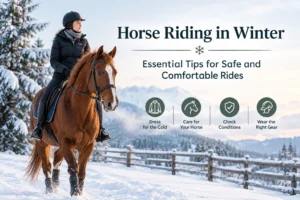
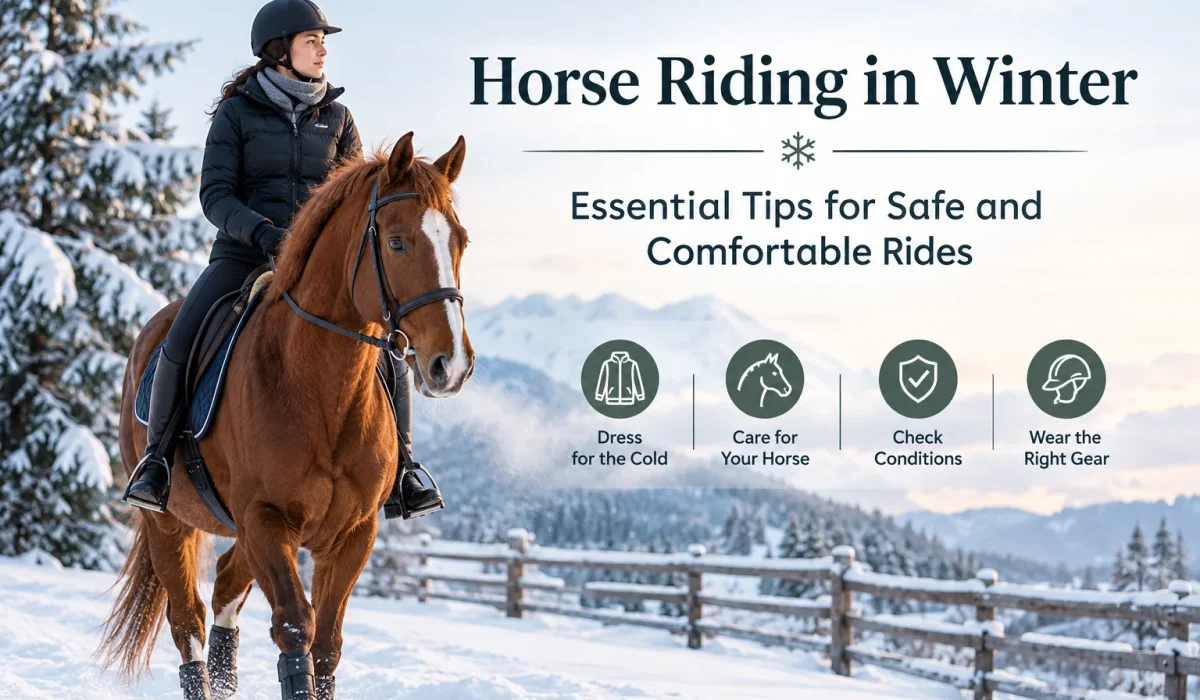
Horse riding in winter is safe and rewarding when you prepare for three things: the ground, the temperature, and your horse’s condition. This guide gives you the exact checks, gear, and riding adjustments that keep you both warm, balanced, and sound through the coldest months.
Winter changes what your horse can do. Footing gets harder, muscles tighten faster, and cold air asks more of the airway. Get those three factors right and most cold weather rides feel no harder than a spring hack. Get them wrong and you risk a slip, a strain, or a chilled horse that needs days to recover.
| KEY TAKEAWAYS Riding is usually safe above roughly 15 degrees F when footing stays firm, dry, and completely free of ice. Cancel the ride when ice, deep drifts, freezing rain, or strong wind chill make the surface or the air unsafe. Extend your warm up to at least fifteen minutes of walking before you ask for trot or canter work. Layer thin thermal fabrics under a windproof shell instead of one thick coat that blocks your position. Keep water above 45 degrees F and forage in front of your horse to prevent impaction colic and weight loss. |
Is It Safe to Ride a Horse in Winter?
Yes, riding is safe for most healthy horses down to roughly 15 degrees F, provided the footing is firm and free of ice and you lengthen your warm up. Horses tolerate cold far better than heat, because a large body mass and a thick winter coat trap heat with remarkable efficiency.
Your horse is better built for cold than you are. Kentucky Equine Research places the lower critical temperature for a healthy adult horse in full winter coat near 5 degrees F. That is the point where the horse must burn extra calories simply to hold its body temperature steady.
Here is the key thing. The thermometer is rarely the real limit. Wind chill, moisture, and ground conditions decide whether a ride makes sense, and a damp 25 degree day with a stiff wind is harder on you both than a still, dry 15 degree morning.
The Three Conditions That Actually Matter
Judge every winter ride on these three factors before you look at the forecast temperature:
- Footing: firm, level, and dry ground with no hidden ice under soft mud or snow.
- Wind chill: exposed hacking turns risky once wind chill drops below about 10 degrees F.
- Your horse: age, body condition, clipping, fitness, and respiratory history all move the safe limit.
A fit, unclipped nine year old on a well drained track has a very different threshold from a clipped senior horse on a frozen field. Judge the horse in front of you, not the calendar.
How Your Horse Stays Warm in the Cold
Your horse holds heat through four mechanisms, and knowing them tells you when to step in. The winter coat lofts to trap air, the hindgut produces heat as it ferments fiber, skin vessels narrow to keep warmth in the core, and body fat insulates everything inside.
- Coat loft: raised hair traps a warm layer of still air.
- Hindgut fermentation: digesting hay creates steady internal heat.
- Vasoconstriction: skin vessels narrow so warmth stays in the core.
- Body condition: a layer of fat works as natural insulation.
Rain and wind defeat two of those four. Wet hair cannot loft, and wind pushes the warm air straight out of the coat. That is why a waterproof rug matters more on a wet 40 degree day than on a dry 20 degree one.
Cold Air and Your Horse’s Airway
Cold, dry air irritates the equine airway, and hard work in freezing conditions can trigger coughing in sensitive horses. Research reported in the Journal of Equine Veterinary Science has linked strenuous exercise in very cold air to airway inflammation, which is the body’s protective response to irritation.
Cold weather horse riding therefore asks more of the lungs than the same work in summer. Keep the intensity moderate, let your horse blow at the walk between efforts, and avoid fast work on the coldest, driest days of the year.
Watch the first ten minutes closely. Repeated coughing, a sudden change in breathing rhythm, or nasal discharge all mean you should finish at the walk and speak to your veterinarian before the next session.
When You Should Avoid Winter Horse Riding
Skip the ride whenever the ground is frozen hard, icy, or buried under more than a few inches of unbroken snow. Frozen ruts and ice can do more damage in a single stride than a week of missed schooling ever will.
Conditions That Mean No Riding Today
Treat any one of these as a clear stop signal. None of them improve with optimism:
- Visible ice on tracks, gateways, arena edges, or the yard itself.
- Ground frozen solid enough to ring or crunch under a hoof.
- Freezing rain, sleet, or heavy falling snow that hides the surface.
- Wind chill below roughly 10 degrees F, especially on exposed routes.
- Deep or drifted snow that conceals ruts, rocks, and holes.
- Fading light without high visibility clothing and working lights.
Horses That Need Extra Caution
Some horses need a higher temperature threshold than the weather alone suggests. These horses lose heat, tire, or struggle to breathe sooner than a fit, hairy young horse:
- Senior horses and horses carrying too little body condition.
- Fully clipped horses ridden without a quarter sheet or exercise rug.
- Horses recovering from illness, injury, or a laminitis episode.
- Horses with a known cough or diagnosed airway disease.
- Young horses that have not yet learned to balance on variable footing.
The Wind Chill Trap
But here is where most horse owners go wrong. They check the air temperature and ignore the wind. The British Horse Society advises riders to plan winter hacking around wind, light, and surface conditions rather than temperature alone, because moving air strips heat from damp skin far faster than still cold air.
Wind also changes behaviour. Gusts, flapping hedges, and blowing snow unsettle even steady horses, so choose sheltered routes and keep the session simple when the wind picks up.
Safer Options on a No Ride Day
A cancelled ride does not have to mean a lost day. Your horse keeps condition and mental freshness through low risk work that never asks for speed or sharp turns on bad ground:
- Walk your horse in hand on swept or gritted surfaces.
- Use a horse walker at walk for twenty minutes.
- Do in hand stretches and gentle carrot stretches in the stable.
- Groom thoroughly to boost circulation and check the skin.
- Extend turnout in a safe, well drained paddock.
Horses lose surprisingly little fitness across a week of walking only, and one avoided injury saves you months of rehabilitation. Patience costs far less than a tendon.
10 Essential Horse Riding Tips for Winter
These horse riding winter tips turn a risky cold ride into a productive one. Work through them in order, because each step depends on the one before it. Read them once now, then run through them mentally before every cold ride.
1. Check the Weather Before You Ride
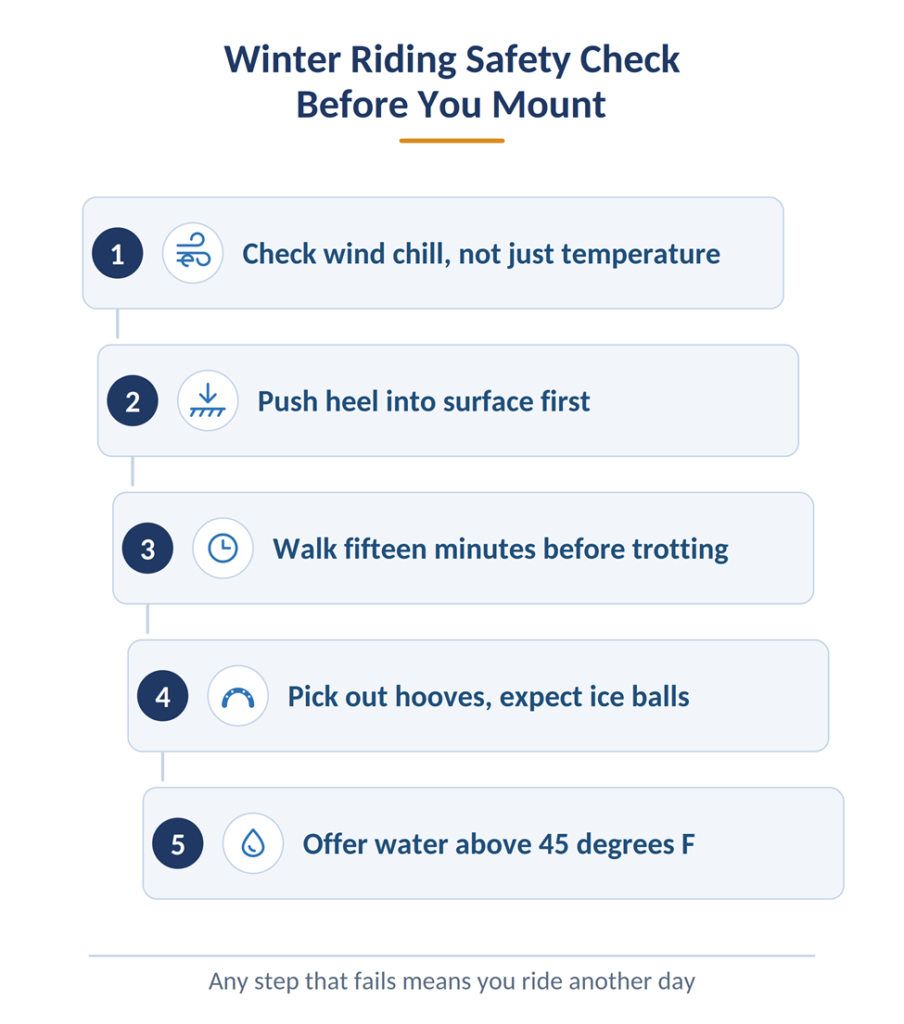
Check wind chill, precipitation, and the overnight low, not just the daytime high. An overnight freeze can leave a plate of ice under a thin skin of soft mud long after the air has climbed above freezing.
Use a forecast that reports wind chill and ground conditions. Ground stays colder than air for hours after sunrise, so a surface that felt safe at midday can freeze again by four in the afternoon.
2. Inspect the Ground and Riding Surface
Walk your arena or the first stretch of your route on foot before you mount. Push a heel into the surface. If it resists like concrete or crunches into frozen plates, ride another day.
Sand arenas freeze from the top down and can look perfectly rideable while the base stays solid. Harrowing a frozen surface loosens the top inch and hides the problem rather than fixing it.
3. Dress in Layers
Wear three thin layers rather than one thick coat. A wicking base layer moves sweat off your skin, a mid layer traps warm air, and a windproof outer shell blocks the chill without bulking out your shoulders or dulling your rein contact.
Test the layers before you mount. Raise both arms, fold your elbows, and look down at your hands. If any layer restricts that movement on the ground, it will block your rein contact in the saddle.
4. Wear Proper Winter Riding Gear
Prioritize grip and circulation over thickness. Winter riding boots need a slim sole that still slides freely out of the stirrup, and gloves must stay thin enough to feel the reins. Gear that squeezes actually makes you colder, because it restricts blood flow to your fingers and toes.
- Insulated winter riding boots with a slim, smooth sole.
- Thin riding gloves with a textured, grippy palm.
- Certified helmet plus a thin helmet liner or skull cap.
- Windproof jacket cut for a riding position.
- Reflective or high visibility outer layer for low light.
5. Give Your Horse a Proper Warm Up
Walk for at least fifteen minutes on a long rein before you trot. Cold muscles, tendons, and joint fluid need time to become elastic, and the risk of a soft tissue strain peaks in the first few minutes of work on a cold day.
Add ten more minutes once the temperature drops below freezing. If your horse stands stabled overnight, walk in hand for five minutes first so the joints move before they carry your weight.
6. Start Slowly on Cold Days
Build effort gradually and shorten the schooling session. Aim for a long warm up and a small number of clear, achievable movements instead of the full workload you would ask for in July.
Save your hardest asks for milder days. Cold muscles fatigue sooner, and a tired horse on firm ground lands heavily, which is how small strains become long layoffs.
7. Pay Attention to Your Horse’s Hooves
Pick out every hoof before and after the ride, and expect packed snow to form ice balls under the sole. Those frozen balls lift the hoof off the ground and destroy balance on landing.
Snow pads, rim pads, and a thin smear of petroleum jelly across the sole all reduce packing. Your farrier can also add tungsten carbide studs or borium to shoes for grip on slick ground, which is a fitting decision rather than a guess.
8. Keep Your Horse Hydrated
Offer water above 45 degrees F before and after every ride. A classic University of Pennsylvania study by Kristula and McDonnell found horses drank substantially more when offered warmed water in freezing weather. The American Association of Equine Practitioners links low winter water intake directly to impaction colic, which is a blockage of the large intestine.
Watch for early signs of dehydration. Dry gums, a slow skin pinch test, and firm, dry droppings all point to reduced intake, and all three appear well before your horse looks unwell.
9. Allow Your Horse to Cool Down Properly
Walk until the breathing settles and your horse’s chest feels cool, then dry the sweaty areas before you rug up. A damp horse put straight under a rug chills quickly, because wet hair cannot loft and trap a layer of warm air.
Give the cool down the same respect as the warm up. Ten minutes of walking on a loose rein settles the breathing, eases the muscles, and lets sweat evaporate before the rug goes on.
10. Know When to End the Ride
End the session while your horse still works forward willingly. Stumbling, shortening strides, repeated coughing, or a sudden reluctance to go forward all mean the ride is over, whatever the training plan said.
Set your finish point before you mount. Riders who plan to stop after one good transition rarely overtrain, while riders chasing a perfect movement keep going long past the point where cold muscles can deliver it.
Your Six Step Winter Warm Up Sequence
Think of it this way. A winter warm up is a sequence, not a stopwatch. Follow these six steps in order on every cold ride:
- Walk on a long rein for five minutes in straight lines and gentle curves.
- Add large turns, shallow loops, and frequent changes of direction for five minutes.
- Ask for a few steps of stretching trot on a long rein.
- Trot in a rising position for three to four minutes on both reins.
- Check that the stride feels even, unhurried, and equal on both sides.
- Only then begin canter work, lateral work, or jumping exercises.
How to Ride a Horse in Winter Without Losing Fitness
Winter fitness comes down to one trade: swap intensity for frequency. Four short, steady sessions each week hold more condition than one hard session followed by six days of standing still.
Trade Intensity for Frequency
Ride more often and ask for less each time. Aerobic fitness responds well to regular steady work, and shorter sessions cut the time your horse spends breathing hard in freezing air.
Twenty five minutes of purposeful walk and trot beats an hour of stop start schooling in the cold. Keep the horse moving, because standing in a chilly arena stiffens the muscles you just warmed up.
Use Hill Work and Pole Work
Build strength with hills and poles instead of speed. Walking up a gentle slope loads the hindquarters without concussion, and walking over ground poles improves proprioception, which is your horse’s sense of where its limbs are.
Both options work at walk, so they stay available on days when the footing rules out faster work entirely.
Cross Train With Groundwork
Fill the gaps with groundwork rather than rest. Lunging on a good surface, long reining, and in hand lateral work all maintain suppleness and topline while keeping speed and impact low:
- Long rein in straight lines along a safe, level track.
- Lunge briefly on both reins, never on frozen ground.
- Walk over ground poles to build hind limb strength.
- Use a horse walker for steady, low risk mileage.
- Add ten minutes of in hand stretching after work.
Watch Your Horse’s Recovery
Track recovery rather than effort. A fit horse settles back to a normal breathing rate within ten minutes of finishing, and a horse that takes much longer is telling you the session was too hard for the conditions.
Write down what you rode and how the horse recovered. Two weeks of notes will show you the intensity your horse handles comfortably in cold weather, which removes guesswork from every later ride.
What to Wear Horse Riding in Winter
Winter riding clothing follows one rule: three thin layers beat one thick coat. A wicking base layer, an insulating mid layer, and a windproof outer shell keep you warm while leaving your shoulders, elbows, and hips free to follow the movement.
The table below shows what each layer does and what to look for when you buy it.
| Layer | What it does | What to look for |
| Base layer | Moves sweat away from skin | Merino wool or synthetic wicking fabric, close fit |
| Mid layer | Traps warm air for insulation | Fleece or light down, full zip for venting |
| Outer shell | Blocks wind and light rain | Windproof, water resistant, stretch shoulders |
| Gloves | Keeps fingers working | Thin insulation, grippy palm, secure cuff |
| Boots | Warmth plus stirrup safety | Slim smooth sole, defined heel, insulated lining |
Base Layers
Choose merino wool or a synthetic wicking fabric next to your skin. Cotton holds sweat against your body and chills you the moment you halt, which is exactly why it fails on winter rides.
Winter Riding Jacket
Pick a jacket that is windproof, water resistant, and cut for riding. Look for a longer back, stretch panels at the shoulder, and no bulk at the waist that would push you out of a balanced position.
Gloves
Wear thin, insulated riding gloves with a grippy palm. Thick ski gloves dull your feel on the reins and slow your reactions, so warmth must never cost you contact or control.
Carry a spare pair in your pocket. Gloves soak through quickly when you tack up in sleet, and wet gloves cool your hands faster than no gloves at all.
Winter Riding Boots
Look for insulated boots with a slim, smooth sole and a clearly defined heel. The sole must slide out of the stirrup instantly, which rules out chunky winter walking boots with deep treads.
Leave room for one sock. Boots bought for a snug summer fit squeeze in winter, and a compressed foot loses warmth no matter how good the insulation is.
Warm Socks
Wear one pair of thin wool socks, not two thick pairs. Doubling up compresses your foot inside the boot, cuts circulation, and leaves your toes colder than a single well chosen sock would.
Riding Helmet
Keep your certified helmet and add a thin skull cap or helmet liner underneath. Never swap the helmet for a woolly hat, and never wear a liner so thick that the harness no longer sits and fastens correctly.
Layering Mistakes to Avoid
The most common clothing mistake is choosing warmth over movement. Every layer you add must still let you fold your elbows, turn your shoulders, and sit deep in the saddle:
- One thick coat instead of three thin layers.
- Cotton next to the skin, which holds sweat and chills you.
- Oversized gloves that dull your feel on the reins.
- Deeply treaded boots that can grip the stirrup.
- Two thick socks that cut circulation to your toes.
How to Keep Your Horse Comfortable During Winter
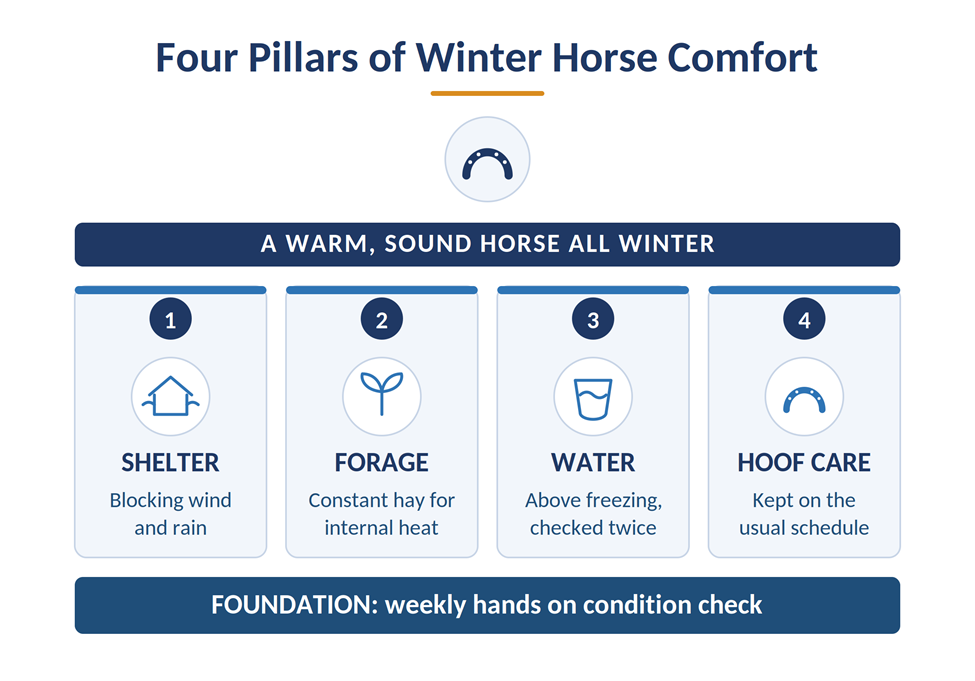
Good winter horse care rests on four pillars: shelter from wind, constant forage, water above freezing, and hoof care on schedule. Riding well through the cold months starts with management that keeps your horse warm and sound between rides.
Provide Adequate Shelter
Give your horse a way to escape wind and wet, not just cold. A three sided shed, a thick hedge, or a dense tree line lets a horse with a good coat regulate its own temperature far more effectively than a rug alone.
Face the open side away from the prevailing wind. Rutgers Equine Science Center notes that shelter from wind and rain matters more to a horse than air temperature alone, because both strip heat from the coat.
Maintain a Suitable Winter Diet
Feed more forage, not more grain, when temperatures fall. Fermentation of hay in the hindgut produces internal heat, and the National Research Council notes that energy requirements rise roughly one percent for every degree below the horse’s lower critical temperature.
Weigh your hay rather than counting slices. A slice from one bale can weigh twice as much as a slice from another, which makes eyeballing portions the fastest way to lose control of winter condition.
Make Sure Your Horse Has Access to Water
Check water at least twice a day and break or remove ice every time. University of Minnesota Extension recommends offering water between 45 and 65 degrees F, because horses drink less as water nears freezing and reduced intake raises the risk of impaction colic.
A heated trough or bucket pays for itself in avoided vet bills. If you cannot heat the water, carry warm water out twice daily and soak part of the hay ration to add moisture.
Rug Your Horse Without Overheating
Match the rug to the coat, the shelter, and the weather rather than to your own comfort. A horse with a full coat and a windbreak often needs no rug above freezing, while a clipped horse needs one much sooner.
Check under the rug daily. Warm, damp skin at the shoulders or over the loins means the rug is too heavy, and sweating under a rug chills a horse faster than cold air ever would.
Check the Coat and Skin Regularly
Part the coat weekly and feel the skin beneath. A thick winter coat hides weight loss, rain scald, and rub marks from rugs, so run your hands over the ribs, withers, and shoulders instead of trusting your eyes.
Wet ground causes most winter skin problems. Mud fever, a bacterial infection of the lower leg, and rain scald along the back both begin with skin that stays wet for hours at a time:
- Dry the legs thoroughly after every muddy ride.
- Avoid repeated washing, which strips protective oils.
- Check heels and pasterns daily for scabs or heat.
- Clip feathers only when your veterinarian advises it.
Maintain Regular Hoof Care
Keep your farrier on the usual schedule right through winter. Hoof growth slows in cold weather but never stops, and ground that turns wet then frozen stresses the hoof wall, which makes balanced trimming and secure shoeing more important rather than less.
Indoor vs. Outdoor Horse Riding in Winter
Indoor riding wins on consistency, and outdoor riding wins on variety and air quality. The strongest winter routine uses both: school indoors when footing outside is doubtful, and hack outside whenever the ground allows it.
| Factor | Indoor arena | Outdoor riding |
| Footing | Consistent, rarely freezes solid | Varies daily, can freeze or ice over |
| Air quality | Dust builds up without watering | Fresh air, but cold and dry |
| Session length | Full schooling sessions possible | Shorter, simpler rides are safer |
| Horse focus | Calm and predictable, can feel stale | Fresher mind, more spooking risk |
| Daylight | Lights extend the usable day | Limited by short winter daylight |
The bottom line is this. An indoor school removes the weather but concentrates dust, so water the surface and open the doors when you can. Outdoor riding keeps your horse’s mind fresh and the airway clear, as long as you accept shorter sessions and abandon the plan when footing turns.
How to Choose Day by Day
Use a simple rule. If you cannot push your heel into the surface, ride indoors. If the surface gives under pressure and the wind stays light, get outside for the fresh air and the change of scene:
- Frozen or icy outside: school indoors at walk and trot.
- Soft and dry outside: hack out and enjoy the variety.
- Wet and windy: short indoor session, then extra turnout.
- Fresh snow under three inches: quiet hack on ground you know.
Making an Outdoor Surface Rideable
Salt and grit belong on yards, not on arena surfaces. Keep an outdoor arena usable by maintaining drainage, harrowing before a freeze rather than after it, and accepting that a frozen base needs time rather than machinery.
Ride the outside track only when the edges thaw at the same rate as the middle. A soft centre with frozen edges pushes your horse onto the worst footing on every turn.
Horse Riding in Winter FAQs
Can you ride a horse in winter?
Yes. Most healthy horses work comfortably through winter as long as footing is safe and you adjust the session. Keep rides shorter, warm up for at least fifteen minutes, and choose firm, ice free ground. Cancel the ride when the surface is frozen solid, icy, or hidden under deep snow.
What temperature is too cold to ride a horse?
Most experienced riders stop when air temperature or wind chill falls below roughly 10 to 15 degrees F. No official cutoff exists, and coat, age, fitness, and clipping all shift the line. Wind and moisture matter more than the number itself, so a damp, windy 25 degree day can tax your horse more than a dry, still 15 degree morning.
What should I wear for winter riding?
Wear three thin layers: a wicking base layer, an insulating mid layer, and a windproof outer shell. Add insulated winter riding boots with a slim sole, thin grippy gloves, one pair of wool socks, and a helmet liner under your certified helmet. Avoid bulky coats and oversized gloves.
How do you keep a horse warm after riding?
Walk your horse until the breathing settles and the chest feels cool, then dry the sweaty areas before you rug up. Use a wicking cooler or a thatch rug over damp patches so moisture passes through the fabric. Once the coat is dry, replace the usual rug, offer warmed water, and hang a haynet.
Can horses exercise in cold weather?
Yes, and regular exercise maintains fitness, circulation, and hoof health through the cold months. Cold, dry air can irritate the airway during hard work, so keep intensity moderate and watch for repeated coughing. Build effort gradually and skip demanding interval work on the coldest days.
Is it safe to ride a horse on snow?
Fresh, soft snow up to a few inches deep is usually safe on ground you know well. Risk climbs sharply with drifted snow that hides ruts and ice, with wet snow that packs into hard balls inside the hoof, and with a frozen crust on top. Ask your farrier about snow pads or rim pads.
How do you warm up a horse in winter?
Walk on a long rein for at least fifteen minutes, then add large turns and stretching trot before any schooling. Cold tendons and joint fluid need time to become elastic, and most winter strains happen in the first minutes of work. Stabled horses benefit from five minutes of walking in hand first.
Do horses need more food in winter?
Most horses need more forage rather than more grain. The National Research Council notes that energy needs rise roughly one percent for every degree below the horse’s lower critical temperature, and hay fermenting in the hindgut produces warmth that grain does not. Weigh the hay and monitor condition by hand.
Horse riding in winter comes down to preparation rather than toughness. Check the ground before you mount, layer thin fabrics instead of thick ones, extend the warm up, and keep the session shorter than your summer schooling. Between rides, protect the four pillars: shelter from wind, forage in front of your horse, water above freezing, and hoof care on schedule.
Riding horses in winter also asks for honesty. Some days the safest decision is to walk in hand, use the indoor school, or do nothing at all, and that decision protects far more than a single ride. Every horse carries a different threshold, so treat these winter riding tips as a starting point and then read the horse in front of you.
Horseback riding in winter rewards riders who plan ahead and stay flexible. Keep your gear ready, your farrier on schedule, and your expectations realistic, and horse riding in cold weather becomes one of the most peaceful parts of the year rather than a risk you tolerate.
For advice tailored to your horse’s individual needs, including winter feeding changes, clipping decisions, and any concerns about breathing or soundness in cold weather, consult your veterinarian or a certified equine nutritionist.