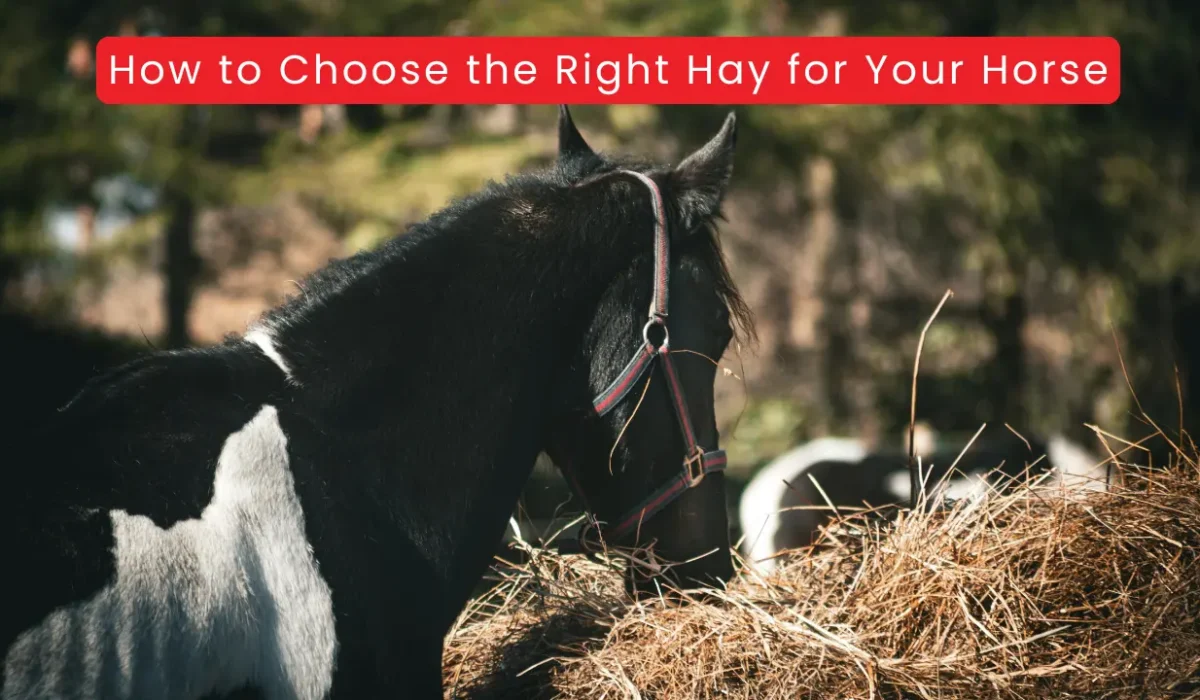
Hay is the foundation of your horse’s diet, and knowing how to choose the right hay for your horse is one of the most important skills you will develop as an owner. The right forage decision affects your horse’s energy levels, digestive health, body weight, and long term soundness. Whether you are caring for a competitive show horse, a retired trail companion, or a young horse still growing into their full potential, hay selection has a direct and measurable impact on their daily wellbeing.
Good quality hay for horses is not simply about grabbing whatever is available at the local feed store. It is about understanding what your horse needs nutritionally, what different hay types provide, and how to assess what you are buying before it ends up in the feed bucket. Most owners underestimate how much variation exists between bales, suppliers, and cutting seasons, and that variation matters more than most people realize.
This guide covers everything you need to make confident, informed hay choices: the main types of hay for horses, how to evaluate quality before you buy, how to match hay to your horse’s age and workload, what nutritional values to look for, and best practices for daily feeding and storage.
| KEY TAKEAWAYS • Hay type matters enormously: grass hays are lower in calories and protein while legume hays like alfalfa are richer and better suited to high demand horses such as performance athletes, breeding stock, and seniors. • Quality indicators you can assess by hand include bright green color, a fresh clean smell, soft texture with a high leaf to stem ratio, and minimal dust or mold. • Your horse’s age, workload, body condition score, and any existing health conditions should all guide your hay selection decision rather than habit or convenience. • A laboratory hay analysis is the most accurate and reliable way to know the exact nutritional content of any hay you purchase, and it removes all guesswork. • Most horses should consume approximately 1.5 to 2 percent of their body weight in forage each day, divided across multiple feedings or offered through a slow feeder net. |
Types of Hay for Horses
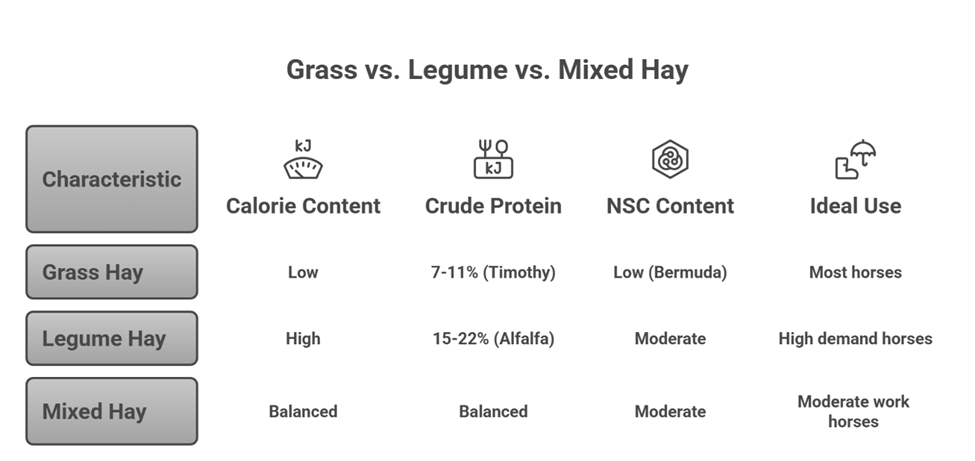
Understanding the main types of hay for horses is your essential starting point. Not all hay is created equal, and each variety has a distinct nutritional profile, texture, palatability, and appropriate use depending on your horse’s individual situation. Broadly, horse hay falls into three categories: grass hay, legume hay, and mixed hay. Each plays a different role in a well managed feeding program.
Grass Hay (Timothy, Bermuda, Orchard)
Grass hay is the most commonly fed forage for horses in North America, and it forms the backbone of most equine diets. It tends to be lower in calories and protein compared to legume hays, which makes it an appropriate base diet for the majority of horses, including pleasure horses, horses in light work, and easy keepers that gain weight readily.
Timothy hay is perhaps the most widely recognized grass hay among horse owners. It is highly palatable, widely available, and nutritionally consistent across most growing regions. According to the University of Minnesota Extension, timothy hay typically contains around 7 to 11 percent crude protein and offers moderate digestible energy, making it well suited for maintenance feeding and light activity levels.
Bermuda grass hay is particularly popular in warmer southern climates. It is lower in sugar and starch compared to many other grass hays, making it a favorable choice for horses with metabolic concerns such as equine metabolic syndrome or insulin resistance. Research published in the Journal of Equine Veterinary Science has demonstrated that Bermuda grass hay can serve as an appropriate long term forage option for horses requiring calorie restriction.
Orchard grass hay sits at the higher end of the grass hay nutritional spectrum. It is more digestible than timothy and offers a softer texture that many horses find highly palatable. Horses who need slightly more energy without the richness of a legume hay tend to do very well on high quality orchard grass.
Here is the key thing to keep in mind: within each grass hay variety, quality and maturity at harvest matter as much as the species itself. First cut hay is typically coarser with more stem material and fewer leaves, while second and third cut hay tends to be leafier, finer stemmed, and more nutrient dense overall.
Legume Hay (Alfalfa, Clover)
Legume hays are nutritionally richer than grass hays in virtually every measurable category. Alfalfa hay, the most commonly fed legume hay for horses, can contain anywhere from 15 to 22 percent crude protein depending on cutting and maturity, alongside significantly higher calcium levels and greater caloric density than any grass variety.
This nutritional richness makes alfalfa hay well suited to horses with elevated demands: lactating mares, foals and yearlings building muscle and bone, performance horses in consistent heavy training, and horses recovering from illness or body condition loss. According to the American Association of Equine Practitioners, alfalfa can also be highly beneficial for senior horses who struggle to maintain body condition due to reduced digestive efficiency and dental deterioration.
But here is where many horse owners go wrong: feeding alfalfa to horses that do not need the extra calories or protein. Horses in light work or those already carrying excess weight can develop significant obesity on an alfalfa based diet. Additionally, the calcium to phosphorus ratio in alfalfa can be imbalanced for growing horses if the overall diet is not carefully managed. Overfeeding alfalfa to young horses without compensating with adequate phosphorus sources may interfere with proper bone development and long term soundness.
Clover hay appears frequently in mixed hay and pasture blends. It is high in protein and digestible energy but can cause slobbers syndrome in some horses, resulting from a fungal metabolite produced by Rhizoctonia leguminicola on damaged clover plants. While slobbers is typically not life threatening, owners should be aware of it when clover is present in the diet.
Mixed Hay (Best of Both Worlds)
Mixed hay blends grass and legume species together in the same bale. The most common example is a timothy and alfalfa blend, combining the lower calorie profile of grass hay with the added protein and palatability of alfalfa in one convenient product.
Mixed hays often provide excellent nutritional balance without the extremes of either a pure grass or a pure legume diet. They are well suited to horses in moderate work and owners who want some alfalfa in the diet without committing to a fully alfalfa based ration.
The key with mixed hays is that the ratio of grass to legume within each bale can vary considerably and is not always easy to judge by eye. A hay analysis is especially useful when feeding mixed hays, removing the guesswork and giving you precise data on what your horse is actually consuming.
How to Identify Good Quality Hay
Choosing the best hay for horses is not only about selecting the right type. Quality is equally critical, and poor quality hay can cause respiratory problems, colic, weight loss, and long term health complications. Learning to evaluate hay quality before you buy pays off every time you visit a supplier.
Color and Smell (Fresh vs Moldy)
Good quality hay should display a bright, consistent green color throughout the bale. That green tone is a reliable visual indicator of proper curing, good leaf retention, and effective preservation of carotenoids and other nutrients during the drying process. Hay exposed to excessive sunlight in storage will appear bleached and pale yellow or tan. While sun bleaching reduces some nutrient content, it does not necessarily mean the hay is unsafe to feed.
What you must avoid entirely is hay showing gray, black, or brown discoloration, or hay that smells musty, sour, or moldy. These are unambiguous signs of mold growth. Mold in hay presents serious respiratory risks when horses inhale spores during feeding, and certain mold species produce mycotoxins that are genuinely dangerous. The bottom line is this: if the hay smells wrong, do not feed it. No price or convenience justifies feeding moldy forage.
Think of it this way: fresh, well cured hay should smell clean, slightly sweet, and faintly grassy. Trust your nose as a frontline quality check every time you open a new bale.
Texture and Leaf Content
Run your hand through a flake of the hay and pay attention to what you feel. Good quality hay should feel soft and pliable rather than coarse, stiff, or brittle. A high leaf to stem ratio is one of the clearest indicators of nutritional quality. Leaves contain the majority of the protein, vitamins, and readily digestible nutrients in hay, while stems primarily provide structural fiber and bulk.
Hay composed predominantly of thick, woody stems with very few leaves will have substantially lower nutritional value, regardless of variety labeling. Look for hay where leaves are visibly intact and abundant, and where the overall texture feels like a soft bundle rather than a pile of dry sticks.
Moisture Level and Dust Check
Moisture content at baling is one of the most consequential quality variables in hay. Hay baled too wet will begin to mold and generate internal heat, creating conditions favorable to harmful bacteria and fungi. Hay baled too dry becomes brittle and dusty, with reduced palatability and measurable nutrient loss.
Appropriate moisture at baling falls between 15 and 20 percent for small square bales and slightly lower for large round bales. A hay moisture meter allows you to test this yourself at purchase. Always ask your hay supplier for testing results when available.
Dust is another important consideration for horses with recurrent airway obstruction (sometimes called heaves) or other respiratory sensitivities. Research from the University of Edinburgh Equine Hospital has shown that soaking hay in water for a minimum of 30 minutes before feeding significantly reduces airborne spore and dust counts, making it safer for horses with respiratory challenges.
Choosing Hay Based on Your Horse’s Needs
The most important principle in choosing hay for horses is matching forage type and quality to your individual horse’s specific nutritional requirements. A one size fits all approach consistently falls short. Here is how to align hay selection with four of the most common horse categories.
Hay for Performance Horses
Performance horses in regular intense training have significantly elevated calorie, protein, and micronutrient requirements compared to horses at rest. The best hay for performance horses combines high quality grass hay as the foundation alongside a meaningful portion of alfalfa to meet these increased demands without over relying on grain.
According to the National Research Council’s Nutrient Requirements of Horses (2007), horses in heavy work may require up to 50 percent more digestible energy per day compared to maintenance feeding levels. Including alfalfa as 25 to 50 percent of the total forage ration can bridge this gap while keeping the diet forage centered and digestively sound. Underfueling a performance horse through low quality hay leads to muscle loss, poor recovery, and impaired immune function over time.
Hay for Senior Horses
Senior horses commonly face a combination of dental deterioration, reduced gut motility, and declining efficiency in absorbing protein and key nutrients. These factors make hay selection for older horses both more important and more nuanced than for horses in their prime.
Here is the key thing for senior horse owners: a horse that cannot properly chew long stem hay due to worn or missing teeth is at real risk of choke, weight loss, and malnutrition. When long stem hay is no longer manageable, soaked hay cubes, chopped hay, or complete senior feeds become appropriate alternatives. Alfalfa is frequently recommended for seniors that can still eat conventional hay because it is softer, highly palatable, and provides elevated protein to maintain muscle mass in aging animals.
A study published in the Equine Veterinary Journal noted that older horses demonstrate a measurably decreased ability to digest both fiber and protein compared to younger horses, meaning the quality of hay offered to seniors must be genuinely higher to compensate for this reduced digestive efficiency.
Hay for Overweight or Easy Keepers
Easy keepers, a category that includes many pony breeds, draft crosses, and certain warmblood types, gain weight rapidly even on modest calorie intakes. For these horses, hay choices should center on low sugar, low starch, and lower calorie grass varieties. Mature Bermuda grass and late cut timothy are generally the most appropriate options for horses with metabolic tendencies.
The bottom line is this: restricting hay quantity too aggressively to manage weight causes digestive disruption, behavioral frustration, and an increased risk of gastric ulcers. Horses evolved to eat continuously across much of the day and night. Instead of dramatic quantity restriction, consider using slow feeder hay nets to extend eating time and reduce calorie intake without leaving your horse without forage for long periods.
Soaking hay for 30 to 60 minutes before feeding is a well documented technique for reducing water soluble carbohydrate content. Research from the Rutgers University Equine Science Center has confirmed that soaking can reduce non structural carbohydrate content by 20 to 30 percent depending on hay type and soak duration, making it meaningfully safer for insulin resistant horses.
Hay for Young and Growing Horses
Young horses from birth through approximately three years of age have significantly elevated protein and mineral requirements to support rapid bone development and muscle building. Legume hay, particularly alfalfa, is commonly included in rations for foals and yearlings because of its superior protein content and more favorable amino acid profile compared to most grass hays.
However, the calcium to phosphorus ratio in growing horse diets requires deliberate management. Feeding young horses primarily on alfalfa without compensating with adequate phosphorus sources can create mineral imbalances that interfere with skeletal development. Working with a certified equine nutritionist to design a properly balanced program for young horses is one of the highest return investments you can make in their long term soundness.
Think of it this way: the nutritional decisions made in a horse’s first three years of life echo through their entire athletic career. Getting these foundational years right is worth the extra effort and expert guidance.
Nutritional Value of Hay (What to Look For)
Understanding horse hay nutrition at a foundational level allows you to make genuinely informed purchasing decisions and identify where supplementation may be needed. The most reliable tool available is a laboratory hay analysis, which gives you precise data on the nutrients your hay contains. Here is what each key measurement means in practical terms.
Protein Content
Crude protein is one of the primary measures of hay quality. For adult horses at maintenance, a minimum of 8 to 10 percent crude protein is generally sufficient. Growing horses, lactating mares, and performance horses in heavy work typically need hay at 12 percent or higher.
Protein quality matters alongside quantity. Lysine is the most limiting amino acid in most equine diets, meaning it is the first to fall deficient when protein intake is marginal. Alfalfa tends to be a meaningfully better lysine source than most grass hays, which is one reason it is favored for young horses and hard working athletes where muscle building and repair are priorities.
Fiber Levels
Fiber is the true cornerstone of equine nutrition. Horses evolved as hindgut fermenters, meaning their cecum and large colon ferment plant fiber into volatile fatty acids that provide a substantial portion of daily energy. Disrupting this fermentation through inadequate fiber intake underlies many common equine health problems, including colic, laminitis, and hindgut dysbiosis.
According to the American Association of Equine Practitioners, horses should consume a minimum of 1 percent of their body weight in long stem forage daily to maintain healthy gut motility and a stable hindgut microbial community. Two percent of body weight is the more appropriate target for most horses.
Neutral detergent fiber (NDF) and acid detergent fiber (ADF) are the most commonly reported fiber fractions in a hay analysis. Lower ADF values indicate more digestible hay, while higher NDF values reflect greater fiber content and slower passage through the gut. Here is a practical reference table:
| Measurement | Optimal Range | What It Tells You |
| Crude Protein | 8 to 18 percent | Protein level for life stage needs |
| ADF | Below 45 percent | Higher value means less digestible |
| NDF | 40 to 65 percent | Fiber content and gut fill capacity |
| NSC (Non Structural Carbs) | Below 12 percent for metabolic horses | Sugar and starch load |
| Moisture at Baling | 15 to 20 percent | Mold risk and nutrient preservation |
| Calcium | Varies by hay type | Bone health and mineral balance |
Sugar and Starch (NSC Levels)
Non structural carbohydrates, commonly abbreviated as NSC, represent the combined sugar and starch content of hay. This measurement is particularly critical for horses diagnosed with equine metabolic syndrome, insulin resistance, or equine Cushings disease (formally known as pituitary pars intermedia dysfunction). For these horses, equine nutrition specialists recommend hay with NSC content at or below 10 to 12 percent on a dry matter basis.
Bermuda grass and mature late cut timothy tend to be naturally lower in NSC, while early cut orchard grass and most legume hays register higher values. Think of it this way: for a metabolically sensitive horse, hay NSC levels are a genuine health management parameter. A hay analysis is not optional in these cases; it is a basic requirement of responsible care.
How Much Hay Should You Feed Your Horse? (Daily Feeding Guideline)
One of the most common questions from horse owners is how much hay a horse should eat each day. The answer depends on body weight, body condition score, workload, and access to pasture. Clear guidelines exist to give you a reliable starting framework.
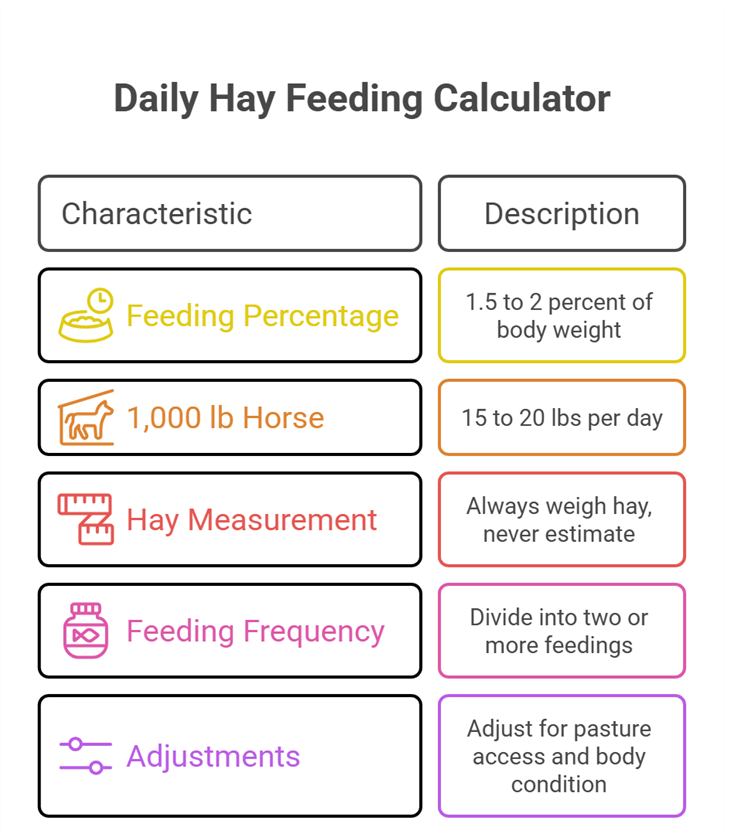
The standard recommendation from equine nutrition authorities is to feed between 1.5 and 2 percent of your horse’s body weight in forage daily. For a 1,000 pound horse, this translates to 15 to 20 pounds of hay per day. These numbers assume hay is the primary forage source; horses with significant pasture access will consume correspondingly less hay.
Here is a step by step framework for calculating and managing daily hay needs:
- Weigh your horse accurately using a livestock scale or a properly fitted weight tape to establish a reliable baseline.
- Multiply body weight by 0.015 to determine the minimum daily forage intake in pounds.
- Multiply body weight by 0.02 to determine the maximum daily forage intake in pounds.
- Adjust within this range based on body condition score, current work level, and grazing access.
- Divide the total daily hay allocation into a minimum of two feedings, or use slow feeder hay nets to allow near continuous access.
- Weigh hay at each feeding rather than estimating by eye or flake count, since bale density varies enormously between suppliers and seasons.
- Reassess and adjust the feeding program every three months or whenever your horse’s workload, health status, or body condition changes significantly.
But here is where most horse owners go wrong: they rely on visual estimates and flake counts rather than actual weights. A single flake of hay can weigh anywhere from 3 to 10 pounds or more depending on bale type, compression, and species. The only way to feed consistently and accurately is to weigh each portion.
For horses in heavy training or those with elevated energy needs beyond what forage alone can provide, concentrate feed can be added on top of an adequate forage base. Forage must always come first, and concentrates fill the remaining nutritional gap rather than substituting for adequate hay.
Tips for Storing Hay Properly
Selecting excellent hay is only half the job. Proper storage is equally important, because even the highest quality hay deteriorates rapidly under poor conditions. Moisture, mold, excessive heat, and pest activity are the four primary threats to hay quality in storage. Managing all four consistently protects your investment and your horse’s health.
Keep It Dry and Ventilated
Hay should always be stored off the ground on wooden pallets, concrete blocks, or a raised platform to prevent moisture from wicking upward from the ground into the base of the stack. A covered barn or dedicated hay shed offers the best protection. When outdoor storage is unavoidable, use a breathable hay tarp rather than solid plastic sheeting. Plastic traps moisture against the bales and dramatically accelerates mold development.
Adequate airflow is essential to long term hay quality. Stacking bales too tightly without air gaps between rows creates pockets of trapped heat and humidity that cause internal sweating and mold growth even in hay that appeared perfectly dry at purchase. Leave a few inches of space between bale stacks wherever possible to allow air movement throughout the storage area.
Avoid Mold and Spoilage
Mold is the most serious and most common quality threat in stored hay. It develops when moisture inside a bale exceeds safe thresholds, and it can begin forming within the first few weeks after baling even in hay that appeared well cured at purchase.
Never purchase hay in large quantities from a new supplier without inspecting several bales from the interior of the stack. Insert your arm or a moisture probe into the center of a bale before buying. If a freshly purchased bale feels noticeably warm several days after delivery, this signals active internal heating and you should consult your supplier before continuing to feed from that batch.
Safe Storage Practices
Keep stored hay away from heat generating equipment, electrical panels, direct sustained sunlight, and areas prone to standing water. Effective rodent and pest control in hay storage areas is also important, since contamination introduces pathogens and causes significant waste through tunneling and nesting.
Manage your hay stock on a first in, first out rotation so older inventory is always fed before fresher bales arrive. While properly stored hay can remain nutritionally adequate for up to two years, the practical goal for most owners is to feed hay within the same season it was purchased. Fresher hay provides better palatability, higher nutrient density, and lower spoilage risk.
The bottom line is this: the care you invest in storing hay is just as important as the care you invest in selecting it. Exceptional hay that molds in storage is a financial loss and a genuine health hazard for your horse.
Horse Hay FAQs
How much hay should a horse eat per day?
Most adult horses should consume between 1.5 and 2 percent of their total body weight in hay or combined forage each day. For a 1,000 pound horse, that works out to approximately 15 to 20 pounds of hay daily. This range should be adjusted based on body condition score, current workload, and whether the horse also has regular access to pasture grass. Weighing rather than estimating ensures consistent and accurate daily intake.
What is the difference between grass hay and legume hay?
Grass hay varieties such as timothy, orchard grass, and Bermuda grass are lower in protein and calories, making them appropriate for most horses at maintenance or in light work. Legume hay varieties such as alfalfa are significantly higher in protein, calcium, and caloric density, and they are best reserved for horses with elevated demands such as performance athletes, lactating mares, growing horses, and seniors. Mixed hays combine both types and offer a practical middle ground.
Should hay be tested before feeding horses?
Yes. A certified forage laboratory test is strongly recommended for all horses and is essential for horses with metabolic conditions, insulin resistance, equine Cushings disease, or other diet sensitive health concerns. A basic forage analysis reports protein, fiber fractions, moisture, non structural carbohydrate content, and major minerals, allowing you to make precise feeding decisions and identify where supplementation is genuinely needed.
What color should good hay be?
Good quality hay should display bright, consistent green color throughout the bale. This indicates proper curing, preserved leaf content, and intact nutrients including carotenoids and vitamins. Pale yellow or tan hay has been sun bleached in storage and has lost some nutritional value, though it may still be safe to feed. Gray, brown, or black patches or streaks are signs of mold and indicate hay that should not be fed to horses under any circumstances.
How should hay be stored to keep it fresh?
Store hay in a covered, well ventilated space on raised pallets that keep bales off the ground. Maintain airflow between stacks and avoid areas prone to moisture or standing water. Use breathable tarps for any outdoor storage rather than plastic sheeting. Rotate inventory on a first in, first out basis and aim to feed hay within the same season it was purchased for best freshness and nutritional value.
Is timothy hay better than alfalfa for horses?
Neither hay type is universally superior. Timothy hay is lower in calories and protein, making it appropriate and sufficient for most pleasure horses, easy keepers, and horses at maintenance. Alfalfa is nutritionally richer and better suited to horses with higher energy and protein requirements, including performance horses, breeding animals, and older horses losing body condition. For many horses, a timothy and alfalfa blend or another mixed hay offers the most practical and balanced approach overall.
What is the best hay for a horse with insulin resistance?
Horses with insulin resistance or equine metabolic syndrome should be fed hay with a non structural carbohydrate content at or below 10 to 12 percent on a dry matter basis. Mature Bermuda grass and late cut timothy hay are commonly recommended starting points. Soaking hay for 30 to 60 minutes before feeding further reduces water soluble carbohydrate content. A certified hay analysis is necessary to confirm any hay falls within a safe NSC range for your horse.
Can horses live on hay alone without any additional feed?
Many horses with moderate workloads and no special health conditions can maintain good body condition on hay alone when quality and quantity are appropriate. However, most horses benefit from a daily vitamin and mineral balancer to fill nutritional gaps, particularly for trace minerals such as zinc, copper, and selenium. Horses in heavy work, young growing horses, and lactating mares typically require energy dense concentrate feed in addition to a strong forage foundation.
Choosing the right hay for your horse is one of the most consistent and meaningful ways you can invest in their long term health and performance. By taking the time to understand hay types, evaluate quality carefully, match your forage choices to your horse’s life stage and workload, and store your hay properly, you build a nutritional foundation that supports your horse every single day. Every horse is unique, and what works for one may not be the best fit for another. For guidance tailored to your horse’s individual health history, body condition, and nutritional requirements, always consult your veterinarian or a certified equine nutritionist who can provide personalized recommendations based on direct evaluation.