Spotting the early signs of illness in horses starts with knowing what healthy looks like every single day. Your horse cannot tell you when something feels wrong, so the smallest change in appetite, energy, or manure often becomes your first and most valuable clue. This guide shows you exactly what to watch for, how to run a fast daily health check, and when a change means you should call your veterinarian right away. You will also learn the normal vital sign ranges every owner should memorize, plus the emergency symptoms that mean you cannot afford to wait even a single hour.
| KEY TAKEAWAYS Early detection turns small problems into simple, affordable fixes instead of emergencies. Appetite loss, low energy, and changed manure are the most common first warning signs. Learn your horse’s normal temperature, pulse, and respiration so you can measure real change. Colic, labored breathing, and severe lameness are emergencies that need a vet now. A two minute daily health check protects your horse better than any single treatment. |
Why Early Detection of Horse Illness Matters
Early detection matters because a horse that looks slightly off today can be seriously ill by tomorrow. Horses evolved as prey animals, so they hide weakness by instinct. That survival trait means visible symptoms often appear only after a condition has already advanced.
Your daily attention closes that gap. When you know your horse’s normal habits, you notice the first subtle shift long before a stranger would. This single advantage sits at the heart of good horsemanship.
Think of it this way. You are the person who sees your horse most, so you are also the best early warning system it will ever have. Veterinary skill matters enormously, but the vet can only act on what you notice and report.
The Importance of Regular Health Monitoring
Regular health monitoring is the daily practice of checking your horse’s body, behavior, and vital signs to catch change early. It works because illness almost always announces itself through small departures from normal before it becomes obvious, which gives you a real head start on treatment.
Consistent observation builds a mental baseline. You learn how much your horse usually eats, how it greets you at the gate, and how its manure looks in the stall. Once that baseline is clear, horse health symptoms that others miss will jump right out at you.
The American Association of Equine Practitioners recommends that owners learn routine equine health monitoring so problems surface sooner. Here is the key thing. Monitoring costs you nothing but a few minutes, yet it protects one of your largest investments.
Keep a simple written record if you can. A small notebook or a phone note tracking daily appetite, temperature, and mood turns scattered impressions into a clear pattern.
Benefits of Early Veterinary Treatment
Early veterinary treatment usually means a shorter illness, a lower bill, and a far better outcome for your horse. A minor wound caught early needs simple cleaning, while the same wound ignored for days can turn into a deep, stubborn infection.
The financial case is just as strong as the medical one. Catching colic early may cost only a farm call, whereas advanced colic can require costly surgery. Early action protects both your horse and your budget at the same time.
Early treatment also protects comfort and future soundness. A respiratory infection caught in its first days often clears with rest and simple care, while the same infection left alone can settle into the lungs and shorten an athletic career. Speed is not just cheaper. It is kinder.
Common Early Signs of Illness in Horses
The most common early signs of illness in horses are changes in eating, drinking, energy, and body condition. These four categories catch the majority of developing problems, so they deserve your closest daily attention.
None of these signs alone confirms disease. Instead, they tell you to look closer, take vital signs, and decide whether to call for help. Below are the four you should track every day without fail.
Changes in Appetite and Water Intake
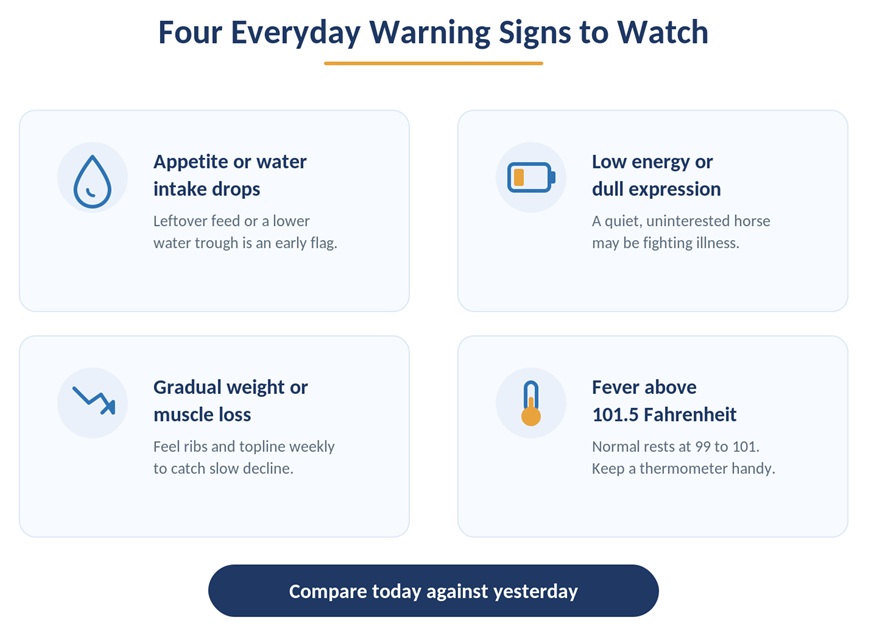
Appetite loss is one of the earliest and most reliable warning signs in horses. A horse that suddenly leaves feed, eats slowly, or drops partly chewed hay may be dealing with dental pain, fever, or the first stage of colic.
Water intake tells an equally important story. A healthy adult horse drinks roughly 5 to 10 gallons daily, and a sharp drop raises the risk of impaction colic. Reduced drinking during cold weather is especially common, so watch the trough closely in winter.
But here is where most horse owners go wrong. They notice a full hay net and assume the horse simply is not hungry, when horse appetite loss is often the very first symptom of a deeper problem.
Watch how your horse chews, not just whether it eats. Dropping balls of half chewed hay, tilting the head, or quidding often points to sharp dental edges that need floating. A horse that wants to eat but cannot chew comfortably is giving you an early, fixable clue.
Low Energy or Unusual Behavior
Low energy is a classic early flag because a bright, alert horse is almost always a healthy one. A horse that stands with a lowered head, dull expression, and little interest in its surroundings may be fighting infection or quiet pain.
Compare today with yesterday. If your normally curious horse ignores your arrival or its feed, treat that shift as meaningful. Departures from healthy horse behavior are among the clearest signs your horse is sick.
The bottom line is this. Personality change is data. A quiet horse that turns lively, or a lively horse that turns flat and withdrawn, is telling you something worth checking today.
Weight Loss or Poor Body Condition
Gradual weight loss signals a problem with nutrition, teeth, parasites, or a chronic disease. Because it happens slowly, you may miss it by eye, so run your hand along the ribs and topline each week.
Use a body condition score from 1 to 9 to track change objectively. A visible drop in muscle over the topline, or ribs that become easy to feel, warrants a closer look and often a conversation with your vet.
A monthly photo from the same angle helps enormously. Weight loss is so gradual that your eye adjusts to it day by day, but a photo taken four weeks apart reveals change your memory cannot.
Fever and Elevated Body Temperature
Fever is one of the most dependable horse illness symptoms because a raised temperature almost always points to infection or inflammation. A normal adult horse runs between 99 and 101 degrees Fahrenheit, so anything above 101.5 deserves attention.
Learn to take a rectal temperature calmly and safely. Horse fever symptoms often appear before any cough or discharge, which makes a simple thermometer one of the most powerful tools in your kit.
Take the reading when your horse is calm and rested, not straight after exercise. Heat, stress, and hard work can push the number up briefly, so a single high reading in a hot, sweaty horse differs from a true fever at rest. Repeat the reading an hour later if unsure.
Physical Symptoms You Should Never Ignore
Certain physical symptoms demand action because they point to conditions that worsen quickly. Eyes, breathing, limbs, and coat each reveal a different window into your horse’s health, and together they form a fast visual scan.
Run this scan during grooming, when your hands are already on the horse. Horse disease warning signs are easiest to catch when checking becomes a natural part of your routine rather than a separate chore you forget.
Dull Eyes and Nasal Discharge
Bright, clear eyes signal good health, while dull, sunken, or weepy eyes suggest pain, fever, or dehydration. Check that both eyes look equal, open comfortably, and stay free of cloudiness or heavy discharge.
Thin, clear fluid from the nose can be normal after exercise. Thick, yellow, or foul discharge is different. It often points to a respiratory infection and belongs on your list of horse illness symptoms to report.
Check whether discharge comes from one nostril or both. Fluid from a single nostril often suggests a localized issue such as a sinus or guttural pouch problem, while discharge from both nostrils more often points to a lower airway infection.
Coughing or Breathing Problems
An occasional cough may mean dust, but a persistent cough is a signal you should never dismiss. Frequent coughing, wheezing, or flared nostrils at rest can indicate infection, allergies, or equine asthma.
Watch the breathing rate at rest, which should sit between 8 and 16 breaths per minute. Fast, labored, or noisy breathing in a standing horse is a genuine emergency and needs immediate horse veterinary care.
Notice the effort behind each breath, not just the count. Nostrils that flare wide, a visible heave line along the belly, or a double push to exhale all signal that your horse is working hard to breathe.
Swelling or Lameness
Swelling and lameness are among the most visible horse disease warning signs. Heat, puffiness, or tenderness in a leg may reveal injury, infection, or the early stage of a joint problem, so compare left with right.
Lameness ranges from a subtle head bob to a clear refusal to bear weight. Sudden, severe lameness may signal a hoof abscess, a fracture, or laminitis, and it always deserves prompt attention.
Here is the key thing. A horse that cannot put weight on a limb is in real distress, and waiting rarely helps. Feel for the digital pulse at the back of the fetlock when a hoof seems sore, since a strong, bounding pulse can be an early sign of laminitis.
Changes in Coat Condition
A glossy, smooth coat reflects good health from the inside out. A dull, rough, or staring coat often reveals poor nutrition, parasites, or an underlying illness that has been building quietly for weeks.
Grooming is your best diagnostic moment. Horse grooming health signs such as bald patches, flaky skin, or new lumps show up under your brush long before they show up from across the paddock.
A coat that fails to shed on time can also carry a message. A long, curly coat that clings into summer is a well known sign of a hormonal condition common in older horses, so mention it to your vet.
Behavioral and Digestive Warning Signs
Behavioral and digestive changes often appear together, and both rank among the most important early warnings. A social, comfortable horse that turns withdrawn or restless is signaling clearly that something has shifted inside.
The digestive system deserves special respect in horses because colic remains a leading cause of equine death. Reading manure, appetite, and behavior together gives you a powerful, practical picture of gut health.
Isolation from Other Horses
Horses are herd animals, so a horse that separates itself from the group is often unwell. Standing apart, facing a corner, or ignoring companions can reveal pain, fever, or emotional distress.
Watch the herd dynamic each day. A horse that suddenly drops to the bottom of the group, or removes itself entirely, is showing a change worth investigating right away.
Isolation paired with any physical symptom raises the concern level sharply. A horse standing alone with a lowered head and no interest in feed needs a closer look. On its own, withdrawal is a yellow flag, but combined with dullness it moves toward red.
Aggression or Irritability
A gentle horse that becomes irritable may be reacting to pain rather than temperament. Pinned ears, biting at the flank, or resistance to the girth can all point to real discomfort in the body.
Think of it this way. New crankiness is rarely bad manners. More often it is your horse’s way of telling you that something hurts and needs your attention.
Note when the behavior appears. Irritability only during saddling may point to back or ulcer pain, while general grumpiness may reflect a wider illness.
Excessive Lying Down
Healthy horses lie down to rest, but frequent lying down, getting up and down repeatedly, or rolling can signal abdominal pain. This restless pattern is a classic early sign of colic and needs quick assessment.
Note how your horse rises and settles. A horse that groans, paws, or looks at its side while lying down is giving you clear digestive warning signs you should not ignore.
Distinguish normal rest from distress. A relaxed horse dozing flat in the sun looks calm and breathes slowly, while a colicky horse looks tense, gets up and down often, and cannot seem to settle in any position.
Reduced Performance During Work
A drop in willingness or stamina under saddle often appears before any physical symptom. A horse that resists, tires early, or feels flat may be masking pain, respiratory trouble, or fatigue from a brewing illness.
Trust your seat. You feel changes in rhythm and effort that no one on the ground can see, so treat a sudden performance dip as useful health data rather than stubbornness.
A horse that suddenly refuses jumps, breaks gait, or sweats far more than usual for light work is worth checking carefully. These shifts often trace back to a physical cause that rest and observation will help reveal.
Colic Symptoms
Colic is abdominal pain in horses that ranges from mild and passing to life threatening. It matters because the gut can deteriorate fast, so recognizing the signs early can be the difference between a farm call and surgery.
Classic colic symptoms include pawing, rolling, sweating, looking at the belly, and refusing feed. If you see these signs, stay calm, remove food, and call your veterinarian without delay.
While you wait for your vet, note the time symptoms started and how often your horse tries to roll. Walking a colicky horse can help if it wants to throw itself down, but never exhaust an already weak animal. Early veterinary contact greatly improves colic outcomes.
Diarrhea, Constipation, and Manure Changes
Manure is a daily report card on gut health. Loose diarrhea, very dry droppings, or a clear drop in output all point to a digestive disturbance that deserves your attention.
Reduced manure output is especially concerning because it can signal an impaction forming inside the gut. Count roughly how many piles your horse produces so you notice a real decline quickly.
Color and smell matter too. Very dark, hard, mucus coated droppings suggest slow gut movement and dehydration, while a sudden foul smell can point to infection. A healthy adult horse usually passes manure eight to twelve times a day.
Daily Horse Health Check Checklist
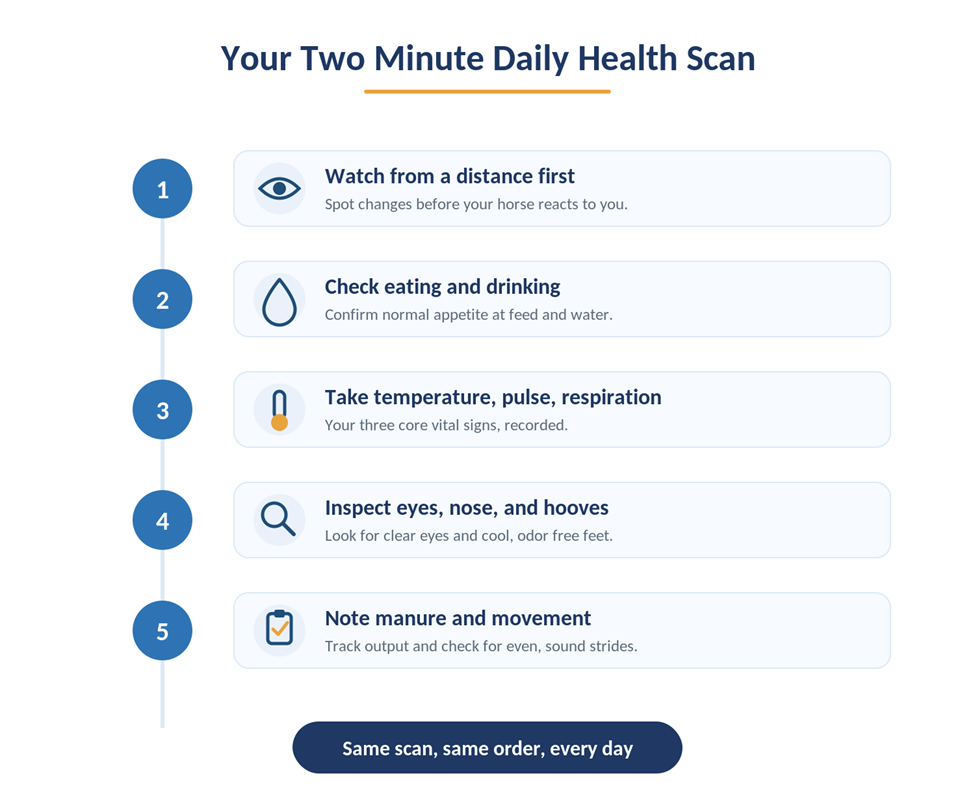
A daily horse health check takes about two minutes and catches most problems early. By repeating the same simple scan each day, you build the baseline that makes every future change obvious.
Follow the same order every time so nothing gets skipped. This horse health checklist turns vague worry into a clear, repeatable routine you can run before or after feeding.
Run through these steps in order each day:
- Watch your horse from a distance before you approach.
- Check that eating and drinking look normal at the trough and manger.
- Take temperature, pulse, and respiration if anything seems off.
- Inspect eyes, nose, and both nostrils for a clear appearance.
- Pick out and inspect all four hooves for heat or odor.
- Watch your horse walk to check for even, sound movement.
- Note manure quantity and consistency in the stall or paddock.
Check Temperature, Pulse, and Respiration (TPR)
Temperature, pulse, and respiration are your three core vital signs, and together they form the foundation of any horse health check. Knowing your horse’s normal numbers lets you measure real change instead of guessing under pressure.
Take a rectal temperature, feel the pulse under the jaw or behind the elbow, and count breaths by watching the flank. Record the numbers so you can share exact figures during any equine health care call.
The Rutgers Equine Science Center advises owners to learn their horse’s resting values while it is healthy, since normal varies slightly between individuals. A pulse of 40 beats per minute might be normal for one horse and high for another. Your own baseline gives each number meaning.
Observe Eating and Drinking Habits
Watch how your horse approaches feed and water each day. A horse that eats eagerly and drinks steadily is usually well, while hesitation or refusal signals that a closer look is needed.
Keep rough track of water use, since a sharp drop raises colic risk. These simple habits sit at the heart of practical horse wellness tips that any owner can follow without special equipment.
Notice small refusals too. A horse that eats hay but ignores grain, or drinks less from a fresh bucket, may be telling you about mouth pain or early nausea before any dramatic sign appears.
Inspect Eyes, Nose, and Hooves
Look for bright eyes, clear nostrils, and cool, odor free hooves. Heat in a hoof or a strong smell can reveal an abscess or thrush before lameness even appears.
Handle each foot daily. This habit alone prevents many common health problems in horses by catching small hoof issues while they are still easy and cheap to treat.
Run a quick hand over the legs as you work. Fresh heat, filling, or a flinch when you press tells you where to focus long before your horse takes a lame step in front of you.
Monitor Movement and Posture
Watch how your horse stands and moves. A relaxed, balanced posture and even strides suggest comfort, while a hunched back, a pointed toe, or shifting weight suggests pain.
Posture speaks volumes. A horse that stands stretched out or refuses to move normally is showing you a change that belongs on your daily record.
Watch for a horse that rocks its weight back onto its heels, a classic laminitis stance, or one that keeps shifting from foot to foot. These postures are the body trying to relieve pain, and reading them early protects your horse.
When to Call a Veterinarian
Call your veterinarian whenever a symptom is severe, sudden, or simply outside your horse’s normal range. When you are unsure, a quick phone call is always the safer choice, and most vets welcome early questions.
The table below helps you sort routine concerns from true emergencies. Use it as a fast reference, but remember that your instinct about your own horse carries real weight in the decision.
| Situation | Likely Response | Urgency |
| Mild, brief appetite dip, otherwise normal | Monitor closely for 12 to 24 hours | Routine watch |
| Temperature above 101.5 degrees Fahrenheit | Call your vet for advice | Same day |
| Persistent cough or thick nasal discharge | Schedule a veterinary visit | Within a day |
| Signs of colic such as rolling or pawing | Call your vet immediately | Emergency |
| Severe lameness or non weight bearing limb | Call your vet immediately | Emergency |
| Laboured breathing while standing at rest | Call your vet immediately | Emergency |
Emergency Symptoms That Need Immediate Care
Some symptoms mean you should call before doing anything else. Severe colic, heavy bleeding, a non weight bearing limb, labored breathing, or a sudden collapse all count as genuine emergencies.
Do not wait to see if these signs pass. In these situations, minutes matter, and prompt horse veterinary care gives your horse its best chance of a full recovery.
Keep your vet’s number and an out of hours line saved where anyone at the barn can find them. Having the number ready and a trailer available can save time you cannot spare.
What Information to Share with Your Vet
Give your vet clear, specific information so they can help fast. Report the temperature, pulse, and respiration, when the problem started, and any change in eating, drinking, or manure.
Describe the behavior you see in plain words. Precise details from your horse health check let your vet prioritize the case correctly and arrive prepared to treat your horse.
Mention any recent changes as well. New feed, a new pasture mate, recent travel, or a missed vaccine can all shape the diagnosis, so share these facts even if they seem minor at first.
Tips to Prevent Illness in Horses
Preventing horse diseases is far easier and cheaper than treating them. A steady routine of good feeding, vaccination, clean housing, and daily attention keeps most common problems away before they ever start.
Prevention is not complicated. These four pillars form the backbone of horse illness prevention and give your horse the best possible foundation for a long, healthy life.
Balanced Nutrition
Good nutrition begins with clean, quality forage and constant access to fresh water. Most of a horse’s diet should come from hay or pasture, with grain and supplements added only to meet a real, measured need.
Sudden feed changes upset the gut, so introduce new feed gradually over one to two weeks. The Merck Veterinary Manual notes that consistent feeding supports stable digestion and lowers colic risk.
Match the ration to the workload in front of you. An idle horse on rich grain can gain dangerous weight, while a hard working horse on poor forage will fade. Weigh feed rather than guessing by the scoop, and let quality hay remain the foundation of every diet.
Vaccination and Deworming
Vaccination and strategic deworming protect your horse from serious, preventable diseases. Core vaccines guard against threats such as tetanus, rabies, and mosquito borne viruses that circulate in many regions each year.
Work with your vet on a schedule suited to your area and your horse. Fecal egg count testing now guides deworming, replacing blanket dosing and helping to preserve the medicines that still work.
The American Veterinary Medical Association supports this targeted approach because it slows the spread of dewormer resistance. Test first, treat the horses that need it, and record what you use. This measured strategy protects your horse and the wider equine community.
Clean Stable Management
A clean, well ventilated stable reduces exposure to bacteria, mold, and ammonia that harm the lungs. Muck out daily, keep bedding dry, and store feed where pests and damp cannot reach it.
Fresh air matters as much as cleanliness. Good airflow lowers the risk of respiratory disease and supports overall equine health monitoring by keeping your horse breathing comfortably.
Keep water sources spotless too. A scrubbed trough encourages steady drinking and lowers the chance of gut upset, while shared equipment cleaned between horses helps stop infection passing quietly through a busy yard.
Regular Exercise and Grooming
Regular exercise keeps the gut moving, supports healthy weight, and builds the fitness that helps a horse resist illness. Even light daily turnout provides real benefit for both body and mind.
Grooming does double duty. It keeps the coat healthy while giving you a hands on chance to spot early signs of sick horse conditions such as lumps, heat, or tenderness.
Turnout supports mental health as much as physical fitness. A horse with room to move, graze, and socialize tends to eat better, sleep better, and show fewer stress behaviors.
Horse Illness FAQs
What are the first signs that a horse is getting sick?
The first signs are usually subtle changes in appetite, energy, or manure. A horse that leaves feed, stands dull and quiet, or produces less manure than usual is often showing you the earliest stage of illness. Learning how to tell if a horse is ill starts with knowing these small daily shifts and acting on them before they grow.
What are the most common health problems in horses?
The most common health problems in horses include colic, lameness, respiratory infections, dental issues, and skin conditions. Colic is the one most likely to become an emergency, which is why any sign of abdominal pain deserves quick attention and a call to your vet. Knowing these common horse diseases helps you react faster when something looks wrong.
When should I call a veterinarian for my horse?
Call your veterinarian for any severe, sudden, or unusual symptom. Signs of colic, labored breathing, heavy bleeding, or a limb that cannot bear weight are always emergencies. When you feel unsure whether a symptom is serious, a quick phone call is the safest choice you can make, and most vets would much rather hear from you early than late.
How often should I perform a horse health check?
Perform a basic horse health check every single day. A short two minute scan of appetite, behavior, eyes, hooves, and manure catches most problems early. Taking full temperature, pulse, and respiration readings weekly, or whenever something seems off, keeps your baseline current and reliable so you can spot real change the moment it appears.
Can behavioral changes indicate illness in horses?
Yes, behavioral changes are often among the earliest signs your horse is sick. A social horse that isolates itself, a calm horse that turns irritable, or a willing horse that suddenly resists work may all be reacting to pain or illness rather than mood. Treat any clear shift in healthy horse behavior as a signal worth investigating without delay.
How can I prevent common horse diseases?
You can prevent many common horse diseases through balanced nutrition, timely vaccination, strategic deworming, clean housing, and daily observation. Together these habits form a simple equine health care guide that keeps most illness away and helps you catch anything new while it is still easy to treat.
How do I know if my horse has a fever at home?
You know your horse has a fever by taking a rectal temperature with a digital thermometer. A normal adult horse reads between 99 and 101 degrees Fahrenheit, so a reading above 101.5 usually means fever. Because horse fever symptoms often appear before a cough or discharge, a thermometer is one of the most valuable tools any owner can keep in a first aid kit.
What should be included in a daily horse health checklist?
A complete daily horse health checklist should include appetite, water intake, energy and behavior, eyes and nostrils, hoof condition, movement, and manure output. Running the same simple scan each day builds the baseline that makes early signs of illness in horses far easier to spot. Write down anything unusual so you can track a pattern over several days.
Spotting the early signs of illness in horses is a skill you build one calm, consistent day at a time. The owner who watches closely, knows their horse’s normal, and runs a quick daily check becomes the most powerful protector of that horse’s health. Trust what you see, keep good records, and act early rather than waiting for a small change to grow into a crisis. When any symptom looks severe, sudden, or simply unlike your horse, please consult your veterinarian or a certified equine health professional for advice tailored to your horse’s individual needs.