The Belgian Draft Horse price varies widely with training, health, age and intended use. US listings checked in November 2026 included asking prices from $2,000 to $25,000 for individual Belgian geldings; this small sample is not a market average or a record of completed sales. This guide separates purchase prices from the monthly expenses and first-year budget you need to plan.
The purchase price is only one part of ownership. A large Belgian can require more forage, larger equipment and specialist hoof care than a smaller riding horse. For a broader introduction, see our Belgian Draft Horse breed, temperament and care guide. All figures below are in US dollars. Unless a listing or provider is identified, cost ranges are illustrative planning allowances, not surveyed national averages or quotations.
Key Takeaways
- Compare current asking prices for horses with similar training, health and intended use; a low price does not establish good value.
- Age, training, soundness, registration and location shape the Belgian Draft Horse price more than color or size.
- Build feed costs from your horse’s weight, forage analysis, pasture access and individual needs, rather than a fixed amount for every Belgian.
- The independent first-year examples below total $9,100 to $40,600, including purchase, setup and a cash reserve. Actual costs can fall outside these examples.
- An independent prepurchase examination and appropriate testing help identify risks, but cannot guarantee future soundness.
How Much Does a Belgian Draft Horse Cost?
There is no single reliable price for a Belgian. Trained riding and driving horses, young prospects, companions and elite show horses serve different buyers. Compare like-for-like horses and distinguish a seller’s asking price from the amount eventually paid.
On DreamHorse’s Belgian gelding listings, checked November 13, 2026, Tomahawk Bob in Colorado was advertised at $2,000, MA Nash in New Hampshire at $13,000, and Duke in Iowa at $25,000. Availability and prices can change. These examples show why a $15,000 budget is not a ceiling for a trained Belgian. The category allowances below are starting points for planning, not measured market ranges.
| Horse category | Illustrative budget allowance | What to assess |
|---|---|---|
| Weanling or yearling foal | $1,000 to $4,000 | Unstarted horse with years of training ahead |
| Green broke young horse (3 to 5 years) | $3,000 to $7,000 | Basic handling, limited driving or riding experience |
| Trained driving or riding gelding (5 to 14 years) | $5,000 to $15,000 | Verify experience, suitability and veterinary findings |
| Matched working team (pair) | $10,000 to $30,000 | Two horses trained to work together in harness |
| Elite show or breeding stock | $20,000 to $100,000+ | Top bloodlines, show records, proven offspring |
| Senior or companion horse | $500 to $3,000 | Light duty, retired or pasture companion |
Regional supply, individual suitability and seller expectations affect the final price. Obtain current comparisons before making an offer; unusually expensive show horses should not determine an ordinary owner’s budget.
Belgian Draft Horse Price by Sex and Intended Use
Geldings are a common choice for working and pleasure homes. A gelding is a castrated male, but sex alone does not establish temperament or safety. Mares may suit the same roles, while breeding history and pedigree can influence a breeder’s valuation.
Stallions sit at the extremes. An ordinary stallion can be hard to sell because few owners can safely manage one, while a proven breeding stallion with champion offspring can sell for tens of thousands of dollars. Intended use matters just as much: a horse trained to pull a forecart or show hitch wagon is priced differently from a quiet trail mount.
What Affects a Belgian Draft Horse's Price?
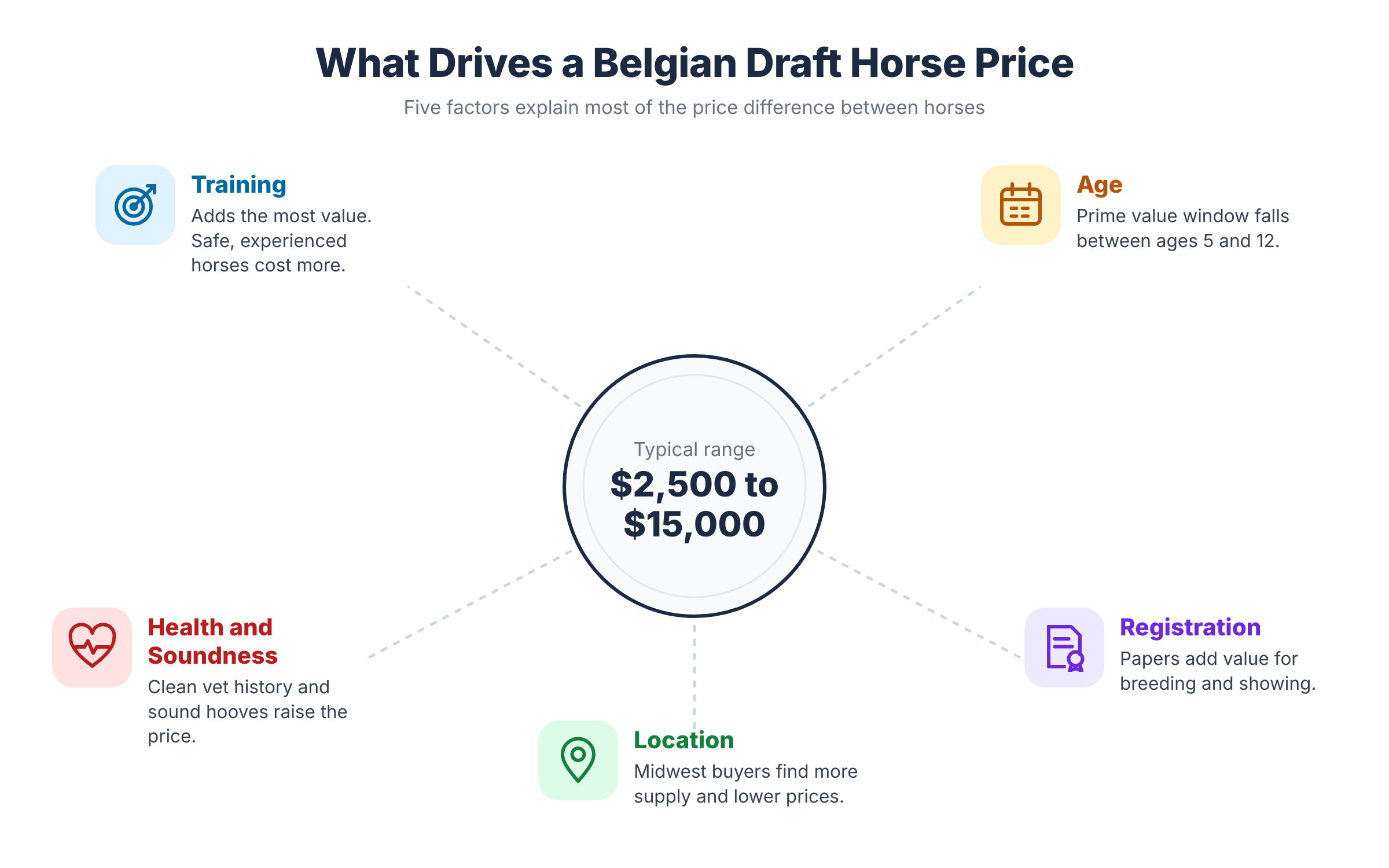
Five factors explain most of the variation in a Belgian horse price: age, training, health, pedigree and location. Understanding each one helps you judge whether an asking price is fair before you start negotiating.
Age and Level of Training
Documented training and demonstrated suitability can add value. Watch the horse perform the work you expect to do. Age matters alongside its workload, veterinary findings and experience; there is no universal most valuable age band.
A young horse may have a lower purchase price but require years of care and professional training before it is ready for your intended work. Obtain a trainer’s quote before treating an unstarted horse as the cheaper option.
An older horse may suit a lighter workload well, but its health and likely care needs deserve close attention. The Belgian Draft Horse Corporation of America describes the breed’s lifespan as about 20 years; individual working lives and longevity vary.
Health, Soundness and Veterinary History
Soundness means the horse moves without pain or lameness and can do the job you intend. A sound horse with clean records commands a higher price, and it should. Lameness, chronic hoof problems or a history of colic all lower value and raise your future costs.
Ask your veterinarian about muscle and movement disorders relevant to draft horses. Type 1 polysaccharide storage myopathy (PSSM1) is associated with an inherited genetic variant. Shivers is a separate movement disorder that can make backing and hind-limb handling difficult.
Discuss the horse’s history, movement and any indicated tests with an independent veterinarian. A negative PSSM1 test does not rule out every cause of muscle disease or establish that a horse is suitable for work.
Registration, Pedigree and Proven Performance
Registration documents pedigree and can matter to breeding and showing buyers. It may influence price, but papers do not guarantee soundness, training, resale value or eligibility for every competition. Verify the actual registration and relevant show rules.
Pedigree matters most to breeders and exhibitors. Horses descended from champion lines, or with show wins of their own, can sell for many times the price of a sound grade horse. If you want a dependable horse for farm work or trail driving, an unregistered Belgian horse can deliver excellent value.
Prioritize the qualities needed for your intended use. Pedigree alone is not a substitute for a horse you can handle and whose veterinary assessment supports that use.
Location and Local Availability
Local availability changes both the selection of horses and the cost of comparing them. Search regional listings and draft-horse networks, then compare horses with equivalent training and health histories.
Include travel and delivery when comparing distant sellers. For example, a $6,000 horse plus a $2,000 haul costs $8,000 before examinations and equipment; those amounts illustrate the calculation rather than a regional price rule.
Color, Size and Appearance
Color and size matter less than most buyers expect. American Belgians are typically sorrel or chestnut with a flaxen mane and tail, and a matching color helps when breeders assemble show hitches. A well matched pair or six horse hitch can therefore sell above the value of each horse alone.
For a single working or pleasure horse, extra height adds little value. Very tall horses can even cost more to keep, since they need bigger stalls, trailers and harness. Focus on horse age and soundness first, then training, and treat appearance as a tiebreaker.
Where to Buy a Belgian Draft Horse
Breeders, private sellers, auctions and rescues offer different buying processes. Verify records and written terms in every case.
Belgian Horse Breeders
A breeder who has raised a horse may be able to provide detailed training, pedigree and health records. Ask to see those records and clarify all sale terms rather than assuming that the source provides a guarantee.
Expect to pay a full market Belgian Draft Horse purchase price from a breeder. You can find reputable breeders through the Belgian Draft Horse Corporation of America, state draft horse associations and regional draft horse shows.
Private Horse Sellers
Private horse sellers, often found through online listings and local farm networks, can offer fair prices on trained geldings. Some sellers are retiring farmers or families downsizing a team, and they may price a horse below market to find it a good home.
Verify age, health records, training claims and ownership before agreeing to a private sale. Arrange your own veterinary assessment and written terms.
Draft Horse Auctions
Draft horse auctions, such as the Mid America Draft Horse Sale in Illinois and the Topeka sale in Indiana, give you access to many horses at once.
Auction prices depend on the horses offered and the bidders present. Check sale conditions, inspection opportunities, fees and payment requirements before bidding.
Now for the important part: auctions reward experienced buyers. The pace is fast, vet checks are limited and returns are rare. If you are new to draft horses, bring a knowledgeable friend or trainer, inspect horses before the sale starts and set a firm spending limit.
Rescues and Adoption Programs
Adoption can reduce the acquisition fee, but suitability, care needs and the rescue’s contract matter more than the headline cost. Ask about rehabilitation needs and any restrictions on use or rehoming.
Additional Costs before Bringing Your Belgian Home
Set aside money for examinations, delivery, equipment and any facility work before agreeing on a purchase. The first-year worksheet below separates these costs so you can replace each allowance with a local quote.
Prepurchase Examination and Relevant Health Tests
A prepurchase examination assesses health and suitability for the buyer’s intended use at the time of examination. Ask the veterinarian to quote the basic examination, travel and any additional imaging or tests separately; the scope determines the cost.
The UC Davis Veterinary Genetics Laboratory lists the Belgian JEB test at $48 when checked for this article. JEB causes severe disease in affected foals. Discuss breeding risks and appropriate PSSM1 testing with your veterinarian. For registry purposes, follow the Corporation’s DNA and JEB testing process; registry fees and requirements can differ from a direct laboratory test.
An inexpensive horse still deserves an independent examination. Testing reduces uncertainty; it does not guarantee that future illness or lameness will not occur.
Registration Transfer and Paperwork
If you buy a registered horse, the registration must be transferred into your name. The Belgian Draft Horse Corporation of America publishes a current fee schedule on its website, and transfer fees are modest compared with the purchase price. Ask the seller to sign the transfer paperwork at the time of sale.
Before arranging transport, ask your veterinarian and the destination animal-health authority which tests and health documents apply to that specific journey. Include examination, laboratory and document fees in your transport budget.
Horse Transport and Delivery
Ask experienced horse haulers for written quotes covering the horse’s size, route, shared or dedicated transport, stops and any additional charges. The $150 to $2,000 amounts in the example budget are allowances, not a per-mile market rate; actual delivery can cost more.
Confirm usable trailer dimensions, load capacity and safe access for your individual horse. Tell the hauler the horse’s measured height, estimated weight and loading experience before booking.
Initial Equipment and Facility Setup
Measure before buying draft-size tack, collars, harness and blankets. Prices vary with fit, materials, condition and intended use. The example budget allows $1,000 to $4,000 for equipment; obtain quotations for what you actually need.
Check shelter, stall space, fencing, gates, footing and hay storage before arrival. The $500 to $5,000 facility allowance assumes that usable land and basic infrastructure already exist. It does not cover buying land, constructing a new barn or purchasing a truck and trailer.
How Much Does a Belgian Draft Horse Cost per Month?
The monthly worksheet below adds up to $375 to $1,210 for home care or $755 to $2,130 for boarding when hay and bedding are included in board. These are illustrative allowances, including reserve contributions. They exclude land costs, owner labor, major repairs, training and emergencies beyond the reserve.
| Monthly Expense | Kept at Home | Boarded |
|---|---|---|
| Hay and minerals | $180 to $460 | Often included in board |
| Bedding | $40 to $120 | Often included in board |
| Board fee | None | $600 to $1,500 |
| Farrier (averaged monthly) | $40 to $300 | $40 to $300 |
| Routine vet and dental (averaged) | $40 to $100 | $40 to $100 |
| Insurance and emergency reserve | $75 to $230 | $75 to $230 |
| Total monthly allowance | $375 to $1,210 | $755 to $2,130 |
Hay, Feed and Bedding
Forage needs depend on body weight, body condition, workload and health. Merck Veterinary Manual discusses forage intake on a dry-matter basis. For example, 2% of a 2,000-pound horse’s weight is 40 pounds of dry matter; at 90% dry matter that equals about 44.4 pounds of hay as fed, before waste and any pasture contribution. This is a budgeting illustration, not a ration prescription.
Calculate hay cost as pounds actually fed per day × price per pound × days in the month. At an assumed 40 pounds daily and $0.15 per pound, a 30-day supply costs $180 before waste, delivery or supplements. Replace both assumptions with your own figures. Our guide to choosing horse hay explains forage selection.
Provide continuous access to clean water and include trough cleaning, winter water access and utility costs in your own budget.
Do not add grain or fat simply because the horse is a draft breed. Have a veterinarian or qualified equine nutritionist balance the ration, particularly for a horse with a diagnosed muscle or metabolic condition.
Boarding or Keeping Your Horse at Home
Keeping your Belgian at home is usually cheaper, but you supply the land, labor and facilities. Boarding saves time and gives your horse daily supervision, yet many barns charge a surcharge for draft horses because they eat more and need larger stalls.
This worksheet uses a $600 to $1,500 monthly board allowance. Request a quote for a draft horse and ask exactly what it covers: forage quantity, bedding, turnout, handling for appointments and any extra services. Avoid counting included feed and bedding twice.
Farrier and Routine Veterinary Care
Obtain a quote from a farrier who accepts draft horses. Specify whether the horse needs trimming, shoes or corrective work, and whether it stands quietly for handling. Travel, specialist work and handling requirements can change the bill.
Use your farrier’s recommended interval to calculate annual costs. For example, $100 per visit every eight weeks is about $650 a year, or $54 a month on average. The worksheet’s $40 to $300 monthly allowance is a planning range; some care plans will exceed it.
Ask your veterinarian for an annual preventive-care plan covering examinations, vaccinations, dental assessment and parasite management as appropriate. The worksheet allows $40 to $100 monthly; this excludes emergency treatment.
Insurance and an Emergency Reserve
Compare equine insurance quotations, deductibles, limits and exclusions. Mortality and major-medical policies cover different events, and payment is subject to the policy terms. Age, health, use and insured value can affect availability and premiums.
If you plan road driving or public wagon rides, discuss the activity with an equine insurance specialist and check the relevant liability coverage and exclusions.
The worksheet sets aside $50 to $150 monthly toward an emergency fund within the combined insurance-and-reserve allowance. Reserve contributions are cash saved, not necessarily money spent. A serious emergency may cost much more, especially before the fund has accumulated.
Belgian Draft Horse First Year Cost Breakdown
The first-year worksheet below presents two independent home-care examples totaling $9,100 and $40,600. Its annual feed and service assumptions are separate from the wider monthly worksheet, so these totals are not the monthly range multiplied by twelve. They include purchase, basic setup and a cash reserve, but exclude land, owner labor, a new barn, truck or trailer and major emergencies.
| Expense | Low Estimate | High Estimate |
|---|---|---|
| Purchase price | $3,000 | $15,000 |
| Prepurchase exam and genetic tests | $350 | $1,200 |
| Transport | $150 | $2,000 |
| Harness, tack and draft size equipment | $1,000 | $4,000 |
| Facility upgrades | $500 | $5,000 |
| Hay, minerals and bedding (12 months) | $2,200 | $5,800 |
| Farrier care (12 months) | $500 | $3,600 |
| Routine veterinary and dental care | $500 | $1,200 |
| Insurance | $300 | $1,000 |
| Emergency reserve | $600 | $1,800 |
| Total first year estimate | $9,100 | $40,600 |
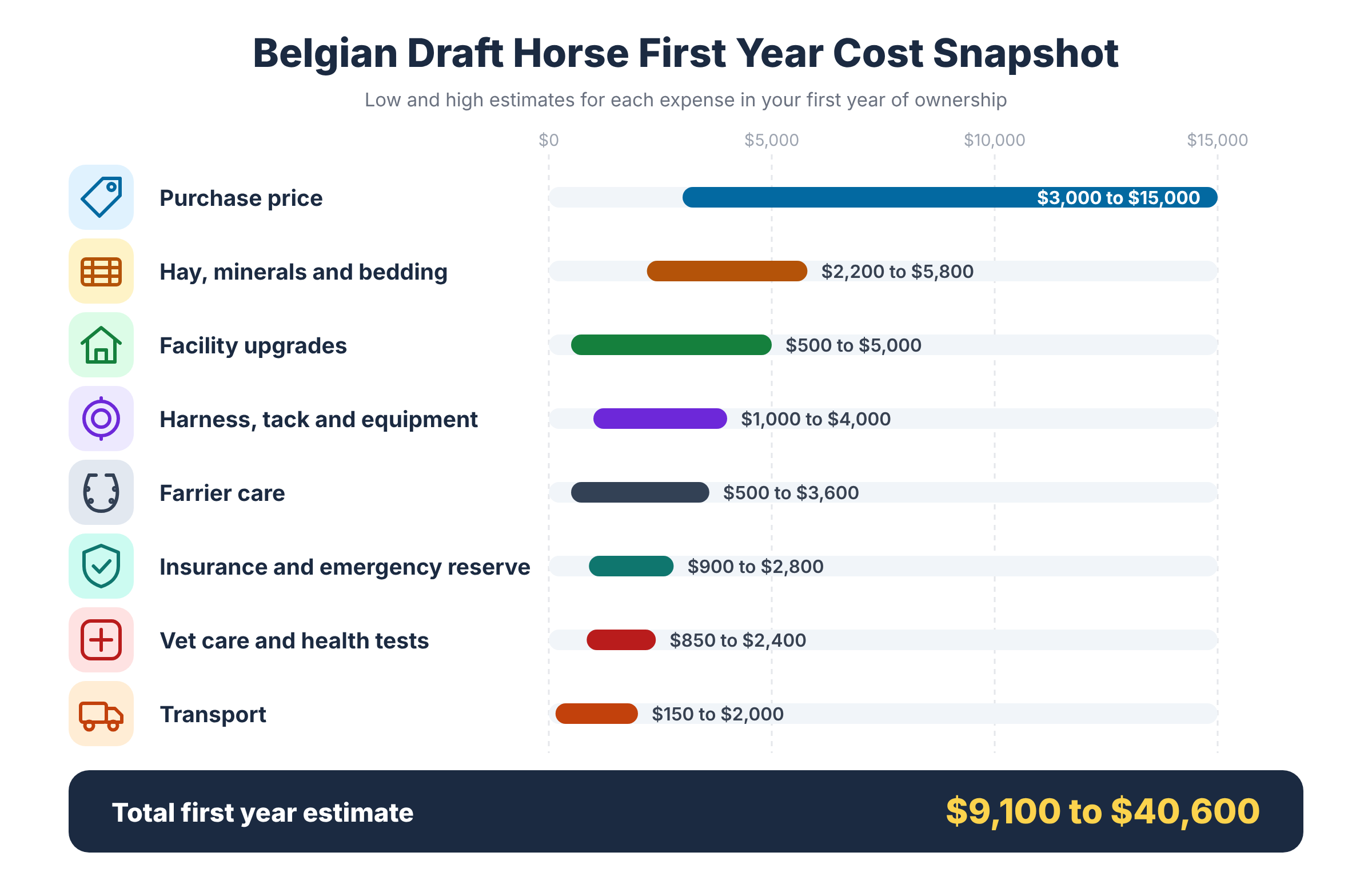
For boarding, replace the home-feed, bedding and facility assumptions with your boarding agreement’s actual charges. Do not add a full boarding bill while retaining feed and bedding already included in board. The examples are neither a minimum nor a maximum ownership cost.
Once purchase and setup are paid, the monthly home-care worksheet annualizes to $4,500 to $14,520, including reserve contributions. Review the budget whenever forage prices, workload or health needs change.
Does a Belgian Draft Horse Cost More to Keep Than a Regular Riding Horse?
A Belgian can cost more to keep because of its size, forage needs, equipment fit and hoof care. There is no single percentage difference that applies to all owners. Compare actual quotes for the individual horses and facilities involved.
| Cost Factor | Belgian Draft Horse | Typical Riding Horse |
|---|---|---|
| Body weight | 1,800 to 2,400 pounds | 1,000 to 1,200 pounds |
| Forage budget | Calculate from individual weight, ration and waste | Calculate from individual weight, ration and waste |
| Farrier cost per visit | Higher, draft rates often apply | Standard rates |
| Tack and harness | Larger, often custom fitted | Widely available sizes |
| Stall space | Check fit and comfortable movement for this horse | Check fit and comfortable movement for this horse |
| Trailer needs | Check dimensions, access and rated load capacity | Check dimensions, access and rated load capacity |
The breed registry describes Belgians as commonly weighing 1,800 to 2,400 pounds and standing 16 to 18 hands. Use the individual horse’s measurements rather than breed averages when arranging transport or feeding. See our guide to horse weight and measurement.
Consider likely years of suitable use alongside present care needs. A younger horse may need training; an older horse may be experienced but require a different workload. Age alone cannot predict value or future veterinary costs.
What to Check Before Paying for a Belgian Draft Horse
Verify health, temperament, training and paperwork before you hand over money. A careful checklist protects your budget far more than a lower asking price. Use these steps for every horse you consider.
- Book an independent prepurchase examination with a veterinarian you choose, not the seller's vet.
- Watch the horse being caught, groomed, harnessed and driven or ridden, then handle the horse yourself.
- Check all four hooves for cracks, flares and signs of past founder or chronic soreness.
- Ask whether the horse has ever shown muscle stiffness, trembling or trouble backing, which may point to PSSM or shivers.
- Review registration papers and confirm the name, markings and transfer details match the horse.
- Request vaccination, deworming, dental and farrier records for at least the past year.
- Get the sale terms in writing, including price, payment, delivery date and any trial period.
Here is the key thing: a reputable seller welcomes these checks. If a seller rushes you, refuses a vet exam or cannot show records, walk away. Another Belgian will come along.
How to Reduce Ownership Costs Without Cutting Essential Care
You can lower costs by buying smarter, feeding more efficiently and sharing services. The goal is to cut waste, not care, so your horse stays healthy while your budget stays manageable.
Small savings add up quickly with a horse this size. Cutting hay waste by even a modest amount, or splitting a farrier's travel fee with two neighbors, can save you hundreds of dollars each year.
Buy the Right Horse the First Time
A low purchase price can be offset by veterinary, training or equipment expenses. Choose a horse whose demonstrated skills and veterinary assessment match your plans, and price any additional support before committing.
Match the horse to your real needs. If you plan light trail driving, you do not need a show hitch pedigree or a horse at the peak of the Belgian Draft Horse price range.
Feed Smarter
Hay waste is a hidden expense. Slow feed hay nets and covered feeders can noticeably cut waste compared with feeding on the ground. Test your hay for nutrient content, then feed to your horse's body condition score, a 1 to 9 scale that rates fat cover.
Calculate daily feed cost before making changes. Base reductions on lower waste and an appropriate ration, not on withholding necessary forage.
Compare seasonal hay quotes and buy only what you can store safely. Good pasture management may reduce purchased forage during suitable growing conditions.
Share and Prevent
Where providers permit it, coordinate appointments with neighbors to share travel fees. Follow individualized veterinary and farrier plans; preventive care helps manage risk but cannot prevent every illness or injury.
Put simply: never cut corners on hoof care, dental care, clean water or forage quality. These are the essentials that protect your horse and your wallet over the long term.
Is a Belgian Draft Horse Within Your Budget?
A Belgian fits your budget when you can cover its acquisition, suitable facilities, recurring care and unexpected costs without relying on the lowest figures in a generic worksheet. Replace the examples here with current local quotes before deciding.
Can you meet the recurring cost throughout winter as well as summer? Are appropriate facilities and transport available? Will a local veterinarian and farrier accept the horse? Include those answers in your budget.
If you answered yes to all three, a Belgian can be a rewarding and reliable partner for years. If not, a lease is a sensible next step.
Leasing as a Trial Run
A lease lets you use a horse without buying it. In a part lease, you share the horse and its costs with the owner, often paying a monthly fee and covering some farrier or feed bills. A full lease gives you sole use of the horse while the owner keeps legal ownership.
A clearly documented lease can help you understand care responsibilities before buying. Agree in writing who pays for routine care, insurance, emergencies and transport, and what use is permitted.
Frequently Asked Questions
How Much Does a Trained Belgian Draft Horse Cost?
There is no verified national average in this guide. Current Belgian gelding asking prices checked for this article included $2,000, $13,000 and $25,000. Training claims must be assessed individually; compare horses doing the same work and arrange a veterinary examination.
How Much Does a Belgian Draft Foal Cost?
The category worksheet uses $1,000 to $4,000 as an illustrative starting allowance for an unstarted youngster, not a verified market average. Actual breeder and seller quotes may be higher. Include years of care and training before the horse can perform your intended work.
How Much Does It Cost to Feed a Belgian Draft Horse?
The monthly example allocates $180 to $460 for hay and minerals. This is a planning allowance, not a guaranteed feeding cost. Weigh the forage fed, calculate its delivered cost per pound, account for pasture and waste, and have the ration balanced for your horse.
Is It Cheaper to Keep a Belgian Draft Horse at Home or Board It?
Home care may have lower direct monthly bills, but it also requires land, facilities, maintenance and daily labor. The illustrative totals here are $375 to $1,210 at home and $755 to $2,130 boarded, assuming board includes hay and bedding. Compare equivalent services and use local quotes.
Does Registration Make a Belgian Draft Horse More Expensive?
Registration can affect value for breeding or showing buyers, but it does not guarantee a higher price. Verify pedigree, transfer paperwork and eligibility for your intended activities; assess health and training separately.
Is Adopting a Belgian Draft Horse Cheaper Than Buying One?
An adoption fee may be below a purchase price, but fees and conditions vary by rescue. Ask for current terms and a veterinary care plan. Ongoing feed, hoof care and facilities still cost money, and rehabilitation can increase the initial budget.
The true Belgian Draft Horse cost includes much more than the seller’s price. Compare suitable horses, obtain local care and transport quotes, and build a reserve before committing.
Plan for the full first year, buy with care and choose a horse that matches your goals. A well chosen Belgian rewards you with calm strength, steady work and years of companionship. Before you buy or change your horse's diet, consult your veterinarian or a certified equine nutritionist for advice tailored to your horse's individual needs.