Adult Belgian draft horses typically stand 16–18 hands at the withers and weigh 1,800–2,400 pounds, according to the Belgian Draft Horse Corporation. That is approximately 163–183 cm and 816–1,089 kg. This guide explains those ranges and how to measure an individual horse for practical care, equipment and transport decisions.
Size matters for practical reasons. It shapes which trailer you need, how you fit tack, how much feed you buy, and how you plan safe handling. Vague impressions lead to costly mistakes, so this guide turns them into precise figures you can act on today. See our guide to Belgian draft horse breed overview for related advice.
Key Takeaways
- Typical adults stand 16–18 hands and weigh 1,800–2,400 pounds.
- Height is measured vertically at the highest point of the withers.
- One hand is four inches; 17.2 hands means 70 inches.
- Use a suitable scale when an accurate weight is needed.
How Big Is a Belgian Draft Horse?
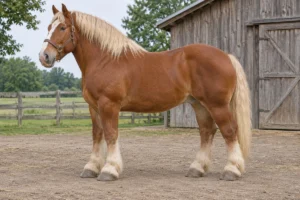
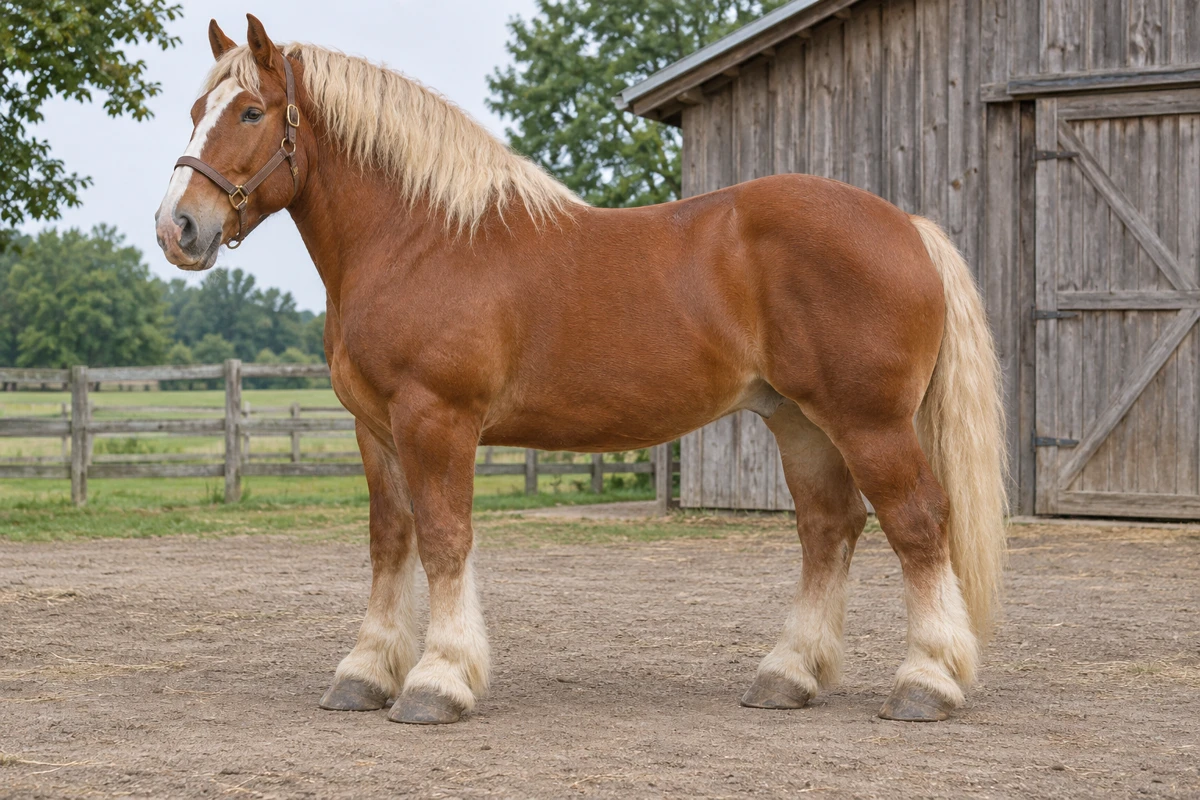
Belgian draft horses combine a tall frame with a broad chest, substantial bone and powerful musculature. Adult size varies considerably, so breed ranges are a starting point rather than a substitute for measuring the horse you own or plan to buy.
When people ask how big these horses are, they usually mean three things at once: how tall, how heavy, and how wide. A Belgian scores high on all three. The chest is deep, the hindquarters are broad and powerful, and the legs carry thick bone that supports enormous pulling force.
Among the common draft breeds, the Belgian consistently ranks as one of the most massive. It shares the heavy weight class with the Percheron, the Clydesdale and the Shire, yet it often carries the most muscle for its height. That is why the breed remains a favorite for pulling contests and heavy farm work across North America.
What Makes the Breed So Heavy
Belgians are a coldblood draft breed, bred over centuries for steady pulling power rather than speed. Coldblood simply means the heavy, calm working type, as opposed to the hot blooded racing horses like the Thoroughbred. The entire body is engineered for traction, which is why mass sits so far above what the height alone suggests.
Think of it this way. A Belgian is built like a powerlifter rather than a sprinter, with weight concentrated for low, steady force at the collar. Every part of the frame, from the thick neck to the wide loin, adds to that working mass.
The feet and lower legs tell the same story. Belgians stand on broad, solid hooves carried on dense cannon bone, giving them a stable base for pulling heavy loads. This foundation supports the great weight above it, which is one reason sound hoof care matters so much for the breed.
The American Belgian and the European Brabant
American Belgian and European Brabant breeding populations share ancestry but have developed different typical builds. American Belgians are often taller and more upright, while Brabants tend toward a compact, substantial build. Individual horses vary.
Both types share the gentle temperament the breed is famous for. If you are comparing horses, always ask which type you are looking at, because the same age horse can finish at a different height depending on its breeding background.
Where You Notice the Size Most
Width through the chest, barrel and hindquarters contributes to the breed’s substantial appearance. These dimensions matter alongside height when choosing housing, harness and transport.
Two horses of the same height can differ considerably in weight and width. Measure each animal instead of assuming one breed will always be heavier.
New owners often underestimate how much space a Belgian needs. Stalls, gateways, wash racks and door frames built for riding horses can feel tight for a draft. Planning your facilities around the breed's true width, not just its height, keeps daily handling safe and low stress for both of you.
Belgian Draft Horse Height in Feet and Centimeters
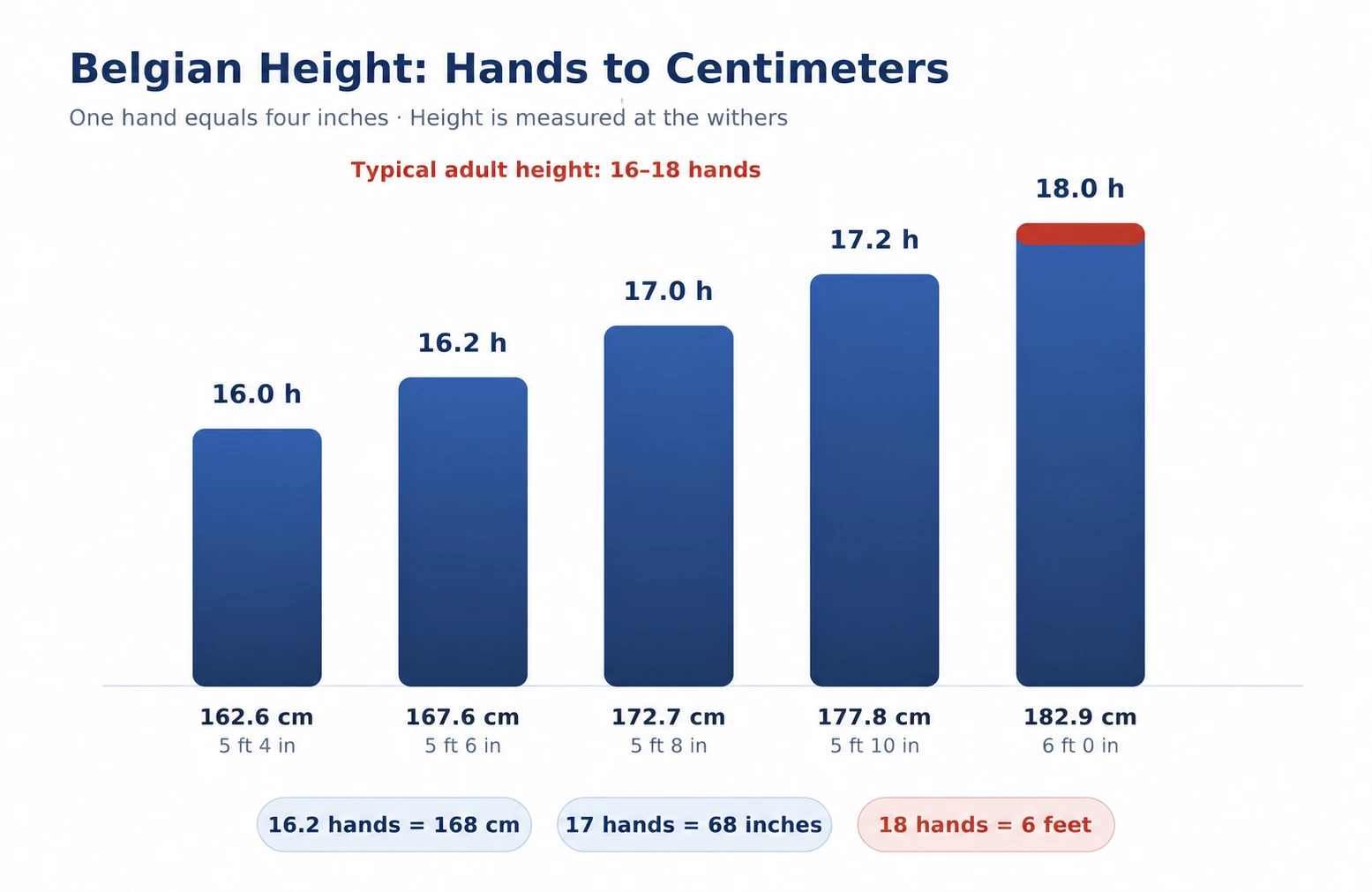
A typical range of 16–18 hands equals 64–72 inches, or 5 feet 4 inches to 6 feet at the withers. In metric units, that is approximately 162.6–182.9 cm.
Reading Height in Hands
The withers is the ridge between the shoulder blades, and it stays level whether the horse raises or lowers its head. That is why every official measurement uses it as the fixed reference point. One hand equals four inches, so a horse listed at 17 hands measures exactly 68 inches tall.
Belgian horse height in hands can confuse newcomers, because the notation looks like a decimal but is not. The number after the point counts inches, from zero up to three, since four inches forms a whole new hand. We will return to this common mix up in the FAQ section.
So a horse written as 16.2 hands is not sixteen and two tenths of a hand. It is sixteen hands plus two inches, which equals 66 inches. Keeping this straight prevents costly errors when you read a sale listing or a registration paper.
Converting Hands to Feet and Inches
Multiply the whole-hand number by four, then add the inches after the point. For example, 17.2 hands is (17 × 4) + 2 = 70 inches, or 5 feet 10 inches. The digits after the point are inches, not a decimal fraction of a hand.
Buyers and trailer makers often ask for feet rather than hands, so this conversion comes up constantly. The table below does the arithmetic for you across the common Belgian height range.
| Height in hands | Inches | Feet and inches | Centimeters |
|---|---|---|---|
| 16.0 | 64 | 5 ft 4 in | 162.6 |
| 16.2 | 66 | 5 ft 6 in | 167.6 |
| 17.0 | 68 | 5 ft 8 in | 172.7 |
| 17.2 | 70 | 5 ft 10 in | 177.8 |
| 18.0 | 72 | 6 ft 0 in | 182.9 |
Converting Hands to Centimeters
Most of the world outside the United States records horse height in centimeters. One inch equals 2.54 centimeters, so a 17 hand horse at 68 inches stands 172.7 centimeters. hands, inches, feet and centimeters all describe the same wither height, just in different scales.
If you buy or sell across borders, this conversion saves confusion. A European advert may list a Belgian at 173 centimeters, which lands right at 17 hands. Learning to move between the systems quickly means you always know exactly what size of horse you are looking at.
How Tall Belgians Get at the Extreme
Some individuals exceed the usual range. Big Jake was a notably tall Belgian gelding recognized by Guinness World Records. Exceptional individuals should not be used as the standard for selecting facilities or predicting a youngster’s adult height.
How Much Does a Belgian Draft Horse Weigh?
The breed registry gives a typical adult weight range of 1,800–2,400 pounds, approximately 816–1,089 kg. An individual’s healthy weight depends on frame, muscle and fat cover, rather than its position within that range alone.
Average Adult Weight Range
Weight is where the Belgian truly separates from lighter breeds. A tall riding horse might stand 16 hands yet weigh barely half as much as a Belgian of the same height. The breed simply carries more muscle and bone per inch, so the scale climbs fast as the frame fills out.
These figures describe a range rather than a measured breed-wide average. A smaller healthy horse and a larger healthy horse can weigh very differently without either being underweight or overweight.
For comparison, an average adult riding horse such as a Quarter Horse weighs around 1,000 to 1,200 pounds. A Belgian can weigh nearly twice that, which changes everything about how you feed, house and transport the animal. This is why draft ownership calls for draft sized planning from the start.
Why Belgians Weigh So Much
The density of the breed explains the numbers. Bone is thick, the barrel is deep and round, and the hindquarters hold huge working muscle. This is the same build that lets a Belgian pull loads that would strain a leaner horse, so the weight is a feature of the breed, not a health problem by itself. Centuries of selective breeding for farm and hauling work shaped this heavy, functional body, and it remains the reason the breed is prized wherever real pulling power is needed.
But here is where most horse owners go wrong. They guess weight by eye, then under feed or over feed based on that guess. Even experienced handlers misjudge a draft horse by hundreds of pounds, because the breed hides extra mass inside a naturally huge frame.
A healthy weight is not the same as maximum weight. Belgians can gain fat just as any horse can, and excess weight stresses the joints and raises the risk of metabolic problems. The goal is a strong, well muscled body at a sensible condition score, not simply the biggest number the scale will show.
Converting Pounds to Kilograms
Belgian draft horse weight in kg is the standard measure outside the United States, so keep the conversion handy. One pound equals about 0.454 kilograms. The table below shows the key figures across the normal adult range.
| Weight in pounds | Weight in kilograms |
|---|---|
| 1,800 | 816 |
| 2,000 | 907 |
| 2,200 | 998 |
| 2,400 | 1,089 |
What This Size Means for Trailers and Equipment
Weight drives the practical side of ownership. A pair of Belgians can approach 4,000 pounds, so you must check your trailer payload capacity and tow vehicle rating before hauling. A standard two horse trailer built for light breeds may be unsafe for drafts.
Draft horse trailer fit also depends on height and width, since a Belgian needs extra stall length, headroom and door width to load calmly. The same scaling applies to draft horse equipment sizing, from halters and harness to blankets, which all run in dedicated draft sizes rather than standard horse sizes.
Buying draft sized gear from the start saves money and frustration. Standard tack rarely fits a Belgian well, and forcing it can rub, pinch or fail under load. When you plan around the breed's real dimensions, both the horse and your budget come out ahead. See our guide to Belgian draft horse ownership costs for related advice.
Foal and Youngstock Weight
The breed registry gives about 125 pounds as an indicative foal birth weight. Actual birth weight and growth vary; assess a young horse with age-appropriate veterinary and nutritional guidance.
Steady growth matters more than fast growth. Pushing a young draft horse to gain weight too quickly can stress developing joints and bone. A balanced diet suited to the horse's age, guided by your veterinarian, supports the slow, even development that a sound adult frame requires.
Why Belgian Draft Horses Vary in Size
Belgian draft horses vary in size because genetics, age, sex, and body condition each pull the final numbers up or down. No single average captures every horse, so understanding these four drivers helps you judge whether an individual is on track for its type.
Genetics and Breeding Lines
Breeding lines set the ceiling for how tall and heavy a Belgian can grow. Horses from tall show lines often finish larger than those from compact farm and pulling lines. When you buy a young horse, the parents and grandparents give you the clearest clue to adult size, so always look at the pedigree and, where possible, the mature relatives.
Different farms also breed toward different goals. Some aim for the tallest possible hitch horses, while others prize compact, powerful pulling types. Knowing a breeder's focus tells you roughly where a young horse is likely to land in both height and weight once it matures.
Age, Growth and Physical Maturity
Height, skeletal development and muscle development do not finish at one universal age. A young Belgian can look tall while still developing its chest and hindquarters. Discuss workload and growth with your veterinarian rather than relying on a fixed birthday.
Judge a young horse against its own age, never against a mature adult. A two year old may already stand tall yet still look narrow and gangly, because the width and muscle arrive last.
Follow the individual horse’s development over time. Adult height and a mature-looking body are not the same measure of readiness for demanding work.
Sex, Frame and Individual Build
Sex can influence size, but breeding line and individual frame also matter. There is substantial overlap between mares, geldings and stallions, so measure the horse rather than estimating from sex.
Muscle, Body Condition and Workload
A working Belgian in hard condition looks and weighs differently from an idle pasture horse. Muscle adds weight without adding fat, so a fit horse can be heavy yet healthy. Veterinarians assess this using the Henneke body condition scoring system, a nine point scale developed at Texas A&M University that rates fat cover from poor to extremely fat.
Think of it this way. Two Belgians can share the exact same height and still differ by two hundred pounds, purely from muscle, fat and frame. That variation is normal, and it is why size always comes as a range rather than a single fixed figure.
Workload shifts the picture through the year as well. A horse in a demanding pulling or plowing season builds muscle and may weigh more, while the same horse resting over winter can soften and change shape. Tracking condition regularly helps you feed for the work the horse is actually doing.
How to Measure a Belgian Draft Horse's Height
You measure a Belgian draft horse's height at the withers using a rigid measuring stick on level ground, reading the result in hands. The process takes two minutes and gives you a number far more reliable than any eye estimate. Follow these steps in order for an accurate reading.
- Choose a firm, level surface. Soft or sloped ground throws the reading off, so use a flat barn aisle or concrete pad.
- Position the horse squarely with a relaxed head. All four legs should stand evenly under the body, with the head at a natural height.
- Locate the highest point of the withers. Run your hand up the shoulder to the ridge between the shoulder blades and mark that peak.
- Use a rigid horse measuring stick with a level crossbar. Rest the upright beside the foreleg and lower the crossbar until it just touches the withers.
- Repeat the measurement from the other side. Comparing both sides catches any tilt and confirms the stick stood truly vertical.
- Record the result and whether the horse was shod. Shoes add a small amount of height, so always note whether the horse stood shod or unshod.
Why the Withers Is the Reference Point
The withers gives a fixed, repeatable landmark, which is the whole point of a standard. A horse constantly moves its head, so measuring to the poll or crest would give a different answer every time. The withers stays put, so two people measuring the same horse reach the same number.
Common Measuring Mistakes
A flexible tape following the shoulder’s contour can overestimate vertical height. Use a level measuring stick for consistency, and follow the relevant organization’s rules for official measurements.
Other frequent errors include measuring on sloped ground, letting the horse stand unevenly, and forgetting to note shoes. Each one shifts the figure by a fraction of a hand, which matters at a sale or a show where height classes are strict.
Patience with the horse also improves accuracy. A nervous animal that raises its head or shifts its feet can throw the crossbar off the true wither point. Let the horse settle, keep the handler calm, and take the reading only once all four feet are planted squarely.
How to Measure or Estimate a Belgian Draft Horse's Weight
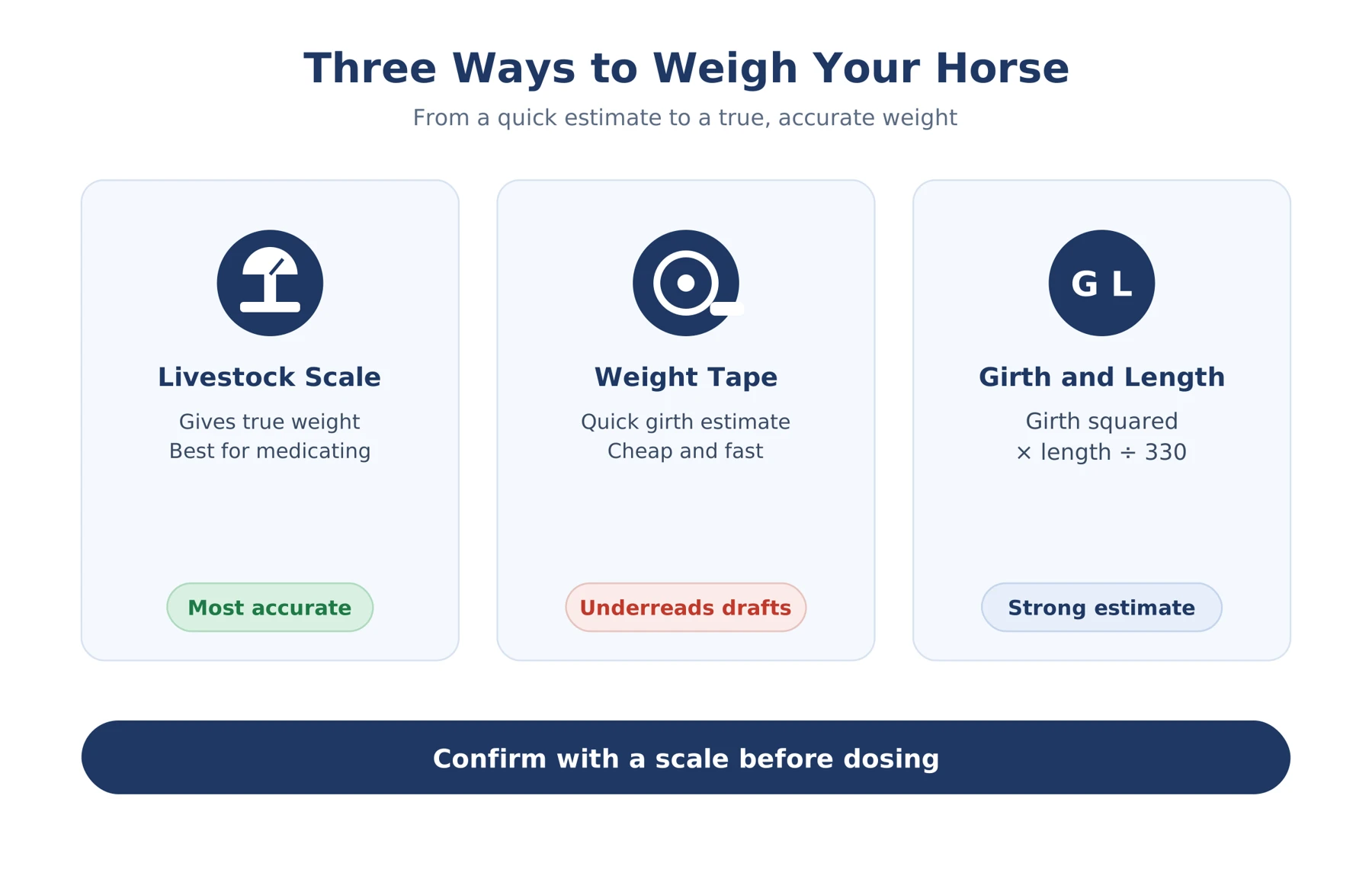
You can measure a Belgian's weight precisely with a livestock scale, or estimate it closely using a weight tape or body measurements. Each method trades accuracy for convenience, and knowing the limits of each keeps you from feeding or dosing your horse on bad numbers.
Using a Suitable Livestock Scale
A livestock scale gives the only truly accurate weight, which matters for medication, feeding and health tracking. Many veterinary clinics, feed mills and larger farms have drive on platform scales rated for draft horses. Lead the horse on calmly, let it settle, and read the figure once it stands still.
Weigh on the same scale over time whenever you can. Consistency lets you track small changes in condition that signal a health or feeding issue early, long before they become visible to the eye.
Accurate weight also makes medication safe. Wormers and many drugs are dosed by body weight, and a draft horse needs far more than a riding horse. Under dosing leaves the treatment ineffective, while over dosing wastes product and can risk the horse, so a true number protects your animal.
Using a Weight Tape and Understanding Its Limitations
A weight tape estimates body mass from the heart girth, the circumference just behind the front legs. You wrap the tape around the barrel, snug but not tight, and read the weight printed on it. It is cheap, fast and useful for tracking trends over time.
But here is where most horse owners go wrong with tapes. Standard weight tapes are calibrated for average sized horses, not drafts, so they commonly underestimate a Belgian. Treat the tape reading as a rough baseline for a heavy horse, never as a precise figure, and never rely on it alone for drug dosing.
Using Body Measurements to Estimate Weight
Heart girth and body length can be used in a general weight-estimation equation. Draft conformation can reduce its accuracy, so it is more useful for a rough estimate or consistent trend than for a precise weight.
The widely used formula, published by University of Minnesota Extension, works like this. Multiply the heart girth in inches by itself, multiply that result by the body length in inches, then divide by 330. Body length runs from the point of the shoulder to the point of the buttock.
This general equation is not a validated guarantee for every draft horse. Errors may be substantial; confirm with a suitable scale when accuracy matters, particularly for medication decisions.
Take your measurements carefully for the best result. Keep the tape level around the barrel, measure on a horse standing square, and record the figures the same way each time. Small errors in the girth measurement grow when the number is multiplied, so steady, consistent technique makes the estimate far more trustworthy.
How Does Belgian Draft Horse Size Compare With a Clydesdale?
Belgian and Clydesdale height ranges overlap. Belgians often look broader and more compact, while Clydesdales often have a taller, longer-legged appearance. Breed descriptions cannot establish which of two individual horses is bigger.
Height and Build Compared
The difference shows most in the frame. A Clydesdale carries a leaner, more refined body with the famous white leg feathering and flashy knee action. A Belgian is broader through the chest and hindquarters, with heavier overall mass packed onto a slightly lower frame. Both are gentle giants, yet they feel different to stand beside, and seasoned horse people can often tell the two breeds apart at a glance from build alone.
Compare the actual horses, their dimensions and suitability for the intended job. The table provides broad reference ranges, not guaranteed differences.
| Trait | Belgian draft horse | Clydesdale |
|---|---|---|
| Typical height | 16–18 hands | 16–18 hands |
| Typical weight | 1,800–2,400 pounds | Approximately 1,600–2,200 pounds; individuals vary |
| Build | Broad, heavy, thickly muscled | Taller, leaner, more refined |
| Leg feathering | Light to moderate | Heavy and prominent |
| Best known for | Pulling power and mass | Height and flashy action |
Choosing Between the Two
At the same height, either individual may be heavier depending on frame, muscle and condition. Height alone cannot answer the comparison.
For heavy farm work and pulling competitions, the Belgian's mass is a clear advantage. For parade hitches and eye catching presence, many owners favor the Clydesdale. Neither choice is wrong, since the right horse depends entirely on the job you have in mind.
Temperament is similar across both breeds, since each was bred to work calmly alongside people. That gentle nature is a large part of why draft horses remain popular for therapy programs, carriage work and family farms. Size draws the eye first, but the steady mind keeps these horses in demand. See our guide to Belgian vs Clydesdale comparison for related advice.
Frequently Asked Questions
How Tall Is a Belgian Draft Horse in Feet?
A typical Belgian stands about 5 feet 4 inches to 6 feet at the withers, corresponding to 16–18 hands. This is not the height to the top of the head; allow separate headroom when assessing transport and buildings.
How Much Does an Adult Belgian Draft Horse Weigh in Kilograms?
The typical 1,800–2,400-pound range converts to approximately 816–1,089 kg. Use a suitable livestock scale for an accurate individual weight.
Can a Belgian Draft Horse Be Taller Than 18 Hands?
Yes, a Belgian draft horse can stand taller than 18 hands, though it is uncommon. Big Jake, a Belgian gelding recognized by Guinness World Records, reached more than 20 hands. Most breeding programs aim for a useful working size rather than record height, so very tall individuals remain the exception.
Are Male Belgian Draft Horses Always Bigger Than Females?
No. Sex may influence size, but breeding line and individual variation matter substantially. A large mare can be taller or heavier than a smaller stallion or gelding.
Can You Estimate a Belgian Draft Horse's Weight From Height Alone?
No, you cannot reliably estimate a Belgian draft horse's weight from height alone, because build and muscle vary so widely between individuals. Two horses of identical height can differ by two hundred pounds. Use a heart girth measurement and body length together, or a proper scale, for any estimate you plan to act on. Height tells you how tall the horse is, but only girth and length capture the depth and width that make up most of a draft horse's true weight.
What Is the Difference Between 17.2 Hands and 17.2 Decimal Hands?
In horse-height notation, 17.2 hands means 17 hands plus 2 inches: 70 inches (177.8 cm). A decimal calculation of 17.2 × 4 gives 68.8 inches and is incorrect for that notation. Only .0, .1, .2 and .3 are used before moving to the next whole hand.
Belgian draft horse size always depends on the individual animal, shaped by its genetics, age, condition and care, so treat the ranges in this guide as reliable averages rather than fixed rules. When you need exact figures for feeding, medicating, buying or transporting your horse, measure the animal directly and confirm the numbers with your veterinarian or a certified equine professional who can assess your horse's individual needs in person.