Every horse sound carries a message, and learning to read those messages changes how you care for your animal. Horse sounds are the vocal signals horses use to share emotion, location, and intent, because their survival once depended on fast communication across a herd. A whinny, nicker, snort, or squeal each tells you whether your horse feels calm, excited, anxious, or alert. This guide explains the most common horse vocalizations, what triggers them, and how body language confirms the meaning behind each call.
Most owners recognize a loud neigh but miss the quieter signals that matter just as much. By the end of this guide, you will know what sound a horse makes in different moods, why it makes that sound, and how to respond with calm confidence.
KEY TAKEAWAYS
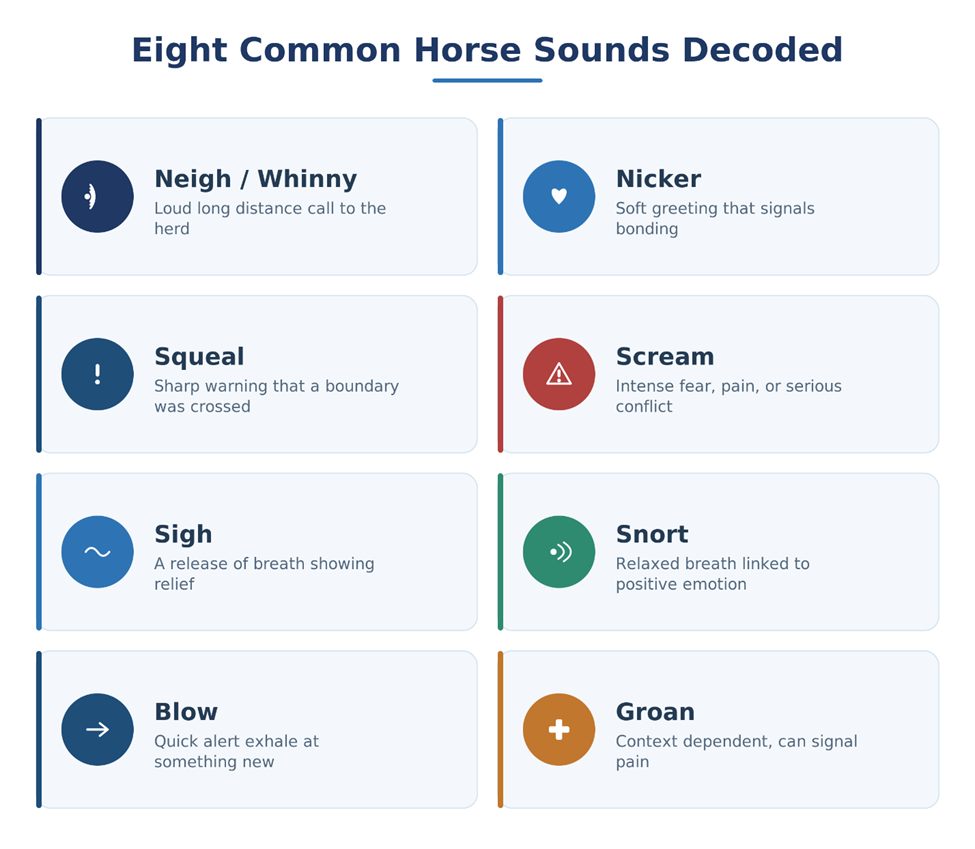
- Horses use eight core sounds, each tied to a specific emotion or social need.
- A nicker signals comfort and bonding, while a scream signals fear or conflict.
- Snorts often reflect positive emotions and good welfare, backed by research.
- Sound always pairs with body language, so read ears, eyes, and tail together.
- Sudden changes in your horse vocalizations can be an early sign of pain or stress.
Common Horse Sounds and What They Mean
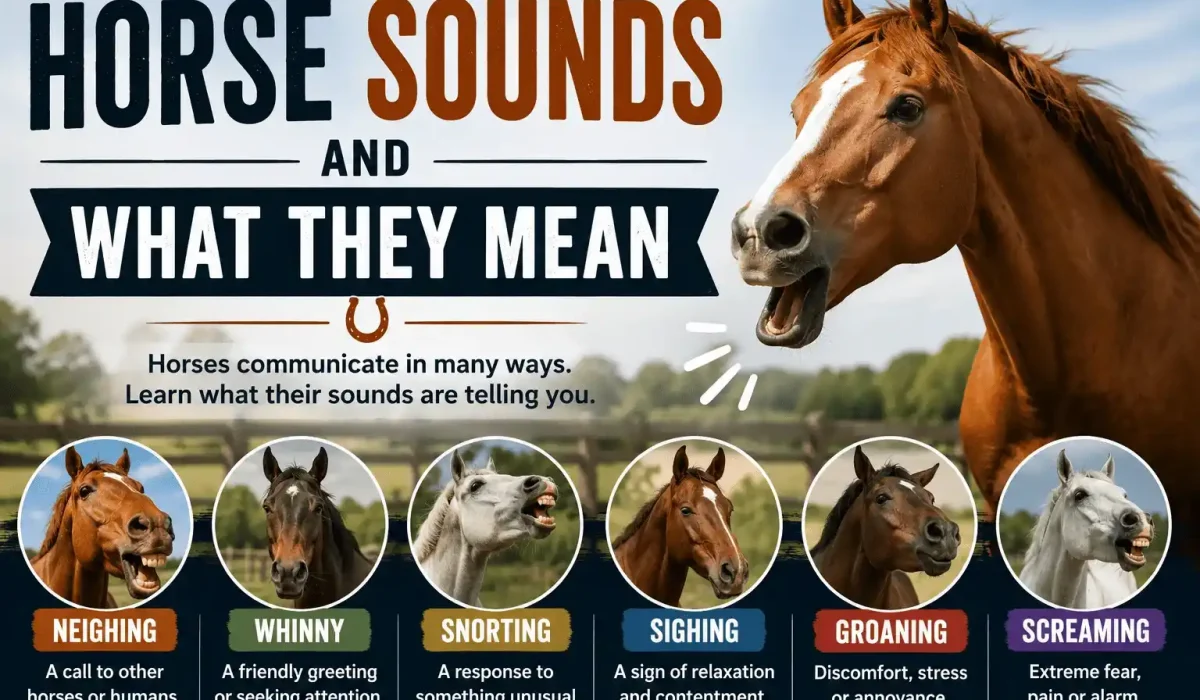
Horses make eight main sounds, and each one maps to a clear emotional state. Once you learn this small vocabulary, you can read your horse almost like a conversation. The sections below break down every common horse sound, the feeling behind it, and the situation that usually triggers it.
Here is the key thing to remember. No single sound stands alone. Volume, pitch, and the body language around it shape the full meaning every time, so always listen and watch together.
Treat the descriptions that follow as a starting map. With practice, you will blend them into a single, fluent read of your horse in just a few seconds.
Neigh or Whinny
A neigh, also called a whinny, is the loudest and longest horse sound, and it works as a long distance call. Your horse uses it to locate companions, announce its presence, or ask where the herd has gone. You will hear it when a horse is separated from friends or when a familiar trailer pulls into the yard.
Equine behaviorist Sue McDonnell of the University of Pennsylvania School of Veterinary Medicine defines the whinny in her Equid Ethogram as a loud, prolonged call that begins high pitched and ends lower pitched. That rising and falling shape is what makes it carry across an open field.
Research adds even more detail. A 2015 study by Maigrot and colleagues in Scientific Reports found that each whinny contains two separate frequencies. One frequency reveals whether the emotion is positive or negative, and the other reveals how strong that emotion is. So why do horses neigh in such a layered way? Because a single call can broadcast both mood and urgency at the same moment.
Nicker
A nicker is a soft, low rumble a horse makes to greet you or call a foal, because it signals comfort, anticipation, and social bonding. You will hear it most at feeding time, when your horse recognizes a trusted person, or when a mare reassures her young. It is one of the warmest happy horse sounds you can hear.
The horse nicker meaning shifts slightly with context. A feeding nicker is eager and quick. A maternal nicker is gentler and more rhythmic. A courtship nicker, used by stallions, sits somewhere between the two in tone and intensity.
Think of it this way. A nicker is your horse speaking quietly to someone it trusts, never to a stranger across a field. When you receive one, your horse is treating you as part of its inner circle.
Squeal
A squeal is a short, sharp, high pitched sound that usually means a boundary has been crossed. Horses squeal during introductions, in the early stages of play, or when one animal warns another to back off. Mares often squeal at pushy geldings or stallions that step too close.
A squeal is not always aggressive, but it is always emphatic. It says, in plain terms, that is enough. Pair a squeal with pinned ears and a stamping foot and you are watching a clear warning unfold in real time.
Listen for the squeal during turnout, when horses sort out their social order. It is a normal part of equine behavior and rarely leads to injury when the animals have room to move.
Scream
A scream is the most intense and alarming horse sound, and it signals real fear, pain, or serious conflict. It is rare, and most owners hear it only a handful of times. A horse may scream during a violent fight or in a moment of genuine panic.
But here is where most horse owners go wrong. They confuse a loud whinny with a scream. A scream is rawer, harsher, and far more urgent than any ordinary call. When you hear one, treat it as an emergency and check for injury or threat right away.
A screaming horse is flooded with adrenaline. Approach with caution, keep your own body calm, and remove the danger before you try to soothe the animal.
Sigh
A sigh is a long, audible release of breath that usually signals relief and relaxation. Your horse may sigh after a grooming session, during a rest, or once a stressful moment has passed. It is a quiet sign that built up tension has drained away.
That said, context matters. A horse that sighs repeatedly while standing dull and withdrawn may be bored or shut down rather than content. Read the whole picture before you celebrate a sigh as a happy sound.
A single soft sigh during a calm grooming session is a lovely thing to hear. It often means your horse has settled fully into the moment with you.
Snort
A snort is a strong, rapid push of air through the nostrils, and it often reflects a positive emotional state. A 2018 study by Stomp and Hausberger at the Université de Rennes, published in PLOS ONE, found that horses snort far more in pleasant situations, such as grazing freely at pasture. The same research linked frequent snorts to better overall welfare.
Snorts also clear the nostrils and serve a practical purpose. A horse may snort when it meets a new smell, breathes in dust, or notices a mild surprise on a trail ride.
The bottom line is this. A relaxed snort with soft, forward ears usually means your horse feels good about where it is and what it is doing.
Blow
A blow is a sharp, quick exhale through the nose that signals alertness and investigation. You will hear it when your horse spots something unfamiliar, like a new object, an unexpected animal, or a sudden movement in the distance. It is the equine version of asking, what is that?
A blow is not panic. It is focus. The horse is gathering information and deciding whether the situation is safe or worth fleeing. Watch the ears and eyes that follow the blow to learn what your horse decides next.
If the blow turns into repeated blowing with a tall, rigid stance, the horse has moved from curious to worried. Give it time and space to assess the trigger before you ask for anything.
Groan
A groan is a low, drawn out sound that can mean very different things, so it always needs context. A relaxed horse may groan softly while lying down or rolling in the dirt. That kind of groan is harmless and even a sign of comfort.
A groan during exercise, eating, or movement is different. It can point to discomfort, effort, or pain, especially if it appears suddenly or repeats often. If a normally quiet horse starts groaning frequently, call your veterinarian to rule out colic or another medical issue.
Never ignore a new groaning habit. Among all horse noises, the groan is the one most likely to flag a hidden physical problem that needs prompt attention.
Why Do Horses Make Different Sounds?
Horses make different sounds because each call solves a specific survival problem, from finding the herd to warning off a rival. As prey animals, horses evolved a flexible system of equine communication that works across distance and within a tight social group. Their voices, breath, and posture all carry information at once.
Communication Across Distance
Loud sounds exist to cross open ground and reach companions that cannot be seen. The neigh travels far, which is why a separated horse calls so urgently for its herd. Quiet sounds, by contrast, stay private and protect a close bond.
So why do horses whinny loudly yet nicker softly? The answer is range and risk. A loud call reaches absent friends but may also attract predators, while a soft nicker keeps a message between two animals that are already close.
This is why barns grow noisy at feeding time. Excited horses call across the stalls, and the volume reflects anticipation rather than any real distress.
Signals Within the Herd
Within a herd, clear sounds keep everyone safe and reduce conflict before it escalates. A foal that calls its mother, a sentry that blows at a strange shape, and a mare that squeals at a pushy neighbor are all using sound to manage relationships.
These signals form a shared language that every horse learns young. Understanding horse sounds in this social context helps you see that most calls are about connection and order, not random noise.
Order keeps the herd calm. When every horse understands the signals, the group settles faster and serious fights become far less common.
The Prey Animal Instinct
Here is the key thing. Horse noises always balance the need to be heard against the danger of being noticed. That ancient prey animal tradeoff still shapes the full range of horse vocalizations you hear in a modern barn or paddock.
Knowing the why behind a sound helps you respond well. When you grasp the purpose of a call, you stop guessing and start reading your horse with real intent.
Modern horses still carry this wiring. Even a safe, well kept animal weighs each sound against an ancient instinct to stay hidden from danger.
How to Tell If Your Horse Is Happy, Scared, or Angry
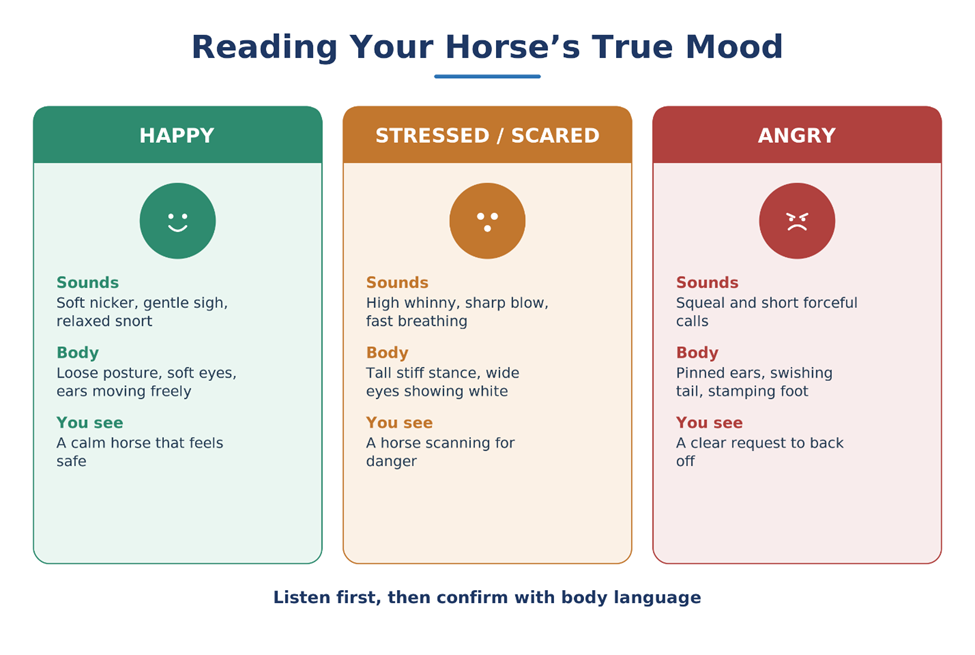
You can read your horse’s mood by matching its sound to the emotion that usually drives it, then confirming with body language. Happy horse sounds, stressed horse sounds, and angry signals each follow recognizable patterns. The trick is to listen and watch at the same time.
Think of it this way. Sound tells you what your horse feels, and body language tells you how strongly it feels it. Use both together and you will rarely guess wrong.
Mood can also shift fast. Stay flexible and update your read the moment the sound or the body language changes in front of you.
Reading the Happy Horse
A content horse is usually quiet, with soft, occasional sounds. Gentle nickers, relaxed snorts, and the slow sigh of a resting animal all point to comfort. The body looks loose, the ears move freely, and the eyes are soft.
A happy horse does not need to shout. Calm and quiet, broken by a friendly nicker at feeding time, is the everyday sound of a horse that feels safe in its home.
Reading the Stressed or Scared Horse
A frightened horse often produces sharp, sudden sounds, such as a blow, a high whinny, or in extreme cases a scream. Stressed horse sounds tend to rise in pitch and arrive with a tense, tall posture and wide eyes that may show white at the edges.
Watch for fast, shallow breathing and frequent blowing. These point to a horse scanning for danger. Your job is to lower the pressure, give space, and remove the trigger as soon as you safely can.
Reading the Angry or Irritated Horse
An angry horse uses squeals and short, forceful sounds to set a firm boundary. Pinned ears, a swishing tail, and a stamping or striking foot usually appear alongside the sound. This is a clear request to back off and give room.
Respect that message. Pushing a horse that is already warning you sharply raises the risk of a bite or kick that harms both of you.
Use these five steps to read your horse’s mood in any situation:
- Listen to the sound and note its pitch and volume.
- Check the ears for direction and tension.
- Read the eyes for softness or visible white.
- Watch the tail for relaxed swishing or hard swatting.
- Combine all four signals before you decide how to respond.
Horse Body Language That Supports Their Sounds
Body language confirms what a sound means, and reading both together is how horses communicate most clearly. A nicker with soft ears means something very different from a nicker paired with a tense neck and a hard stare. The body removes the guesswork.
The table below shows how sound and posture combine to reveal emotion. Use it as a quick reference until the pattern becomes second nature to you.
| Sound | Common Body Language | Likely Emotion | What You Should Do |
| Nicker | Soft ears, relaxed neck, approach | Affection or anticipation | Greet calmly, proceed with feeding or handling |
| Whinny | Alert ears, raised head, scanning | Searching or excitement | Locate the companion or trigger, then reassure |
| Squeal | Pinned ears, stamping foot | Warning or irritation | Give space and ease the social pressure |
| Snort | Forward ears, loose body | Calm or positive interest | Continue the activity, the horse feels good |
| Blow | Focused ears, fixed gaze, tall stance | Alertness or surprise | Let the horse assess, stay quiet and steady |
| Scream | Rigid body, wide eyes, flared nostrils | Fear or conflict | Treat as urgent, check for injury or threat |
Now look at the four body signals that matter most. Each one supports the sounds described above and sharpens your read of horse emotions.
Ear Position
Ears are the fastest indicator of mood, and they move almost constantly. Forward ears show interest and attention. Ears that flick back and forth show a horse splitting focus between you and the surroundings.
Pinned ears, flattened hard against the neck, are a serious warning. Combined with a squeal, they tell you a horse is ready to defend its space and wants you to step away.
Watch how quickly the ears change. Rapid, repeated flicking often means a horse is uncertain, so give it a moment to settle before you ask for anything.
Tail Movement
The tail reveals tension that the face may hide. A loose, gently swishing tail signals a relaxed horse, often brushing away flies with no urgency. A hard, fast swat or a clamped tail signals irritation or stress.
A tail held high can mean excitement or alarm, while a tail tucked tight points to fear or cold. Read it alongside the sound for an accurate picture of how your horse feels.
Flies complicate the read, of course. On a buggy day, separate the normal fly swatting from the harder, faster swish that signals true irritation.
Eye Expressions
The eyes carry a surprising amount of equine behavior. Soft, half closed eyes show calm and trust. Wide eyes that reveal the white around the edge point to fear, pain, or sudden alarm in the moment.
A hard, fixed stare can signal focus or challenge. When the eyes tighten and wrinkle above the lid, your horse is often telling you that it feels worried or uncomfortable.
Soft eyes are your green light. When the gaze is gentle and the lids are relaxed, your horse feels comfortable and open to interaction with you.
Head and Neck Movements
The head and neck broadcast intent from a distance. A lowered, relaxed neck shows ease, while a high, rigid neck shows arousal or alarm. A snaking, low swung head with pinned ears is an aggressive drive used to move others away.
Tossing or shaking of the head can signal frustration, irritation, or a physical problem such as discomfort from tack. As always, pair the movement with the sound to confirm the message before you act.
Position tells you direction too. A horse that swings its head toward a companion is often inviting contact, while a head swung away signals a wish for distance.
How Horses Communicate Beyond Sound and Posture
Horses combine voice, body, scent, and touch into one rich communication system, so sound is only part of the story. Understanding this fuller picture explains why horse vocal cues sometimes seem subtle or mixed. Equine communication evolved to work in a herd that depends on constant, low key signals.
Touch and Grooming
Touch plays a major role in horse social behavior. Mutual grooming, where two horses nibble each other’s withers, builds trust and calms both animals at once. A horse that invites grooming from you is extending that same social gesture of friendship.
You can use this knowledge in daily handling. Gentle, predictable touch in the places a horse enjoys helps lower stress and strengthens the bond between the two of you.
Many horses groom a trusted person in return, nibbling gently at a shoulder or sleeve. Accept it as a compliment, but set limits so the habit stays safe and polite.
Scent and Smell
Scent matters more than many owners realize. Horses greet by breathing into each other’s nostrils, exchanging information that voice alone cannot carry. This exchange helps them recognize friends and assess newcomers.
This is why a calm horse may snort softly while investigating a new smell rather than calling out loudly. The horse is reading its world through its nose as much as its ears.
Give new horses time to sniff before you rush an introduction. A calm scent exchange lays the groundwork for a peaceful first meeting.
What This Means for You
Here is the key thing about horse psychology. Horses are honest communicators that rarely bluff for long. When you learn to read the full set of signals, including the quiet ones, you understand your horse far better than sound alone allows.
That deeper understanding is the real reward. It turns daily handling into a genuine back and forth between you and your horse, built on mutual trust.
Common Mistakes When Reading Horse Sounds
Most misreads happen when owners judge a sound in isolation or rush to a conclusion. Learning how horses communicate means slowing down and reading the full situation. Avoid the three mistakes below and your accuracy will climb quickly.
Assuming Loud Always Means Aggressive
A loud sound is not always an angry one. A booming whinny is usually a search call, not a threat, and an excited horse at feeding time can be noisy yet perfectly friendly. Volume signals intensity, not hostility.
Judge the emotion by the type of sound and the body language, not by how loud it is. A quiet squeal with pinned ears is far more of a warning than a loud, happy nicker.
Ignoring the Quiet Signals
Many owners wait for obvious noise and miss the soft cues that come first. A subtle sigh, a low nicker, or a faint snort often reveals your horse’s mood before any loud call appears.
Tune in to these quiet horse vocal cues and you will catch shifts in emotion early. Reading the small signals is what separates a confident handler from a guessing one.
Reading Sound Without Context
The same sound can mean different things in different settings. A groan while rolling is content, while a groan under saddle may signal pain. Context decides the meaning every time.
Before you judge a sound, ask what is happening around your horse. The setting, the body language, and recent events all shape the true horse sound meanings you are trying to read.
How Horse Sounds Change With Age and Personality
Horse sounds are not identical across every animal, because age, sex, and temperament all shape how a horse uses its voice. Knowing these differences helps you set fair expectations for your own horse rather than comparing it to others in the barn.
Foals and Young Horses
Foals rely heavily on the nicker and the whinny to stay connected to their mothers. A foal separated from its dam will whinny with sharp urgency, and the mare answers with a low, reassuring nicker that guides the youngster back to her side.
As young horses grow, their range of sounds widens steadily. They learn squeals and blows through play and social contact, gradually building the full vocabulary of adult horse vocalizations over their first months and years.
Foal sounds are easy to misread as distress. In most cases the calling is simply a youngster checking that its mother and the herd remain nearby.
Mares, Geldings, and Stallions
Sex influences vocal habits in clear ways. Stallions tend to be the most vocal, using loud whinnies and courtship nickers to advertise their presence and interest. Mares often squeal during social exchanges and when defending personal space.
Geldings usually fall in the middle, calmer than stallions yet still expressive. None of these patterns is absolute, so treat them as broad tendencies rather than fixed rules for every horse you meet.
Management plays a part as well, since horses kept alone often call more than those living in settled, social groups.
Individual Personality
Personality shapes voice as much as biology does. Some horses are naturally chatty and greet every passing person with a nicker, while others stay quiet and reserve their calls for moments that truly matter to them.
Learn your own horse’s baseline. Once you know how talkative your horse normally is, any sudden shift toward silence or constant calling becomes an easy signal to notice and act on quickly.
Keep a mental note of your horse’s usual voice. That simple baseline turns you into the best early warning system your horse could have.
Horse Sounds FAQs
What sound does a happy horse make?
A happy horse usually makes soft, low sounds, especially the nicker. You will hear a gentle nicker at feeding time or when your horse greets a person it trusts. Relaxed snorts and the occasional sigh also point to contentment. Remember that quiet behavior, paired with soft ears and a loose posture, is itself a strong sign of a calm and happy horse. Above all, look for relaxation in the whole body, since a truly content horse shows ease in its posture as much as in its voice.
What sound does a horse make when stressed?
A stressed horse tends to make sharp, sudden, higher pitched sounds. Frequent blowing, tense whinnies, and rapid breathing all suggest worry or fear. In extreme situations a horse may scream. These stressed horse sounds usually arrive with a raised head, wide eyes, and a stiff body, so watch for those physical cues to confirm what you are hearing. If the signs persist, review the surroundings for a clear trigger and address it calmly before the stress builds further.
Why do horses neigh or whinny at night?
Horses neigh or whinny at night for the same reasons they do by day, mainly to locate companions and confirm the herd is near. Darkness can heighten a prey animal’s alertness, so a horse may call more if it feels isolated or hears an unfamiliar noise. If night calling is constant, check that your horse has company and feels secure in its space. A small amount of night calling is normal, so focus only on patterns that seem excessive or new for your horse.
What does it mean when a horse nickers at you?
When a horse nickers at you, it is offering a friendly, low greeting that signals comfort and anticipation. The horse nicker meaning is almost always positive. It often appears at feeding time or when your horse recognizes you approaching. A nicker is reserved for trusted individuals, so receiving one is a quiet sign that your horse feels safe and bonded with you. Returning a calm greeting and a gentle scratch rewards that trust and deepens your bond over time.
Why does my horse snort so much?
Frequent snorting is usually good news. Research from the Université de Rennes links snorts to positive emotions and better welfare, so a horse that snorts often while grazing or relaxing likely feels content. Snorts also clear dust and respond to new smells. If snorting comes with coughing or nasal discharge, however, contact your veterinarian to rule out a respiratory problem. In short, treat regular snorting during pleasant activities as a welcome sign that your horse is enjoying itself.
Do horses make sounds when they are in pain?
Yes, horses can make sounds when in pain, most often groans during movement, eating, or rest. A sudden increase in groaning from a normally quiet horse deserves attention. Pain signals are frequently subtle, though, so pair any unusual sound with body language such as a tucked posture, tense eyes, or reluctance to move, and call your veterinarian if you are concerned. When in doubt, it is always safer to have a professional check your horse than to wait and hope the sound passes on its own.
How can I tell if my horse likes me?
A horse that likes you will often nicker as you approach, relax its body in your presence, and seek contact through gentle touch. Soft eyes, a lowered head, and a willingness to be groomed all show trust. These signals, combined with calm horse vocalizations rather than tense or warning sounds, tell you that your horse feels safe and comfortable around you. Consistency on your part matters most, since horses bond with people who stay calm, fair, and predictable every day.
What sound does a horse make when it is scared?
A scared horse often blows sharply, whinnies in a high tense tone, or, in rare and extreme cases, screams. These sounds arrive with a tall, rigid body, flared nostrils, and wide eyes. Knowing what sound a horse makes when frightened helps you act fast, lower the pressure, and remove the trigger so your horse can settle safely again. Once the threat is gone, give your horse quiet space, and its breathing and posture will gradually return to normal.
Learning what your horse’s sounds mean is one of the most rewarding parts of ownership, and it deepens the trust between you over time. The more you listen and watch together, the more fluent you become in the language of horse sounds, from the loudest whinny to the softest nicker. Still, every horse is an individual, and sudden or unusual vocal changes can point to stress, illness, or pain. For advice tailored to your horse’s specific needs, always consult your veterinarian or a certified equine behaviorist who can assess your animal in person.