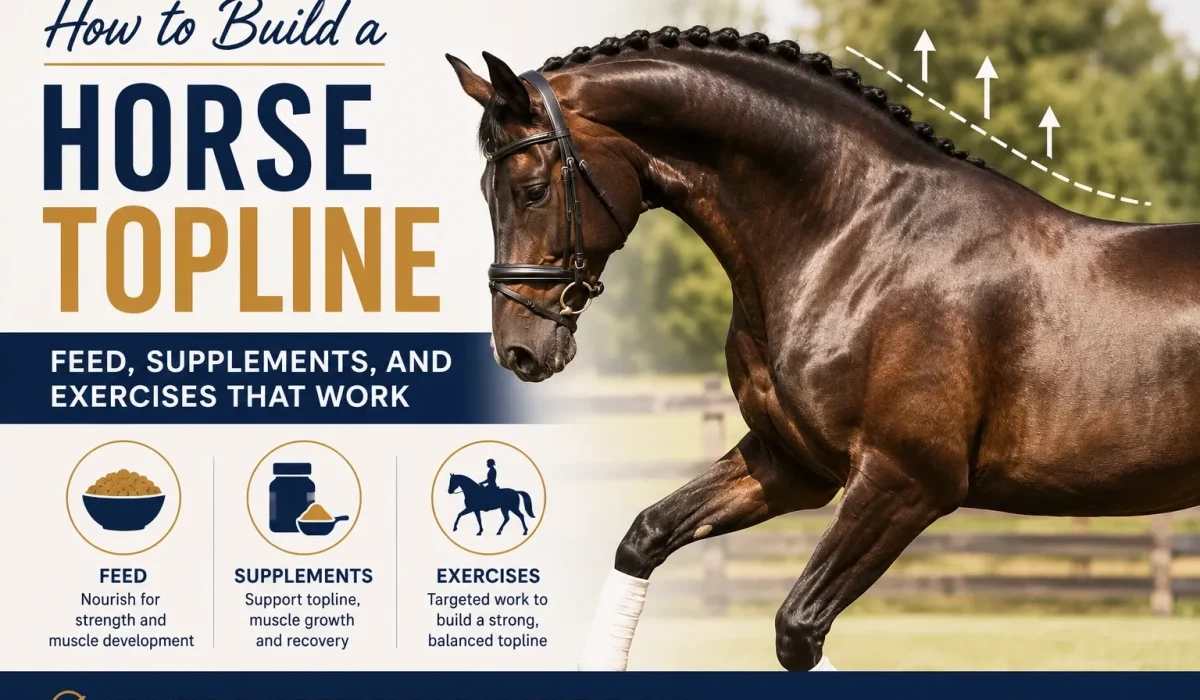
Learning how to build a horse’s topline comes down to three forces working together: correct nutrition, targeted exercise, and proper saddle fit. This guide shows you exactly how each piece fits, so you can turn a weak, dipped back into a strong, rounded topline that carries your horse for years.
A poor topline is not only a cosmetic issue. It tells you the horse lacks the muscle needed to carry a rider comfortably and move with balance. The good news is that most horses rebuild topline with the right plan, and you can start the very first week with tools you already own.
Key Takeaways
- Topline is muscle, so it responds to protein and correct work, not extra calories.
- Quality protein and the amino acid lysine drive real horse muscle development.
- Hill work and pole work build topline faster than feed used on its own.
- A poorly fitting saddle can block topline gains no matter how well you feed.
- Expect visible change within eight to twelve weeks of consistent effort.
What Is Topline in Horses and Why It Matters
The topline is the group of muscles that runs along your horse’s spine from the withers, over the back and loin, to the croup. It matters because these muscles carry the saddle, support the rider, and power balanced movement, which makes a healthy horse topline essential for both comfort and performance.
When the topline is strong, your horse lifts through the back, steps under with the hind legs, and stays sound under work. When it weakens, the back hollows, the saddle slides, and strain travels into the limbs and joints. Think of it this way: the topline is the bridge that carries power from behind into a stable, weight bearing frame.
Three main muscle systems shape the topline. The longissimus dorsi runs the length of the back and supports posture. The multifidus stabilizes each vertebra and protects the spine during movement. The gluteal muscles over the croup deliver drive. Together they define your horse’s posture and balance, which is why topline assessment is such a useful window into overall fitness and comfort.
How to Assess Topline: Fat vs Muscle
Here is where most horse owners go wrong: they confuse fat with muscle. Fat feels soft and wobbles when you walk the horse, and it gathers in patches over the loin and the tailhead. Muscle feels firm and springy, and it fills in evenly along the spine. Knowing fat vs muscle in horses stops you from feeding calories when the real need is protein and correct work.
Run your flat hand along the spine each month. A strong topline sits level with or slightly above the spinous processes, so the back feels full rather than ridged. A weak topline leaves the spine standing proud like a peak, with hollows running down either side. The difference is easy to feel once you know what you are touching.
The Horse magazine and many equine veterinarians recommend pairing a body condition score with a separate topline score, because a horse can be overweight and still lack muscle along the back. Photographs taken from the same angle every four weeks turn this into a simple, honest record you can track, and they reveal slow gains that daily handling tends to hide.
Nutrition First: Best Horse Feed for Building Topline
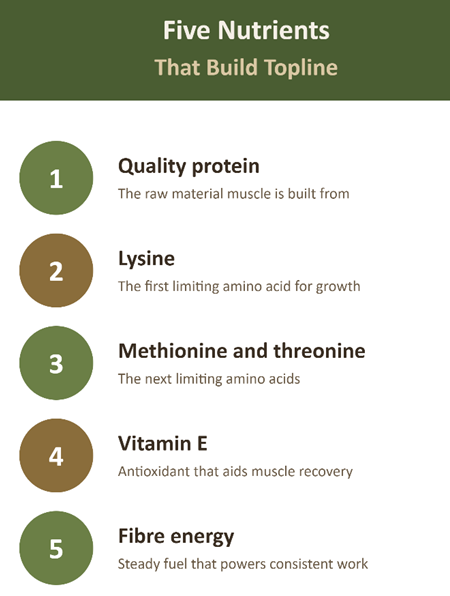
The best horse feed for building topline supplies quality protein, steady energy from fibre, and the vitamins and minerals that support muscle repair. Muscle is built from amino acids, so no amount of exercise will add topline if the diet falls short on protein. Nutrition comes first, and training then turns that raw material into shape.
Start with forage, because a forage based horse diet forms the foundation of every sound feeding plan. Good hay or pasture should make up the bulk of daily intake. From there you add a balancer or feed designed for horse nutrition for muscle growth, matched to your horse’s workload and to the quality of the forage in front of you.
Protein Quality and Essential Amino Acids
Protein quality matters more than the crude protein percentage printed on the bag. What your horse truly needs are the essential amino acids for horses, the building blocks the body cannot manufacture on its own. The National Research Council, in its Nutrient Requirements of Horses, identifies lysine as the first limiting amino acid, which means muscle growth stalls the moment lysine runs short.
Lysine for horses sits at the top of the list, followed closely by methionine for horses and threonine for horses as the next limiting nutrients. Feeds rich in these amino acids, such as soybean meal and quality alfalfa, support faster and more even horse muscle development than plain grain ever could.
Here is the key thing: feeding more low quality protein will not fix a topline. Feeding the right amino acids in the right balance will. This is why a small, targeted balancer often outperforms a large, heaping scoop of straight grain. You are feeding precision, not volume.
Energy from Fibre, Not Excess Starch
Your horse needs energy to train, but the source of that energy matters. Fibre rich horse feed delivers slow, steady fuel that supports work without the spikes and crashes of high starch diets. Kentucky Equine Research has long promoted fibre and oil as safer energy sources for muscle building than large grain meals.
Excess starch raises the risk of digestive upset and excitable behavior, and neither outcome helps you build muscle on horses. Replace some grain with beet pulp, soaked fibre cubes, or a measured amount of oil to lift calories calmly. The bottom line is this: feed energy that powers consistent work, not energy that fuels nervous spookiness in the arena.
Cool, slow energy also keeps your horse relaxed enough to focus during posture work, which is exactly when topline is built. A calm, forward horse rounds its back willingly. A fizzy, distracted horse braces and hollows. So the right energy source supports both the body and the training mindset at the same time.
Vitamins, Minerals, and Antioxidants
Muscle repair depends on far more than protein alone. Vitamin E and selenium act as antioxidants that protect muscle cells during and after exercise, which directly supports equine muscle recovery. Horses on green pasture usually get enough natural vitamin E, but those on stored hay often fall short and benefit from supplementation.
Trace minerals such as copper, zinc, and magnesium support tissue repair and nerve function, while calcium and phosphorus must stay in the correct ratio for healthy structure. A well formulated balancer covers these gaps without adding unwanted calories, which is ideal for an easy keeper that still needs to build muscle.
Where possible, match supplementation to a forage analysis rather than guessing. A simple hay test tells you what your forage already provides and what it lacks. This turns vitamin and mineral feeding into a precise correction instead of a hopeful gamble, and it protects you from both shortfalls and harmful excesses.
Gut Health Supports Muscle Health
Strong horse gut health underpins everything else, because the hindgut ferments fibre into usable energy and helps absorb the very nutrients muscle needs. A disrupted gut wastes good feed and undermines condition, no matter how carefully you balance the ration on paper.
Feed little and often, provide near constant access to forage, and make any feed changes slowly across seven to ten days. These habits protect the microbial population that turns your horse’s diet into topline. Think of it this way: the gut is the factory, and a healthy factory turns raw feed into finished muscle.
Stress, sudden changes, and long gaps without forage all damage that factory. A horse standing for hours with an empty stomach is at risk of discomfort and ulcers, both of which sap condition. Keeping forage in front of your horse is one of the simplest and most powerful things you can do for a healthy horse topline.
Topline Supplements for Horses: What to Look For
Topline supplements for horses can help when the base diet is already sound, but they are not magic in a tub. The most useful products supply quality amino acids, especially lysine, methionine, and threonine, plus vitamin E for recovery. A good topline builder for horses fills a specific, identified gap rather than promising overnight transformation.
Be honest about what a supplement can and cannot do. Researchers writing in the Journal of Equine Veterinary Science consistently stress that an exercise stimulus is required for muscle to grow. No supplement replaces correct training, so be cautious of any product that promises dramatic results without work. The most reliable approach treats a supplement as one supporting tool inside a complete plan.
The table below compares common feed and supplement options so you can match the right tool to your horse’s situation.
| Option | Main Benefit | Best For | Watch Point |
| Ration balancer | Amino acids plus minerals, low calorie | Good doers needing muscle not fat | Feed the full recommended amount |
| Alfalfa or lucerne | Natural lysine and calcium | Horses on poor grass hay | Can add calories quickly |
| Amino acid supplement | Targeted lysine, methionine, threonine | Filling a clear protein gap | Confirm guaranteed levels |
| Vitamin E and selenium | Antioxidant muscle recovery | Hay based diets and hard work | Do not over supplement selenium |
| Soybean meal | High quality concentrated protein | Building muscle on horses | Introduce it gradually |
How to Read a Topline Supplement Label
Read labels with a critical eye and ignore the marketing on the front. Turn the tub around and look for guaranteed amino acid levels, especially a stated amount of lysine, rather than a vague “protein blend” claim. A product that hides its actual amino acid content is telling you something.
Next, check that the daily dose truly delivers a meaningful amount of those amino acids. A tiny scoop can look impressive on the label yet provide too little to matter. When the numbers are unclear, a plain ration balancer with a published amino acid profile is usually the safer and more economical choice for building topline.
Exercises to Build Topline in Horses
Exercises to build topline in horses work by asking the horse to lift the back, engage the core, and step under with the hind legs. Feed supplies the material, but correct movement is the stimulus that tells the body to grow muscle exactly where you want it. Without the right work, topline simply will not form.
The guiding principle is posture, not speed. A horse rushing along with a hollow back builds the wrong muscles and can deepen a dip behind the saddle. Slow, correct work that encourages the horse to round and carry itself builds back strength in horses far more effectively than fast, flat schooling ever will.
Core Principles
Build topline the way you would develop any athlete: with progressive, consistent, and varied work. Dr. Hilary Clayton, a leading equine biomechanics researcher, has shown that exercises encouraging the horse to round the back and engage the deep stabilizing muscles are central to sound equine conditioning.
Aim for short, frequent sessions rather than occasional long ones. Muscle responds best to a regular stimulus followed by genuine recovery. Warm up thoroughly, work in correct posture for focused blocks, then cool down so the muscles repair and adapt between sessions.
Progression is the part most owners skip. Once an exercise feels easy, the muscle has adapted and needs a new challenge to keep growing. Add a little more duration, a small incline, or a slightly higher pole, and you keep the stimulus alive without ever overfacing your horse.
Groundwork and Under Saddle Toolkit
You do not need to ride to build topline. Groundwork exercises such as in hand walking over poles, gentle lunging in a balanced frame, and targeted stretching all develop the back. These are ideal for young horses, horses returning from rest, and any day when riding is not an option.
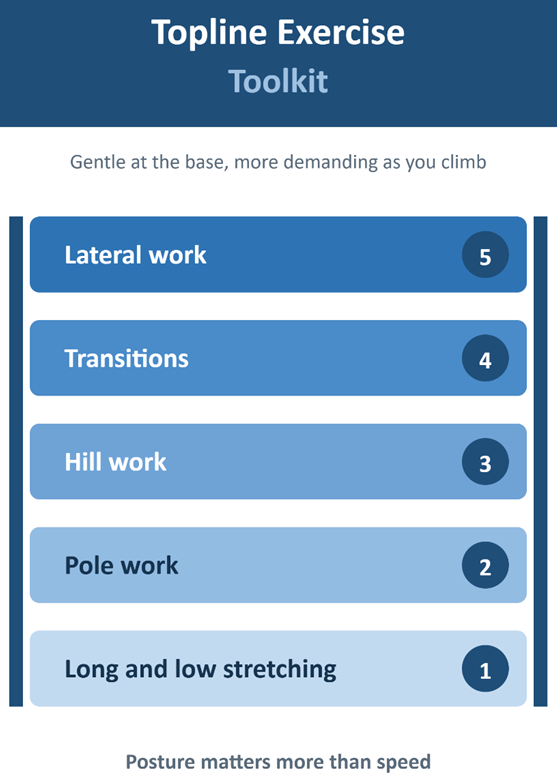
Under saddle, the most effective tools share one goal: lifting the back and engaging the hindquarters. The numbered list below ranks reliable options from gentle to more demanding, so you can match the work to your horse’s current level of fitness and confidence.
- Long, low stretching at walk and trot to lift and swing the back.
- Pole work for horses on the ground to encourage lifting and reach.
- Hill work for horses at walk to load the hindquarters safely.
- Transitions between and within gaits to build self carriage.
- Raised pole and grid work to increase range of motion.
- Gentle lateral work such as leg yield to engage the core.
- Hill work in trot once the horse is balanced and strong.
Progress through these steps over weeks, not days. Mastering correct posture at each stage protects the joints and builds muscle that actually lasts, rather than tension that fades the moment your horse relaxes.
Saddle Fit, Comfort, and Recovery for Topline
A correct saddle fit and topline go hand in hand, because a saddle that pinches or bridges causes pain that makes the horse hollow and brace. The result is wasted training and, very often, lost muscle. Comfort is not a luxury here. It is a basic requirement for any horse to lift and carry correctly.
Have a qualified saddle fitter check the fit regularly, and especially as the topline changes shape during a building program. As muscle develops, the saddle that fit two months ago may now sit too tight or too loose. Plan to recheck fit roughly every eight to twelve weeks while you are actively building topline.
Recovery matters just as much as the work itself, because muscle grows during rest rather than during exercise. Good equine muscle recovery depends on rest days, turnout, and quality sleep. Provide movement on rest days through gentle turnout, since long hours standing in a stall stiffen the muscles and slow your progress.
Common Reasons Topline Does Not Improve
When a topline stalls despite good intentions, the cause is usually one of a few familiar problems. Identifying the right one saves months of frustration. But here is where most horse owners go wrong: they change the feed again when the real issue is pain, posture, or an underlying health condition that needs attention first.
Pain and Discomfort
Pain is the most common hidden blocker of topline. An ill fitting saddle, sharp dental edges, hock or stifle soreness, or gastric ulcers all make a horse reluctant to round and lift. A horse that hurts protects itself by hollowing the back, which is the exact opposite of what topline development needs.
Work through these possibilities with your professionals before adjusting anything else. A veterinary check, a dental exam, and a saddle fit assessment together rule out most sources of discomfort. Once the horse is comfortable, the same exercises that failed before often start to work, because the horse can finally use its body correctly.
Diet and Training Gaps
The second cluster of problems sits in the plan itself. Too little quality protein, too much fast and flat work, or simply too little consistency will stall progress every time. A horse schooled hard but always above the bit will build the underside of the neck and lose the topline you want.
Audit both halves of the plan with a clear eye. Confirm the diet supplies enough lysine and overall quality protein for the workload, then confirm the training genuinely asks the back to lift. When both the fuel and the stimulus are correct and pain is ruled out, topline almost always responds.
Putting It Together: How to Build a Horse’s Topline
How to build a horse’s topline becomes simple once you combine the pieces into a routine. Feed for muscle, train for posture, fit the saddle, and measure your progress. Then repeat the cycle and adjust based on what your monthly checks tell you. Consistency beats intensity every single time.
The framework below turns this guide into a plan you can run month after month. Each step supports the next, so skipping one weakens the whole chain. Treat it as a loop rather than a checklist, because topline is maintained through repetition, not completed once and forgotten.
Audit Forage and Feed
Start with forage, then layer on a balancer or horse feed for muscle gain that closes your protein and mineral gaps. Confirm the diet supplies enough lysine and overall quality protein for the current workload. This audit is the foundation for genuine horse nutrition for muscle growth, and it is the first thing to revisit if progress stalls.
Train for Posture
Schedule short, frequent sessions focused on lifting the back and engaging the hind legs. Rotate pole work, hill work, and stretching to keep the work varied and progressive. Quality of posture always matters more than the number of minutes, so end a session while the work is still correct rather than drilling into fatigue.
Measure Monthly
Photograph and palpate the topline every four weeks from the same angles and in the same light. Tracking change keeps you honest and shows whether your plan is actually working. Topline assessment is the feedback loop that guides every adjustment, and it protects you from quietly drifting off course for months.
Maintain Hard Earned Muscle
Once you reach the topline you want, maintaining horse topline becomes the goal. Keep up correct work and quality protein, because muscle fades fast when the stimulus stops. A simple maintenance routine protects the months of effort you invested and keeps your horse comfortable in its work.
Hold Topline Through the Seasons
The bottom line is this: a topline is built over months and lost in weeks. Muscle is metabolically expensive to keep, so the body sheds it quickly when the stimulus disappears. This is exactly why so many horses lose condition over a quiet winter or a long layoff.
To hold a healthy horse topline through the year, keep three habits steady: maintain quality protein in the diet, keep some form of correct work in the routine, and recheck saddle fit as the seasons change your horse’s shape. Even light, consistent work preserves far more muscle than long gaps followed by sudden hard training.
If a layoff is unavoidable, rebuild slowly and protect the joints. Return to the gentle end of your exercise toolkit, reintroduce posture work first, and give the topline time to respond. Patience now prevents injury later and protects your horse’s long term soundness, which is the real goal behind every topline program.
Horse Topline FAQs
What is the best horse feed for building topline?
The best horse feed for building topline is forage paired with a quality protein source that supplies lysine, methionine, and threonine. For most horses, good hay or pasture plus a ration balancer delivers the amino acids needed for muscle without excess calories. Match the feed to your horse’s workload and the quality of your forage.
What is the best topline builder for horses?
The best topline builder for horses is correct exercise combined with quality protein, not a single product in a tub. Supplements that guarantee amino acids and vitamin E can help fill gaps, but they only work when paired with posture focused training. No supplement builds topline without the stimulus of proper, consistent work.
How long does it take to build topline in horses?
Most horses show visible topline change within eight to twelve weeks of consistent, correct work and a balanced diet. Older horses or those recovering from injury may take longer to respond. Monthly photographs help you see the steady progress that day to day observation tends to miss entirely.
Can a horse’s topline disappear over winter?
Yes, a horse’s topline can disappear quickly when work stops, because muscle fades within weeks without a training stimulus. Winter layoffs, illness, and long rest periods all cause loss. Keeping some correct work and quality protein in the routine through the colder months protects the muscle you worked so hard to build.
How do I improve my horse’s topline naturally?
Knowing how to improve a horse’s topline naturally comes down to combining a forage based diet rich in quality protein with progressive posture work such as pole work and hill work. Add correct saddle fit and proper recovery on top of that. These natural methods build lasting muscle without relying on shortcuts or extreme supplement claims.
Which exercises build topline in horses fastest?
Long and low stretching, pole work, and walk hill work build topline efficiently because they ask the horse to lift the back and engage the hindquarters. Progress to trot hill work and lateral work as fitness grows. Consistent, correct posture matters far more than speed or intensity when you want quick, lasting results.
Why is my horse not building topline despite good feeding?
If your horse is not building topline despite good feeding, suspect pain or posture before changing the diet again. Saddle fit problems, dental issues, ulcers, or joint soreness all make a horse hollow its back. Rule out discomfort first, then review whether the work truly encourages the back to lift and round.
Can older horses still build topline?
Yes, older horses can still build topline, though the process is often slower and steadier. Many senior horses need easily digestible quality protein and gentle, regular posture work to hold condition along the back. Always involve your veterinarian, since age related issues such as dental wear or arthritis can quietly limit progress.
Building topline is a process you control, and small, steady steps add up to real change. Combine quality nutrition, posture focused exercise, correct saddle fit, and patient monthly monitoring, and you give your horse the foundation for comfort, balance, and lasting soundness. Because every horse is an individual, always consult your veterinarian or a certified equine nutritionist for advice tailored to your horse’s specific needs. With the right plan, knowing how to build a horse’s topline becomes a steady habit rather than a guessing game.