Most people use the words horse and equine as if they mean the exact same thing. They do not. The horse vs equine difference matters far more than you might think, especially when reading veterinary notes, feed labels, training manuals, or scientific research about animal health and welfare.
A horse is one specific animal. The word equine covers a much larger group of related animals that share common ancestry, body structure, and grazing biology. This guide explains what each term truly means, when to use them, and why veterinarians, biologists, and equestrian professionals choose one word over the other every day.
By the end of this guide, you will know exactly how to talk about your animal with confidence, read industry materials with full clarity, and understand the simple science behind these two everyday words that so often get used in the wrong context.
Key Takeaways
- A horse is one species, while equine is a broader animal category
- The word equine comes from the Latin root equus, meaning horse
- Donkeys, mules, hinnies, and zebras are all equines but never horses
- Veterinarians and scientists use the word equine for accuracy and scope
- Knowing the difference helps you read research, vet reports, and product labels
What Does the Word Horse Really Mean?
Here is a simple equine definition before we go deeper. A horse is a single animal species known by its scientific name Equus caballus. It is the domesticated, hoofed mammal you ride, work with, or admire in pastures. When most people say horse, they picture this familiar animal with a flowing mane, strong legs, and a herd loving personality that has bonded with humans for thousands of years.
Equine classification places horses in the family Equidae and the order Perissodactyla, which means odd toed mammals. According to the Smithsonian National Zoo, the modern horse evolved from much smaller ancestors over roughly 55 million years. Its survival across so many environments comes from speed, social bonding, and an extraordinary grazing system designed for nearly constant movement.
A horse is a domesticated, hoofed mammal of the species Equus caballus, used for riding, work, sport, and companionship. Horses belong to the larger equine family, sharing common ancestry with donkeys, mules, and zebras, yet they remain a separate and clearly defined biological species recognized worldwide by veterinary science.
There are around 300 to 350 horse breeds across the globe today, from the tiny Falabella to the towering Shire. The American Association of Equine Practitioners (AAEP) recognizes the horse as the central species in modern equine medicine, since most veterinary research, nutrition guidelines, and training protocols focus directly on Equus caballus and its specific physiology.
Here is the key thing. When you say horse, you describe one species with many breeds. You are not describing a category at all. That distinction sits at the heart of the horse vs equine difference, and it shapes how you read every product label, training manual, or veterinary chart you encounter in your daily care routine.
A Brief History of the Domesticated Horse
Archaeological evidence places the first horse domestication around 3500 BCE in the steppes of Central Asia. Genetic studies published in the journal Nature confirm that all modern horses descend from a small population tamed by ancient peoples. Since then, the horse has transformed agriculture, warfare, trade, sport, and human culture across nearly every continent on the planet.
The horse moved with civilizations as they expanded across new lands. It pulled plows in early farming villages, carried warriors into battle, and powered the spread of goods along trade routes such as the Silk Road. Its impact on human history is hard to overstate, which is why so many languages still hold the word horse as a symbol of strength and progress.
Modern science has even traced the horse genome to learn how breeds evolved. Studies in the Journal of Equine Veterinary Science show how selective breeding produced traits like speed in Thoroughbreds, calmness in draft breeds, and gait variety in gaited horse families. This shared genetic story binds every breed together, no matter how different they look in person.
The Modern Horse and Its Many Roles
Today, the modern horse plays many roles. Some live as athletic performers in racing, dressage, or jumping arenas. Others serve as working animals on farms, ranches, and trail systems. Many are loving companions in private homes, equine therapy programs, and youth riding centers across rural and suburban communities worldwide.
Despite this variety, every domesticated horse you see today belongs to the same single species. From a 12 hand pony to a 17 hand warmblood, they all share the same scientific name. Breed differences come from selective breeding for size, color, gait, or temperament, but the underlying biology remains the same across every barn, paddock, and stable in the world.
The Anatomy and Behavior of a Horse
Every horse is built for grazing and flight. Its long legs, single hooves, and powerful hindquarters allow it to cover vast distances quickly. Its eyes sit on the side of the head, giving nearly 350 degrees of vision. This wide field helped wild horses spot predators long before they came close, and it still shapes how domestic horses react to sudden movement today.
Horses are also herd animals at their core. They form deep social bonds, follow clear pecking orders, and feel safer in groups. Many behavior issues seen in stables come from isolation, boredom, or lack of social contact. Understanding this herd nature is one of the most important parts of horse care.
Their digestive system is just as unique. A horse has a small stomach, a long small intestine, and a large hindgut where fiber is fermented by helpful microbes. This setup works best with steady forage and frequent small meals, not large grain feedings. Most modern feeding programs are designed around this gentle, near constant grazing model that mirrors how wild horses lived for millions of years.
What Does the Word Equine Really Mean?
The word equine comes from the Latin equus, which means horse. The meaning of equine in animals is broader than most readers expect. In modern usage, it refers to anything related to horses or, more broadly, to the entire family of animals that share common ancestry. This wider sense is the source of constant confusion among owners, students, and casual readers.
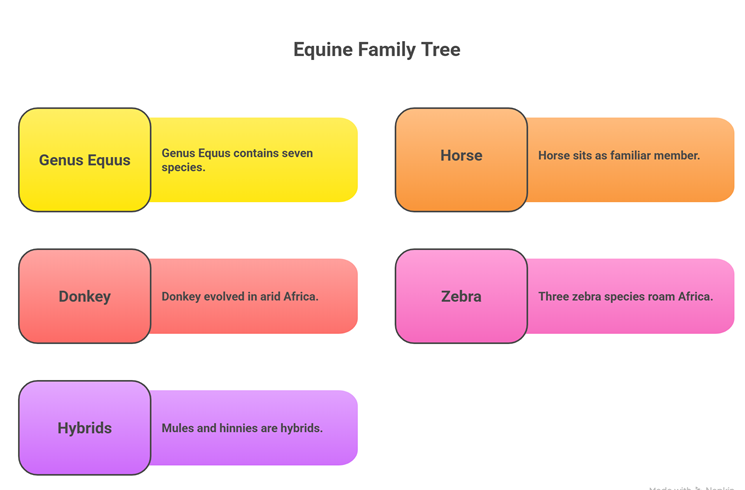
Equine is a scientific and adjectival term referring to all animals in the genus Equus. This includes horses, donkeys, mules, hinnies, and zebras. While horse describes one species, equine covers the entire taxonomic family, making it the precise term used by veterinarians, biologists, equestrian professionals, animal welfare groups, and conservation scientists.
The equine family, known scientifically as Equidae, currently includes seven living species. According to the International Union for Conservation of Nature (IUCN), these species span domesticated horses and donkeys, three zebra species, the kiang, and the onager. Each shares the same single hoof structure and grazing biology that defines the genus.
But here is where most people go wrong. They assume any horse like animal must be a horse. In reality, a zebra is not a horse. A donkey is not a horse. A mule is not a horse. Each is a distinct equine species or hybrid, with its own genetics, behavior, dietary needs, and medical considerations that matter in daily care.
The Latin Roots and Linguistic History
The Latin word equus has lived on through scientific naming, classical poetry, and even modern English vocabulary. The phrase equestrian, for example, also comes from equus. So does equestrienne, equitation, and equine itself. Each carries echoes of ancient Rome, where horsemen and cavalry held a respected place in society.
When Carl Linnaeus built the modern scientific naming system in the 1700s, he chose equus as the genus name for horses and their close relatives. This decision tied the new science of taxonomy to a word that had already meant horse for two thousand years across European cultures.
How Scientists Use the Word Equine
In veterinary science, the term equine appears constantly. Equine medicine, equine nutrition, equine surgery, and equine reproduction all refer to care across the entire genus Equus. This wider scope allows researchers to compare biology across multiple species and apply findings across many animals at once, which speeds up scientific progress.
Researchers also use equine when describing diseases, vaccines, or treatments that may affect several species. Equine influenza, equine herpes virus, and equine infectious anemia all carry the word equine because they can affect more than one species inside the family. This naming convention helps vets across the world track outbreaks accurately.
How the Industry Uses the Word Equine
The equestrian industry uses equine when describing products, services, or events that apply to multiple species. Equine insurance, equine bedding, equine dental services, and equine bodywork are all common examples. These offerings serve more than just horses, so the broader scientific term fits the marketing and packaging much better than horse alone.
Product labels also use equine to signal safety standards. A dewormer marked safe for equines often passes broader testing than one labeled only for horses. The same applies to fly sprays, hoof products, and supplements. The word equine on a label is usually a sign that the product has been studied in a wider range of animals before going to market.
Horse vs Equine: The Core Difference Explained
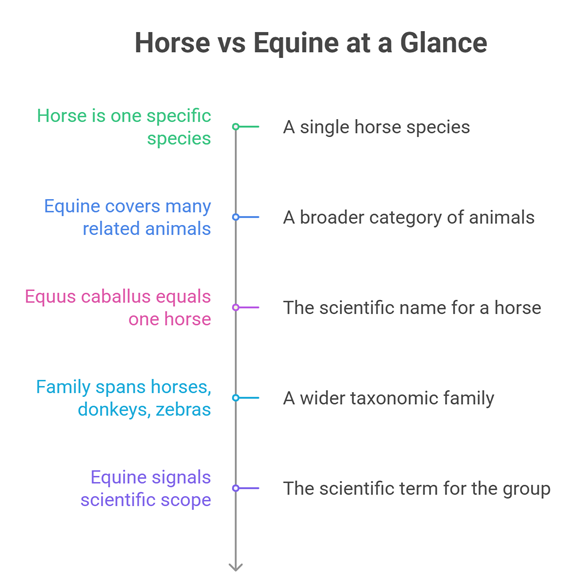
The core difference is simple. A horse is one species. Equine is a category that includes that species and several others. Yet the deeper meaning shows up clearly in how the words are used in real conversation, scientific research, and daily animal care across the world.
Everyday Language vs Scientific Terminology
In casual conversation, most people say horse. You say “I love horses” or “my horse is friendly.” That is direct, natural, and clear. Nobody in a barn aisle says “I love equines,” because the word feels overly formal for daily speech and it confuses listeners who do not work in science.
In scientific or veterinary settings, you hear equine far more often. A research paper titled “Equine Gastric Ulcer Syndrome” applies to all equines, not just horses. A veterinarian who specializes in equine medicine also cares for donkeys, mules, and rescued zebras when needed, not just horses alone in private barns.
Specific Animal vs Broad Category
Think of it this way. Saying horse is like saying poodle. Saying equine is like saying dog. Poodle is one breed inside the larger dog family. Horse is one species inside the larger equine family. This simple analogy clears up the relationship faster than any dictionary or scientific definition.
This horse and equine comparison makes the difference even more visual.
| Feature | Horse | Equine |
| Definition | One specific species (Equus caballus) | A category covering all members of genus Equus |
| Scope | Narrow and specific | Broad and inclusive |
| Common use | Casual and everyday speech | Veterinary, scientific, and industry contexts |
| Example animals | Thoroughbred, Arabian, Quarter Horse | Horses, donkeys, mules, hinnies, zebras |
| Word origin | Old English hors | Latin equus |
| Vet field | Limited mostly to horses | Includes all equine species |
| Industry use | Riding and breed events | Products and services across many species |
Veterinary, Academic, and Industry Use
In equine vs horse biology, the word equine signals scope inside a veterinary clinic. An equine veterinarian treats horses but is also trained to handle donkeys, mules, and rescued zebras when needed. The same applies in academic settings, where equine research grants fund studies across the entire genus, not just one species in isolation.
The bottom line is this. Horse describes one animal. Equine describes a related group of animals. Knowing which word fits the moment helps you read product labels, veterinary notes, and research papers with much greater clarity. It also helps you ask better questions when you talk to a vet or a feed expert.
Why Some People Use the Words Interchangeably
In many barns and casual settings, people use horse and equine as if the words mean the same thing. This works in daily speech because the horse is the most common equine most owners ever meet. The mistake usually has no serious cost in conversation.
The risk shows up when buying products, reading research, or working with rescue animals. Using horse where equine is needed can lead to wrong dosing, wrong assumptions, or wrong purchases. That is why precise word choice matters as soon as you step outside ordinary speech.
Owners who care for both horses and donkeys feel this difference most often. A bag of feed labeled for horses may have too much sugar for a donkey. A wormer dosed for a horse may be too strong for a small donkey or pony. Precise terms protect the animal as much as they protect the owner from costly errors at the feed store.
Is a Horse an Equine? The Simple Answer
Yes. So if you ever ask is horse an equine, the answer is always yes. Every horse is an equine, but not every equine is a horse. This is the most direct way to understand the relationship between the two terms. The horse fits inside the equine family, just as the family contains many other animals beyond the horse itself.
To put it more clearly, the equine family contains many species, and the horse is one of them. So when someone asks whether your horse is an equine, the answer is always yes. The reverse, however, is not always true, and that is where most of the confusion begins.
But the reverse is not true at all. A donkey is an equine, yet it is not a horse. A zebra is an equine, yet it is also not a horse. The category is bigger than the species, much like the dog category is bigger than the poodle breed inside it.
Why This Matters in Practice
When you buy supplements, deworming products, or feed, you may see the word equine on the label. This usually means the product is intended for horses and possibly other equines such as donkeys or mules. However, dosages, ingredients, and sensitivities can vary by species in important ways that affect health outcomes.
According to The Donkey Sanctuary, donkeys metabolize many medications differently than horses, so always check with your vet before assuming a product works the same way across species. Mules, hinnies, and zebras may also have unique responses to common feeds, dewormers, and pain medications used in horses every day.
This is one of the practical reasons the horse vs equine difference matters in daily care. The two words look similar on paper, but the products, treatments, and research behind them can change drastically depending on which animal you actually own and care for at home or in your barn.
A Quick Test You Can Apply
When you read a label, article, or product page, ask one simple question. Is this written about one specific animal species, or is it written about a whole family of related animals? If the word horse is used, the focus is usually narrow and species specific. If the word equine is used, the scope is usually much wider and may include several species. This quick mental test helps you avoid common mistakes.
The same logic applies to news headlines, magazine features, and online videos. A piece about equine therapy probably covers more than horses, often including donkeys and mules used in mental health programs. A piece about horse therapy will usually focus only on Equus caballus. Keeping this filter in mind sharpens your reading every time.
Equine Species You Should Know
The genus Equus currently contains seven living species, plus several well known hybrids. Each one is an equine, but each has its own biology, behavior, lifespan, and care needs. Knowing them helps you understand the rich variety inside one scientific family that has lived alongside humans for thousands of years.
Here are the main equines you should know:
- Domesticated horse (Equus caballus)
- Donkey (Equus asinus)
- Mule (a hybrid of a male donkey and a female horse)
- Hinny (a hybrid of a male horse and a female donkey)
- Plains zebra, mountain zebra, and Grevy’s zebra
- Kiang (a wild Tibetan equine)
- Onager (a wild Asian equine)
Horses
The domesticated horse is the most common equine in the world today. According to the Food and Agriculture Organization (FAO), there are around 60 million horses globally. Horses are bred for speed, strength, beauty, and companionship. They feature heavily in sport, agriculture, therapy, and culture across nearly every country and continent.
Donkeys
Donkeys are smaller, hardier, and longer lived than most horses. They evolved in arid African climates, which explains their thrifty metabolism and unique tolerance for low quality forage. The Donkey Sanctuary reports that donkeys often live 30 to 50 years in good care, far longer than the average horse lifespan of 25 to 30 years.
Their patient temperament and surefooted gait make them strong working partners in many parts of the world. Donkeys also bond closely with one another and with humans, often developing deep social ties that require careful management when one is rehomed or separated for medical care. A grieving donkey can stop eating, which is why pairs are often kept together for life.
Donkeys also have unique health needs. They are prone to hyperlipemia when stressed or off feed, and their hooves require careful trimming due to a different angle than horse hooves. The Donkey Sanctuary publishes free care guides that walk owners through these differences, which is one more reason equine literacy pays off in real care decisions.
Mules and Hinnies
A mule is the offspring of a male donkey and a female horse. A hinny comes from a male horse and a female donkey. Both are hybrids and almost always sterile due to differences in chromosome counts. Mules combine donkey intelligence with horse size and strength, which is why they have served humans for centuries in agriculture, transport, and pack work.
Hinnies are less common because the cross is harder to achieve. They tend to be smaller and more pony like in appearance. Both mules and hinnies are valued for endurance, sound footing, and a calm temperament, especially in mountain and trail environments where horses might struggle with terrain or altitude.
Because both hybrids are usually sterile, every new mule or hinny is the result of fresh breeding between donkey and horse parents. That single fact makes hybrid equines unique in the family. They cannot create a stable population on their own and depend on continued mixed breeding for the lines to continue across each generation.
Zebras
Three zebra species roam Africa today: the plains zebra, the mountain zebra, and Grevy’s zebra. Zebras are wild equines that have never been fully domesticated, partly because they evolved alongside large predators and remain highly alert and reactive. Each zebra has a unique stripe pattern, much like a human fingerprint, according to the IUCN.
Zebras live in herds and form strong social structures. While they share the same single hoof anatomy as horses, their behavior is so different that taming them remains nearly impossible. Conservation status varies by species, with Grevy’s zebra listed as endangered due to habitat loss and competition with livestock in parts of East Africa.
Zebra researchers have also found that the famous stripes likely serve more than one purpose. Studies cited by the IUCN suggest the stripes help confuse biting flies, regulate body temperature in hot sun, and break up the animal’s outline in tall grass. These small details show how each equine species has evolved to fit a very different environment.
Kiang and Onager
The kiang lives on the high plateaus of Tibet, while the onager roams parts of Iran, Mongolia, and surrounding regions in Central Asia. Both are wild equines and are classified as either near threatened or endangered by the IUCN. Conservation efforts continue to protect their remaining populations through habitat work and scientific monitoring across border regions.
The Przewalski’s horse also deserves mention here. Once thought extinct in the wild, this stocky equine has been reintroduced to the steppes of Mongolia thanks to careful breeding and conservation work. It is the only truly wild horse species alive today and is genetically distinct from domesticated horses, with a different chromosome count.
When Do People Use the Word Equine?
People use the word equine when they want to be broad, precise, or professional. The choice often signals the speaker’s field, audience, or topic. It also shows respect for scientific accuracy and the wider animal family being discussed, especially in formal settings.
In Veterinary Medicine
Equine veterinarians treat horses, but they are also trained to handle donkeys, mules, and hybrids. The American Association of Equine Practitioners (AAEP) sets standards for this work and refers to the entire group as equines for clarity across patients. This single term keeps the field consistent across regions, languages, and species borders.
In Academic Research
Researchers prefer equine when their findings apply to more than one species. For example, equine influenza research might involve horses and donkeys at the same time. Equine reproduction studies often compare biology across the entire genus, from wild zebras to domesticated mules in working herds across the globe.
In Industry and Products
Companies that sell supplements, grooming gear, or insurance often use the word equine because their products serve multiple species. You will see equine on a wide range of feed bags, fly sprays, dewormers, and stable supplies because the umbrella term reaches more customers and species at once.
In Sport and Hobby
When the focus is sport, riding, or breed events, people usually default to horse. You hear “horse racing” rather than “equine racing.” You hear “horse show” rather than “equine show.” This is because these events typically involve only the species Equus caballus, often within strict breed registries set by groups such as The Jockey Club.
The bottom line is this. If the topic is broad, scientific, or covers multiple species, equine fits the moment best. If the topic is one animal, one breed, or daily care, horse is the natural and warmer choice that connects with everyday speech and the experience of regular owners.
In Welfare and Rescue Work
Equine rescues and welfare groups often care for many species at once. A single rescue may shelter neglected horses, retired donkeys, and abandoned mules under the same roof. Using the word equine in this setting lets the organization speak about its work without leaving any animal out of the description.
The same is true for charities and policy groups. Reports about equine welfare cover horses, donkeys, mules, and hybrids together. This shared language makes funding, education, and advocacy more effective across the entire animal community.
Governments and global welfare bodies follow the same approach. The World Organisation for Animal Health uses equine in its disease tracking and trade rules. International equestrian groups use the word in their codes of conduct. This consistent use across borders is what keeps animal welfare standards aligned worldwide.
Horse vs Equine FAQs
Is a horse called an equine?
Yes. Every horse is an equine, since horses belong to the genus Equus. However, not every equine is a horse. The word equine also includes donkeys, mules, hinnies, zebras, kiangs, and onagers. So while it is correct to say your horse is an equine, you should not assume every equine is a horse in casual conversation.
Are there any wild equines left in the world today?
Yes. Several wild equine species still exist, including three zebra species, the kiang, the onager, and the rare Przewalski’s horse. According to the IUCN, most wild equines are now classified as either near threatened or endangered, with active conservation efforts in place across Africa, Central Asia, Mongolia, and parts of the Middle East.
What is the lifespan of a typical equine compared to a horse?
A typical horse lives 25 to 30 years, while donkeys often reach 40 to 50 years with proper care. Mules can live 40 years or more. Zebras in the wild usually live around 20 years, but they may live longer in protected reserves. Equine lifespan varies widely by species, environment, diet, and the quality of care provided.
Does equine mean horse or donkey?
The word equine includes both animals. It refers to all members of the genus Equus, so horses, donkeys, mules, hinnies, and zebras are all equines. When someone uses the term equine in a veterinary or scientific setting, they usually mean the whole category, not one specific animal in the family.
Why do people use the term equine instead of horse?
People use the term equine when they want precision or want to include more species. Veterinarians, researchers, insurance companies, and feed manufacturers prefer equine because it covers all members of the family. Saying horse instead would exclude donkeys, mules, and zebras from the conversation, the research, or the product label.
Is equine a breed of horse?
No. Equine is not a breed. It is a broader scientific category that contains many species, including the horse. Breeds such as the Arabian, Thoroughbred, or Quarter Horse all fall under the species Equus caballus, which itself falls under the equine family. Equine is the family name, not a breed name used by registries.
What animals belong to the equine family?
The equine family includes the domesticated horse, the donkey, the mule, the hinny, three zebra species, the kiang, and the onager. The rare Przewalski’s horse, once thought extinct in the wild, is also part of this family. All share single hoof anatomy, herbivore biology, and similar social behavior across diverse environments around the world.
The horse vs equine difference is not just a matter of vocabulary. It shapes how veterinarians treat your animal, how researchers study disease, and how products are labeled in stores worldwide. A horse is one species. Equine is the family that contains the horse along with donkeys, mules, hinnies, and zebras across many regions.
Knowing this difference helps you read scientific studies, veterinary notes, and product labels with much greater accuracy. It also gives you a clearer picture of the rich biological family your horse belongs to, and a deeper appreciation for all the related animals that share its ancient ancestry across continents.
The small habit of using the right word also improves how you communicate with vets, trainers, and feed reps. A clear question gets a clear answer. When you can say whether you mean horses only or equines as a group, you save time and reduce the risk of mixed up advice for your specific animal.
Every animal in your care deserves attention based on its specific needs. Equine biology can differ greatly between species, especially in how they metabolize medication, react to feed changes, or respond to stress and travel. Mastering the horse vs equine difference is the first step. For advice tailored to your horse’s individual needs, always consult your veterinarian or a certified equine nutritionist before making changes to feeding, supplements, training, or medical care.